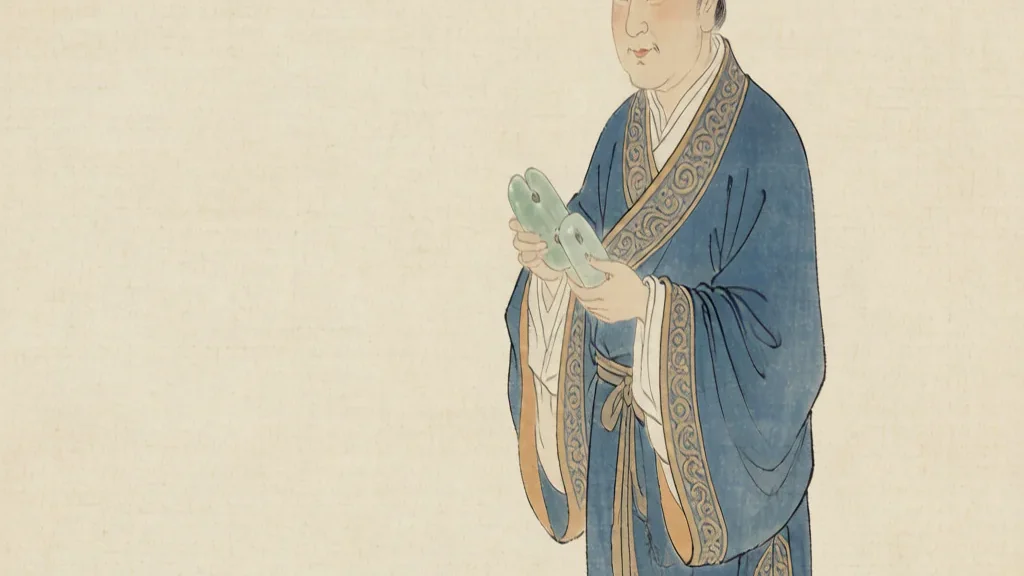
Cao Guojiu is the Eight Immortal most closely tied to the imperial court and to the stage, a man of noble birth said to be the brother in law of a Song emperor, who turned from rank and scandal to the practice of Daoism and was admitted to the company of the immortals. His emblem is the pair of castanets or the jade tablet of office, instruments that mark both his courtly origin and his musical, theatrical patronage, and he is honoured by actors and opera troupes as their protective immortal. The legend of Cao Guojiu turns on the contrast between the splendour of the palace and the bare discipline of the adept, and on the lesson that even the highest blood can be renounced for the sake of liberation. In a group that includes beggars and scholars, he is the immortal who proves that the throne itself is not too grand to be left behind.
The Imperial Brother in Law
The distinguishing claim of Cao Guojiu's legend is his rank. He is presented as a relative of the Song imperial family, most often the brother of an empress or the brother in law of the emperor, a man born inside the charmed circle of the court where few could ever enter. His title, rendered loosely as Imperial Brother in Law or Royal Uncle, marks him as aristocracy of the highest order.
This exalted background sets him apart from the other immortals, most of whom rise from obscurity or the middle ranks. The courtly connection gave the legend a political colour, for it staged the renunciation of the very power that the emperors wielded, and suggested that even the winners of the worldly game might decide it was not worth playing.
The historical basis, if any, is faint; the figure reads more as a wishful image of the courtier who sees through the court. Yet the specificity of the imperial tie gave storytellers a vivid contrast to work with, the silk robe set against the straw cloak of the immortals who began poor.
Scandal and Renunciation
A recurring element of the Cao Guojiu story is disgrace. In the common version his brother commits grave crimes, and though Cao himself is innocent, the scandal drives him to withdraw from public life in shame and disgust. The corruption of the family becomes the occasion of his awakening rather than merely a misfortune.
Disgusted by the abuse of power around him, Cao Guojiu casts off his court dress, abandons the capital, and devotes himself to Daoist cultivation in retirement. The gesture is double: it is both a distancing from guilt and a search for a purity the palace cannot offer. Renunciation is his answer to scandal.
This motif gave the legend a moral edge. Cao Guojiu is not merely bored with greatness; he is repelled by its abuse, and his departure carries a critique of the very court that produced him. The immortal's holiness begins as conscience, not as ambition for wonder.
The Castanets and the Jade Tablet
Cao Guojiu carries two related emblems. The first is a pair of castanets, or wooden clappers, used in music and in the rhythm of recitation; the second is the flat jade tablet, the hu, that officials held at court as a sign of rank and a means of respectful address to the throne. The two objects together tell his whole story.
The jade tablet recalls his office and his blood, the world he left, while the castanets point to the new life of sound and devotion he embraced. Held in the same hand, they show the transformation of status into song, of the badge of power into the instrument of praise. The immortal keeps the form of the court and empties it of ambition.
In art the tablet is usually shown clean and rectangular, a symbol of the upright heart, while the clappers suggest the rhythm of liberation. The pairing makes Cao Guojiu the most formally dressed of the Eight even in his poverty, his emblems a small costume of the refined.
Meeting the Immortals
As with several of the Eight, Cao Guojiu's ascent is mediated by other immortals, most often Zhongli Quan and Lü Dongbin, who discover him in retirement and test his resolve. The test usually involves a question about what he values, and Cao's answer, turning from the visible tokens of rank to the invisible Dao, proves his readiness.
The encounter follows a familiar pattern: the senior immortals appear in disguise, pose a riddle of identity, and admit the candidate once he shows he understands that the true treasure is formless. Cao Guojiu's courtly polish is no obstacle; indeed his very refinement becomes the ground of his insight when rightly directed.
His admission to the group completes the set, supplying the courtly member who balances the beggar, the scholar, and the maid. The Eight are a cross section of society precisely so that no estate is excluded from the promise of immortality, and Cao Guojiu guarantees the inclusion of the noble.
Cao Guojiu and the Stage
Because his emblem is a percussion instrument of rhythm, Cao Guojiu became intimately associated with theatre, music, and the performing arts. The clappers are the musician's tool, and the immortal's patronage naturally extended to those who beat time and sang for a living. The courtier became the player's saint.
Opera troupes in particular placed themselves under his protection, hanging his image backstage and offering him the first bow of the performance. The link is fitting: the stage is a kind of court, and the actor a kind of official who wears rank as costume, a mirror of Cao's own exchange of the robe for the clapper.
This theatrical connection also kept his legend lively in popular culture. Every troupe that invoked him retold, in effect, the story of the noble who chose the play over the palace, and the audience knew the moral without needing to hear it spoken.
The Path of Purification
The spiritual content of Cao Guojiu's legend emphasises purification. Shaken by the corruption around him, he undertakes the cleansing of his own heart, and the Daoist practices he adopts are aimed at washing away the stain of worldly ambition. His jade tablet, already a symbol of purity, becomes the sign of an inner whiteness recovered.
The theme speaks to a broad Chinese ideal in which nobility of blood matters less than nobility of character, and in which the true gentleman is known by his untarnished mind. Cao Guojiu dramatises this ideal by surrendering the outer nobility to recover the inner, a movement from rank to rectitude.
In this he resembles the Confucian gentleman as much as the Daoist adept, and the overlap is typical of the syncretic late imperial piety in which the Eight Immortals could be read through several lenses at once. The immortal is both a Daoist master and a model of moral cleanliness.
Cao Guojiu Among the Eight
Within the fellowship of the Eight Immortals, Cao Guojiu supplies the courtly and musical note. His castanets keep time for the group's raucous assembly, and his former rank lends a strange dignity to a company of outsiders. He is the immortal who proves that heaven admits the privileged as readily as the poor, provided they relinquish the claim.
In the crossing the sea tableau he rides the sound of his own clappers across the water, or is borne by his tablet turned raft, the object of office reborn as a vessel of escape. The image neatly inverts his biography: the sign of service to the throne becomes the means of leaving the throne behind.
The variety of the Eight depends on such contrasts, and Cao Guojiu's polish offsets the raggedness of Lan Caihe and the lameness of Li Tieguai. Together they argue that the immortal nature is not one type but every type, refined or rough, once the self is surrendered.
Patron of Actors
To this day Cao Guojiu is invoked by performers, especially in the traditional theatre, as a guardian who ensures a good show and protects those who make their living by imitation and song. His altar in the green room is a quiet acknowledgment that the player's craft descends from a noble source.
The patronage also carries a moral for the actor: just as Cao exchanged the false rank of the court for the true play of the Dao, so the performer should remember that all roles are costume and that the self behind them is what matters. The stage, under his eye, becomes a school of detachment.
In festival processions the figure of Cao Guojiu, tablet in hand, often leads the troupe, the courtier immortal blessing the players who re-enact the stories of gods. His presence turns entertainment into a kind of worship, and worship into a kind of theatre.
Symbolism of Rank Renounced
The deepest meaning of Cao Guojiu is the renunciation of rank. His whole legend asks what a person of the highest station gains by walking away, and answers that he gains the only thing rank cannot buy: freedom from the need for rank. The jade tablet becomes light in his hand once he no longer fears its loss.
This symbolism spoke powerfully in a society organised around examination, office, and family honour, where the temptation to cling to status was constant. Cao Guojiu offered a sanctioned fantasy of release, the fantasy that even the emperor's kin might shrug off the weight and wander free.
In the end he remains the Eight Immortals' answer to the question of privilege: that birth is neither a sentence nor a guarantee, but a starting point from which, like anyone, the noble may turn toward the Dao. His castanets keep the time of that turning, a music made from the surrender of power.
❓ Frequently Asked Questions
Who is Cao Guojiu?
Cao Guojiu is one of the Eight Immortals, a noble said to be the brother in law of a Song emperor, who renounced the court for Daoist practice and became patron of actors.
What are his emblems?
He carries a jade tablet of office and a pair of castanets or clappers, together symbolising his courtly origin transformed into a life of music and devotion.
Why did he leave the court?
A family scandal involving his brother's crimes disgusted him with the abuse of power, and he withdrew to cultivate the Dao in retirement.
Who worships Cao Guojiu?
Traditional opera troupes, actors, and musicians honour him as their protective immortal, invoking him backstage for a successful and safe performance.
How did Cao Guojiu become immortal?
After his renunciation, the immortals Zhongli Quan and Lü Dongbin tested his understanding and admitted him to the company of the Eight.
What does he symbolise?
He symbolises the renunciation of rank and the purification of the heart, proving that even the highest birth can be surrendered for true freedom.