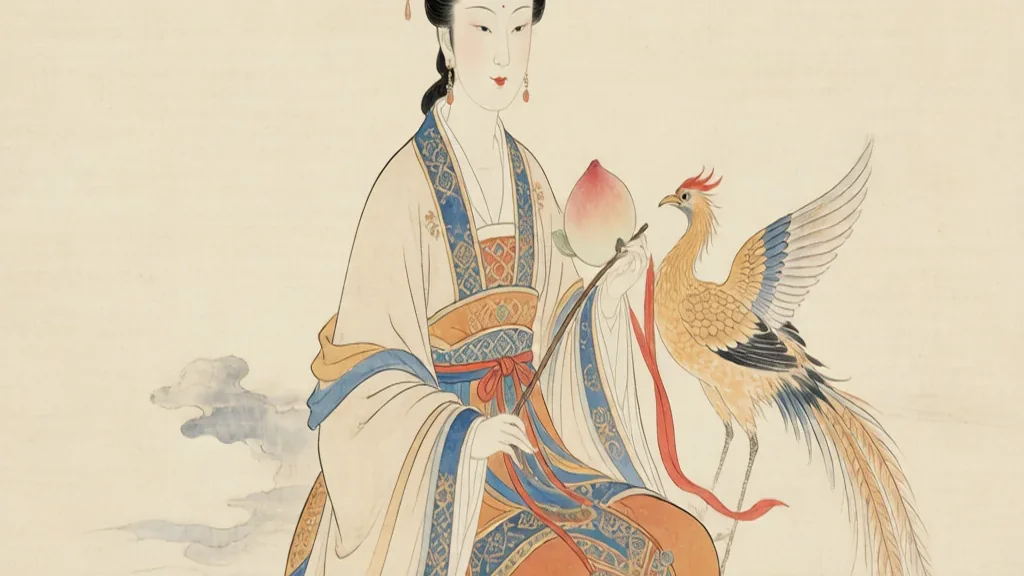
The Queen Mother of the West (西王母) is the goddess of immortality who keeps the peaches of long life in her Kunlun garden.
Origins in the Shang Dynasty
The earliest known references to Xi Wang Mu appear on Shang dynasty oracle bones (c. 1500 BCE). She was originally a fierce goddess of the western wilderness, associated with plague and punishment. The Classic of Mountains and Seas describes her as having the teeth of a tiger, the tail of a leopard, unkempt hair, and a piercing shriek — a guardian of the sacred mountain who dispensed both life and death.
Transformation into the Queen of Immortals
During the Warring States period and the Han dynasty, Xi Wang Mu underwent a remarkable transformation. Daoist alchemists and court poets transformed her from a wild nature spirit into the elegant Queen Mother of the West, ruler of all female immortals and keeper of the Peaches of Immortality.
The Peaches of Immortality
The peach orchard of Xi Wang Mu is one of the most enduring images in Chinese mythology. The trees bloom once every 3,000 years and take another 3,000 years to bear fruit. The peaches confer immortality on anyone who consumes them.
Encounters with Emperor Mu of Zhou
The most famous mortal to visit Xi Wang Mu was King Mu of the Zhou dynasty (r. 976–922 BCE). According to the Annals of King Mu, he traveled westward to the Kunlun Mountains and was received by the Queen Mother.
Xi Wang Mu in Daoism
Xi Wang Mu occupies a central position in Daoist cosmology. She is considered the embodiment of Yin (the feminine principle) and the ruler of the western paradise. She oversees the registration of female immortals.
The Goddess in Art and Literature
Xi Wang Mu has been depicted in Chinese art for over 2,000 years. She typically appears as a beautiful woman in imperial robes, holding a ceremonial ruyi scepter or a peach.
Historical Context and Evolution
This legend has evolved over centuries, with different dynasties adding new elements and interpretations. The earliest versions were simple oral tales that grew more complex as they were retold and recorded by scholars and writers.
The story reflects the values and concerns of the society that created it. Themes of loyalty, love, justice, and the supernatural reveal much about Chinese cultural priorities.
As the legend spread across China, regional variations developed, each adding local flavor while preserving the core narrative.
Legacy in Modern Chinese Culture
This legend continues to influence modern Chinese culture. It appears in films, television series, novels, and even video games. Contemporary adaptations often reinterpret the story for modern audiences while respecting its traditional roots.
The characters and themes from this legend have become part of everyday Chinese language and thinking. References to the story appear in idioms, proverbs, and common expressions.
Festivals and traditions associated with this legend are still observed in many parts of China, keeping the ancient story alive in the modern world.
Historical Development
The history of this topic spans thousands of years of Chinese civilization. Early records from ancient texts provide glimpses into its origins. Over successive dynasties the subject evolved significantly absorbing influences from different regions.
During the Tang and Song dynasties this field experienced a golden age. Scholars and practitioners refined techniques established standards and created works that influenced generations. The imperial court often patronized this art elevating its status.
The Ming and Qing dynasties saw further refinement. Increased trade brought new ideas from beyond Asia. This cross-cultural fertilization enriched the tradition while maintaining its Chinese character.
In the modern era efforts have been made to preserve traditional practices. The government has designated many related crafts as Intangible Cultural Heritage ensuring their survival.
Regional Variations
Different regions of China have developed their own distinctive styles. Northern styles emphasize bold forms and practicality reflecting harsh climates. Southern styles are more refined and decorative.
Eastern coastal regions developed interpretations influenced by maritime trade with Japan and Korea. Western regions with diverse ethnic populations incorporated elements from minority traditions.
Central China as the historical heartland represents the most classical forms. Many standard techniques were established here and spread to other regions.
Modern Applications
Today this tradition continues to evolve. Contemporary practitioners experiment with modern materials while respecting traditional forms. This creative tension between innovation and tradition drives the field forward.
International interest in Chinese culture has created global markets. Exhibitions and workshops have introduced these traditions to worldwide audiences fostering cross-cultural appreciation.
Educational institutions offer programs training the next generation. These combine traditional apprenticeship with modern approaches ensuring effective knowledge transmission.
Cultural Significance
This subject embodies core Chinese values. Its symbolism draws from Confucian ethics Daoist cosmology and Buddhist spirituality creating layers of meaning that reward deeper study.
Materials colors and forms all carry specific meanings. Motifs represent longevity prosperity happiness or spiritual protection. These choices reflect deliberate artistic and cultural decisions.
Rituals and ceremonies associated with this subject connect practitioners to centuries of tradition serving as living links to the past.
❓ Frequently Asked Questions
📝 Chinese Vocabulary
西王母 — : Queen Mother of the West; the supreme goddess of Chinese mythology.
昆仑山 — : Kunlun Mountains; the mythical mountain where Xi Wang Mu resides.
蟠桃 — : Peaches of Immortality; the fruit that grants eternal life.
周穆王 — : King Mu of Zhou; the ancient king who visited Xi Wang Mu.
长生不老 — : Immortality; the gift granted by Xi Wang Mu's peaches.
瑶池 — : The Jade Pool, Xi Wang Mu's mythical garden on Kunlun where the Peaches of Immortality grow.
王母娘娘 — : An informal popular title for the Queen Mother of the West, widely used in folk religion and vernacular tales.
蟠桃会 — : The Peach Banquet, the celestial feast hosted by Xi Wang Mu for the immortals.
🎉 Fun Facts
- The Chinese word for peach (桃, tao) is a homophone for 'long life,' and peach imagery is ubiquitous in Chinese birthday celebrations — a direct reference to Xi Wang Mu's peaches.
- The classic novel 'Journey to the West' features the Monkey King stealing and eating Xi Wang Mu's peaches, triggering a celestial crisis.
- Xi Wang Mu's birthday is traditionally celebrated on the 3rd day of the 3rd lunar month, and temples across China hold festivals in her honor.
- In her earliest mythological form, Xi Wang Mu had tiger teeth, a leopard tail, and unkempt hair, and her shriek was said to be heard across the mountains, a far cry from the elegant queen of later art.
- She was originally a guardian of the passage between the world of the living and the realm of the dead, dispensing both longevity and pestilence.
- Daoist texts sometimes pair her with a male counterpart, the King Father of the East, though he is far less prominent in surviving legend.