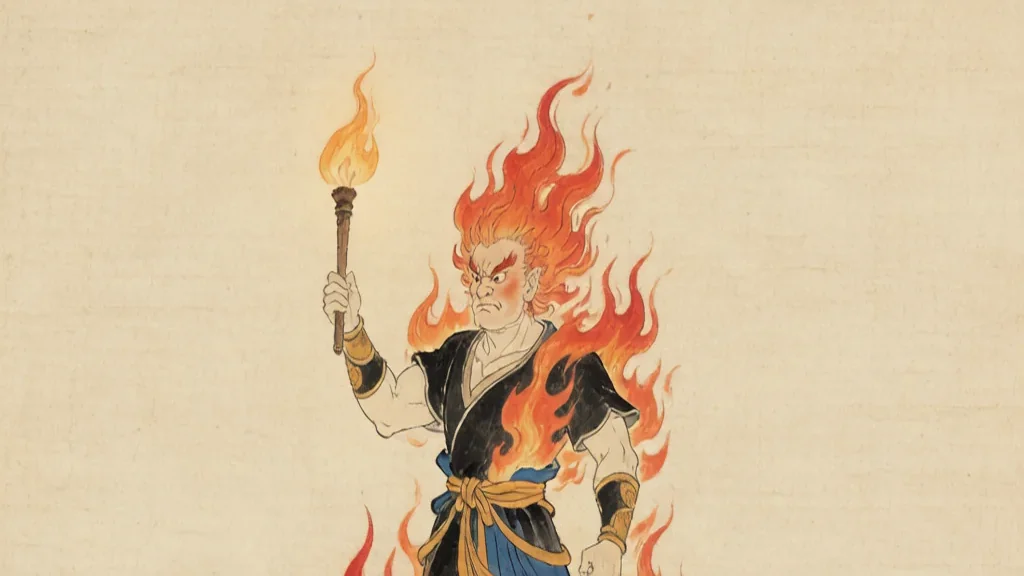
Zhurong is the ancient Chinese god of fire, the south, and the warmth of summer, a radiant counterpart to the water deities who threatened the early world. In the received mythological tradition he is most often remembered as the minister or servant of the Yellow Emperor who was charged with taming the forces of flame and who, in several versions of the great primeval conflict, defeated the rebellious water god Gonggong. As the southern pillar of the cosmos he belongs to a quartet of directional gods who between them governed the four quarters and the four seasons, and his association with both creative warmth and destructive conflagration made him one of the most ambivalent of the early deities. To understand Zhurong is to understand how the Chinese imagination reconciled the gift and the danger of fire, the element that cooks grain and smelts bronze but also consumes cities and forests without mercy.
The Identity of the Fire God
Zhurong's name is commonly interpreted as something like illustrious or glorious fusion, a fitting title for a deity of flame and light. He is usually described as a minister of the Yellow Emperor who was appointed to oversee the southern region of the world and to regulate the fire that dwells there. In this official capacity he belongs to the ordered bureaucracy of heaven, a servant of the cosmic sovereign rather than a wild independent spirit.
Some genealogies make him a descendant of the Yan Emperor, the flame sovereign, which would explain his natural affinity for heat and light. Other accounts present him as a historical officer who was deified after death, a common pattern in Chinese religion in which exemplary ministers of the early kings were promoted into the ranks of the gods. Either way, his authority is always delegated from above, the fire held in the service of order.
His appearance in literature is consistent with his role: he is associated with a blazing chariot, with red and vermilion colours, and with the heat of the southern quarter. Where the northern god governs cold and the eastern god governs wind, Zhurong governs the bright and burning south, the direction of noon and of high summer.
Zhurong and the Four Directional Gods
Chinese cosmology organised the world around the four cardinal directions, each of which was assigned a deity, a season, a colour, and a creature. Zhurong ruled the south, paired with the summer, the colour red, and the Vermilion Bird, one of the four celestial emblems. This systematic assignment shows that fire was not merely an element but a coordinate in a total moral and natural geography.
The southern position carried a particular prestige because it was associated with growth, with the flourishing of vegetation under the summer sun, and with the imperial court that traditionally faced south. To be the southern god was to be the god of maximum vitality, the power at the height of its strength. Zhurong therefore stood for the moment of fullest life in the annual cycle.
The four directional gods together formed a stable frame within which the flux of the seasons could be understood. Zhurong's place in that frame guaranteed that fire would always return, that the warmth of summer was a permanent feature of the cosmic design rather than a random blessing, and that the south would forever be the home of light.
The Battle Against Gonggong
The most famous episode in the Zhurong tradition is his conflict with the water god Gonggong. In the variants that stage this as an elemental duel, Zhurong represents fire and order while Gonggong represents water and chaos, and their struggle is a cosmic version of the perpetual contest between the drying heat and the drowning flood. The fire god's victory in this account establishes the dominance of the ordered south over the rebellious waters.
When Zhurong defeats Gonggong, the consequence is the famous act of revenge in which the beaten water deity butts his head against Mount Buzhou and breaks the pillar of the sky. Thus Zhurong's triumph, far from ending the trouble, indirectly produces the catastrophe that the goddess Nuwa must later repair. The two stories are linked like cause and effect across the mythical timeline.
This linkage makes Zhurong a crucial hinge in the great foundational narrative. Without his victory there is no broken pillar, no tilted sky, no eastward rivers; yet his victory is also the precondition for the world as the Chinese came to know it. He is the fire that both clears and provokes, the necessary aggressor whose success unleashes unforeseen consequences.
Fire as Civilization and as Danger
In the Chinese understanding, fire is doubly valenced. On one hand it is the servant of civilization: it cooks food, hardens pottery, smelts the metals from which tools and weapons are made, and drives away the beasts of the night. The promotion of fire to a god of the south reflects gratitude for these gifts as much as fear of the element itself.
On the other hand, fire is the most frightening of the natural powers, capable of leaping beyond control and reducing the labour of years to ash in a single night. The myths remember this danger in the very same deity who grants the benefit, so that Zhurong is never purely benevolent. He is the flame that warms the hearth and the flame that burns the city, inseparable in a single body.
This duality is reflected in ritual. Offerings to the fire god were at once thanksgiving and appeasement, a way of asking that the useful fire remain tame and the destructive fire remain distant. The worshipper negotiated with the same power that sustained and could annihilate the household.
Zhurong in the Classic Texts
Zhurong appears throughout the corpus of early Chinese literature, from the poetry of the Chu Ci to the cosmological compendia of the Han dynasty. In the Chuci, the shamanistic poems of the southern state of Chu, he is invoked as a burning presence who accompanies the wandering soul on its heavenly journeys, a guide through the fiery southern heaven.
The Huainanzi and related Han texts place him firmly among the ministers of the Yellow Emperor and the regulators of the seasons, embedding him in the systematic cosmology that the imperial court favoured. These texts treat him less as a narrative character and more as a function of the universe, a named point in the grid of correspondences that explained the world.
Later commentarial tradition elaborated his genealogy and his subordinates, turning the bare mythical name into a small bureaucracy of fire. Such elaboration is characteristic of Chinese myth, which tends to administrative rather than personal development, so that a god accumulates offices and relatives rather than psychological depth.
The Vermilion Bird and Southern Symbolism
Zhurong's emblem is the Vermilion Bird, known also as the Red Phoenix or the Zhuque, one of the four supernatural creatures who guard the directions. The bird, associated with fire and with the summer south, mirrors Zhurong's own nature and serves as his visible sign in art, architecture, and astronomy. Its image was carved on tombs and palaces to invoke southern protection.
The Vermilion Bird connects Zhurong to the wider system of omens and portents in which each direction had its creature, its element, and its season. The southern bird of fire thus belongs to the same symbolic family as the eastern dragon of wood and the western tiger of metal, a quadrilateral grammar of the cosmos.
In popular representation the bird and the god are sometimes merged, so that the flaming plumage and the divine office become a single image of southern radiance. The red colour that links them both became a royal and festive colour in later culture, carried in lanterns, weddings, and New Year decorations as a token of the fire god's enduring blessing.
Zhurong and the Yellow Emperor
The relationship between Zhurong and the Yellow Emperor is central to his status as a deity of order. As a minister appointed by the Yellow Emperor, he shares in the civilising mission of that supreme ancestor, the work of bringing the wild elements under human shaped rule. His fire is the fire of the hearth and the forge, not the fire of undirected catastrophe.
This subordinate position distinguishes him from the more independent nature gods who answer to no sovereign. Zhurong's loyalty to the Yellow Emperor is what makes his fire safe; it is fire disciplined by administration, the flame of the state rather than the flame of the wilderness. In this he prefigures the later ideal of the virtuous minister who channels power for the public good.
Some accounts even credit the Yellow Emperor's victory in the great early wars to the fire power placed under Zhurong's command, suggesting that the mastery of flame was itself a technology of empire. To control fire was to control a decisive edge in the founding of civilization, and Zhurong was its keeper.
Legacy in Popular Religion and Culture
Although Zhurong is principally a figure of high myth and state cosmology, the reverence for fire that he embodies survived in countless local customs. Kitchen hearths were treated with ritual respect, and the domestic fire was never to be insulted, for it carried something of the southern god's presence into the home.
Festivals of light and fire, from lantern celebrations to the burning of effigies, can be read as popular extensions of the veneration once directed at the fire god by name. The colour red, his signature, became the dominant auspicious hue of Chinese festive life, a daily echo of his southern radiance.
In literature and opera the fire god appears as a majestic red clad figure, often summoned when a scene requires the intervention of elemental power. His persistence across three thousand years of culture testifies to the depth of the human preoccupation with fire, the element that both feeds and frightens, and that Zhurong forever personifies.
Symbolism of Light and Transformation
Beyond his literal association with flame, Zhurong came to symbolise transformation itself, the power of heat to change one substance into another, grain into cooked food, ore into metal, wood into ash and fertile soil. Transformation is the deepest meaning of fire, and thus the deepest meaning of the god.
In this symbolic register Zhurong stands for the positive side of change, the burning away of the old to make room for the new, the forging of raw material into useful form. He is the patron of smiths and cooks, of anyone whose craft depends on the disciplined application of heat, and by extension of any process that refines the coarse into the fine.
To honour Zhurong is therefore to honour the necessity of transformation, the truth that nothing useful is made without the application of fire, whether literal or moral. He remains the bright southern witness that order is not passive but forged, again and again, in the disciplined flame.
❓ Frequently Asked Questions
Who is Zhurong?
Zhurong is the Chinese god of fire, the south, and summer, usually described as a minister of the Yellow Emperor who regulated flame and defeated the water god Gonggong.
What direction and season does Zhurong govern?
He governs the south, paired with the summer season, the colour red, and the Vermilion Bird, one of the four celestial emblems of the directions.
How is Zhurong connected to Gonggong?
In several myths Zhurong defeats the water god Gonggong, whose act of revenge in breaking the sky pillar then forces Nuwa to repair the heavens.
Why is Zhurong both feared and honoured?
He grants the useful fire of cooking and smelting but also the destructive fire of conflagration, so worship was both thanksgiving and appeasement.
What is the Vermilion Bird?
The Vermilion Bird, or Zhuque, is the southern celestial creature emblematic of fire and Zhurong, one of the four mythic guardians of the directions.
What does Zhurong symbolise?
Beyond literal flame he symbolises transformation and refinement, the disciplined heat that forges raw material into useful form and old things into new.