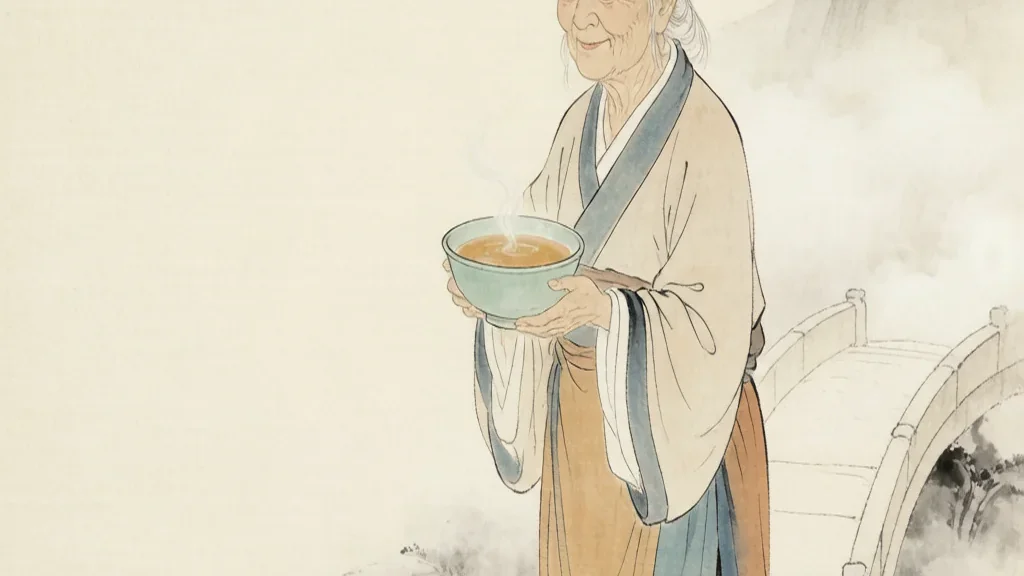
Meng Po, often translated as the Lady of Forgetfulness or the Old Woman Meng, is one of the most enduring and strangely comforting figures in Chinese folklore about the afterlife. Stationed at the crossing between the world of the dead and the cycle of rebirth, she offers every departing soul a bowl of the Five Flavored Tea of Forgetfulness, a draught that erases the memories of a previous life before reincarnation can begin. Unlike the fearsome judges and torturers who populate the courts of the underworld, Meng Po embodies mercy: her task is to spare the newly dead the grief, guilt, and longing that a full recollection of their former existence would bring. Her story belongs to the rich layering of Chinese underworld belief, drawing together indigenous ideas about ancestral continuity, Buddhist teachings on rebirth, and Taoist fascination with the boundary between mortal and immortal realms. From classical tale collections to modern television dramas, Meng Po remains a quiet, maternal presence at the edge of death, reminding believers that forgetting is itself a kind of compassion.
Origins of the Forgetful Lady in Early Folklore
The figure of Meng Po is difficult to pin to a single founding text because she emerged gradually from a blend of oral tradition, popular religion, and literary embellishment rather than from one canonical scripture. Her name appears in local gazetteers and anecdotal collections of the late imperial period, where she is described as a crone who has chosen to remain in the underworld out of compassion rather than pass on to her own reward. The underlying idea that the dead must drink forgetfulness before rebirth is far older and resonates with Buddhist notions of the bardo and the cleansing of karma through successive lives.
Over the centuries her role was absorbed into the popular map of Diyu, the Chinese underworld ruled by Yanwang. Where the judges of the ten courts measured sin and assigned punishment, Meng Po operated at the final threshold, after sentencing and before rebirth, guaranteeing that no soul could carry the burdens of the past into a fresh incarnation. This placement made her essential to the logic of rebirth: a memoryless soul is a neutral soul, ready to begin again without the distortions of former attachment.
Some regional accounts claim Meng Po was once a virtuous woman of the human world who volunteered for the task so that others might be spared suffering, a motif that turns a bureaucratic functionary of the dead into a self sacrificing guardian. Whether understood as a deity, a ghost official, or a symbolic personification of oblivion, her character consistently carries the same gentle authority across the varied tellings recorded in different provinces.
The Geography of the Underworld Crossing
Within the imagined architecture of the Chinese underworld, Meng Po is most often seated at or near the Naihe Bridge, a narrow span whose name evokes the helplessness of fate, the place beyond which the old life cannot be recalled. Souls who reach her have already passed through the courts of judgment and now stand at the last gate before the wheel of reincarnation turns once more. The bridge itself is sometimes described as treacherous, guarded by demons who push the wicked into the waters below, while the virtuous cross safely to receive their cup.
Around her stand the legendary ingredients of forgetfulness. Folklore enumerates a range of plants and fluids gathered from the banks of the underworld river, said to be brewed into a soup with six distinct flavors corresponding to the sorrows of life: birth, aging, sickness, death, separation, and resentment. The precise recipe varies by region, but the symbolic point is constant: the drink dissolves identity as thoroughly as water dissolves salt, leaving the drinker calm and empty.
The spatial logic of this crossing reflects a deeper Chinese intuition about transformation. Movement from one life to the next is not a leap but a passage requiring mediation, and Meng Po is the mediator who ensures the passage is clean. Her station at the bridge marks the exact boundary between memory and amnesia, between the person who was and the person who will be.
The Five Flavored Tea and Its Symbolism
The drink Meng Po serves is variously called Meng Po Tang, the Soup of Meng Po, or the Five Flavored Tea of Forgetfulness, and its description carries heavy symbolic weight. The five or six flavors represent the full spectrum of human affliction, and by swallowing them the soul ingests and then immediately relinquishes the sum of its former pain. The act is both consumption and surrender, a ritual of release performed at the threshold of rebirth.
In many retellings the tea works instantly and completely, erasing not only names and faces but the very texture of former emotion, so that a mother forgets the child she mourned and a wronged man forgets the enemy he hated. This total erasure is precisely what allows the cosmos to function: without it, the ranks of the reborn would be crowded with souls driven by old griefs, and the moral economy of cause and effect would collapse into endless repetition of the same wounds.
The drink also functions as a narrative device in countless stories where a soul manages to avoid it, retains memory, and returns to the living world with knowledge of the afterlife. Such tales invert the normal order to explore longing, justice, and the pain of remembrance, proving by contrast how central Meng Po's cup is to the imagined peace of death.
Meng Po in Classical Literature and Tale Collections
The figure appears in several landmarks of Chinese narrative tradition. In the great comic novel of pilgrimage and enlightenment, the journey westward places the travelers in realms where the boundaries of life and death are thin, and the logic of forgetting the past is woven into the larger Buddhist message that attachment is the root of suffering. Meng Po's draught fits naturally into a cosmology that teaches release from craving.
She is even more vividly present in the late imperial collection of strange tales where ghosts, foxes, and revenants populate a world continuous with the living. There, characters who cross back from death sometimes describe the old woman and her soup, and a few cunning souls contrive to spit out the liquid or evade it, returning with memories intact to settle unfinished business among the living. These episodes use Meng Po to dramatize the tension between duty to the dead and love for the living.
Beyond fiction, moralistic tracts and temple murals of the underworld presented her as part of a cautionary panorama, teaching the faithful that the dead are cared for and that rebirth offers a fresh start. In this didactic context her mercy is framed as incentive: live well, and the forgetting that awaits will be a gentle mercy rather than an escape from terror.
Relationship with Yanwang and the Courts of Judgment
Meng Po should be understood in relation to Yanwang, the king of the underworld who presides over the tribunals that weigh a soul's deeds. Where Yanwang and his subordinate judges administer justice through sentencing and reform, Meng Po performs the final act of clemency that makes reincarnation humane. The two figures together express a complete moral vision: accountability followed by compassion, judgment followed by release.
This division of labor is important to the popular theology of the underworld. A soul might spend time in one of the courts undergoing correction for misdeeds, but however long that process lasts, the conclusion is the same for all: the crossing, the bridge, and the cup. Meng Po does not distinguish between the saint and the sinner at her station, because by the time a soul reaches her, the work of differentiation has already been done by the judges above.
In some temple paintings she is depicted humbly, almost invisibly, beside the grandeur of the infernal courts, a visual hint that her quiet function is the hinge on which the entire system turns. Without her, the dead could not be reborn; without rebirth, the cosmic cycle would stall. Her modesty in art mirrors her modesty in myth.
Regional Variations Across China
As with most Chinese folk figures, Meng Po is not identical everywhere. In the south, temple inscriptions sometimes name her among a host of underworld attendants and emphasize her role as server of tea in a kind of ghostly waystation. In the north, she is more often a solitary crone on the bridge, looming larger in the popular imagination as the single gatekeeper of memory's end.
Certain local cults elevated her into an object of minor devotion, with small shrines where the worried living might pray that a beloved dead one forget their suffering quickly and be reborn into ease. These practices show how a figure born of myth could acquire a liturgical life of her own, blurring the line between folklore character and recognized deity of the local pantheon.
Ethnic and linguistic diversity within China also produced variant names and slightly different attributes, but the core duty never changed. Whether called the old woman of the bridge or the mistress of the forgetful brew, she performed the same service, which suggests the deep cultural consensus that death should bring relief from memory rather than its permanent burden.
Meng Po in Opera, Drama, and Visual Art
Traditional Chinese opera and regional theater have long drawn on underworld journeys for their emotional power, and Meng Po frequently appears in scenes of separation and return. A stock figure in such performances, she is usually costumed as a kindly grandmother, her props a ladle and a bowl, her manner patient, so that audiences read her instantly as the tender executor of oblivion rather than a threat.
Paintings of the underworld, whether commissioned for temples or produced as woodblock prints for the household, place her at the climactic moment of the soul's passage. Artists use soft brushwork for her form to contrast with the sharp, terrifying lines given to demons and torturers, visually encoding the difference between punishment and mercy that her character represents.
In contemporary illustrated adaptations and animated retellings, she is often redesigned as a serene, almost ethereal keeper of a misty riverbank, a figure of melancholy beauty who understands the cost of what she does. This modern aesthetic softening continues the ancient instinct to make forgetting feel like a gift rather than a loss, and keeps her relevant to new generations encountering the myth through screens.
Psychological and Philosophical Readings
Read symbolically, Meng Po addresses one of the oldest human anxieties: that memory of loss makes life unbearable. By externalizing forgetfulness into a single act of drinking, the myth gives believers a reassuring story about how the dead are healed. The cup is a technology of consolation, a way to imagine death as a gentle anesthesia rather than a void.
Philosophically, her draught resonates with teachings that liberation requires letting go of attachment. To remember everything would be to remain chained to the particular loves and injuries of one life, whereas forgetting opens the space for a new beginning unburdened by the past. In this light Meng Po is not erasing the self so much as freeing it, a reading that aligns folk religion with contemplative thought.
Modern psychologists have noted the therapeutic intuition embedded in the legend: that healthy mourning eventually requires a measure of forgetting, a softening of acute grief into manageable memory. The myth narrates in symbolic form what grief counselors describe in clinical language, which may explain why the image of the forgetful lady continues to comfort across centuries and contexts.
Modern Popular Culture and Enduring Appeal
In the contemporary era Meng Po has migrated into web novels, fantasy games, and television serials that reimagine the Chinese pantheon for entertainment. She appears as a wise administrator, a comic relief, or a tragic lover depending on the genre, but the essential function of serving forgetfulness usually survives these makeovers, proof of how central that function is to her identity.
Her image also circulates internationally wherever Chinese diaspora communities maintain festival and funeral customs, carried into new languages and contexts while keeping its original meaning. In overseas Chinatowns, pamphlets and temple art about the afterlife still show the old woman and her bridge, connecting immigrants to a homeland cosmology that promises continuity beyond death.
The reason for her durability is not hard to find. Every culture needs a way to speak about the merciful erasure that death seems to offer, and Meng Po supplies that need with unusual tenderness. She is the only figure in the terrifying machinery of the underworld whose entire purpose is to make the dead feel better, and that singularity guarantees her a permanent place in the imagination.
Comparisons with Similar Figures in Other Traditions
The motif of a drink that erases memory before rebirth is not unique to China, which invites comparison with the river of forgetting in ancient Greek myth, where souls drank before entering the world to lose the knowledge of their heavenly origin. Both traditions imagine a fluid boundary between lives and a liquid that wipes the slate clean, suggesting a shared human solution to the puzzle of how renewal can occur.
Unlike the Greek river, however, Meng Po is a person, a caregiver with a face and a temperament, which makes the Chinese version more intimate and more consoling. The soulless water of one tradition becomes the offered cup of another, and the difference marks a characteristic Chinese preference for embedding cosmic processes in recognizable human relationships of care.
Similar forgetful draughts appear in Norse and Celtic lore connected to death and the otherworld, and scholars of comparative mythology note how often rebirth traditions require amnesia as a condition of new life. Meng Po stands among these figures as perhaps the most fully realized, a deity whose personality is built entirely from the single virtue of compassionate forgetting.
Why the Legend Still Matters Today
In a society increasingly oriented toward memory preservation through archives, recordings, and social media, the legend of Meng Po poses a quiet counterargument: that some forgetting is necessary, merciful, and good. Her story validates the human need to lay down the weight of the past in order to move forward, a lesson with obvious resonance for individuals and for a culture negotiating rapid change.
For families observing funerary rites, the belief that the dead drink forgetfulness and are reborn can ease the terror of permanent separation, substituting a narrative of transformation for one of mere absence. The ritual recitation of such beliefs at graves and altars keeps the figure socially active even among the non religious, as cultural poetry rather than dogma.
Ultimately Meng Po endures because she resolves a contradiction at the heart of how people relate to death. We want the dead to be at peace, yet we fear that peace means annihilation; the forgetful lady offers a third path, in which the dead are changed rather than ended, cared for by a grandmotherly hand at the edge of the river, and sent onward lighter than they arrived.
❓ Frequently Asked Questions
Who is Meng Po in Chinese mythology?
Meng Po is the Lady of Forgetfulness, a figure stationed at the boundary of the underworld who serves souls a draught that erases the memories of their previous life before they are reborn. She is unique among underworld beings for her merciful rather than punitive role.
What is Meng Po Tang?
Meng Po Tang is the Soup or Tea of Meng Po, a brew offered to every soul at the crossing into rebirth. Drinking it removes all memory of the former life so the reborn person can begin anew without the burdens of past attachment, grief, or guilt.
Where does Meng Po stand in the underworld?
She is most often placed at or near the Naihe Bridge, the final passage before reincarnation. Souls reach her only after passing the courts of judgment, making her the last attendant a dying person meets before a new life begins.
Is Meng Po a god or a ghost?
Traditions differ. She is sometimes presented as a deity of the underworld, sometimes as a volunteer ghost official who chose to remain and serve out of compassion. Across versions her essential function remains the same regardless of her exact status.
Why must the dead forget before rebirth?
Forgetting allows the cosmic cycle to continue. A soul carrying full memory of past loves and injuries would be unable to start fresh, and the moral economy of cause and effect would repeat old wounds endlessly. Oblivion makes renewal possible.
Does Meng Po appear outside China?
The specific figure is Chinese, but the motif of a forgetful drink before rebirth appears in other cultures, most famously the river of forgetting in Greek myth. Among these figures Meng Po is unusual for being a caring person rather than a mere body of water.