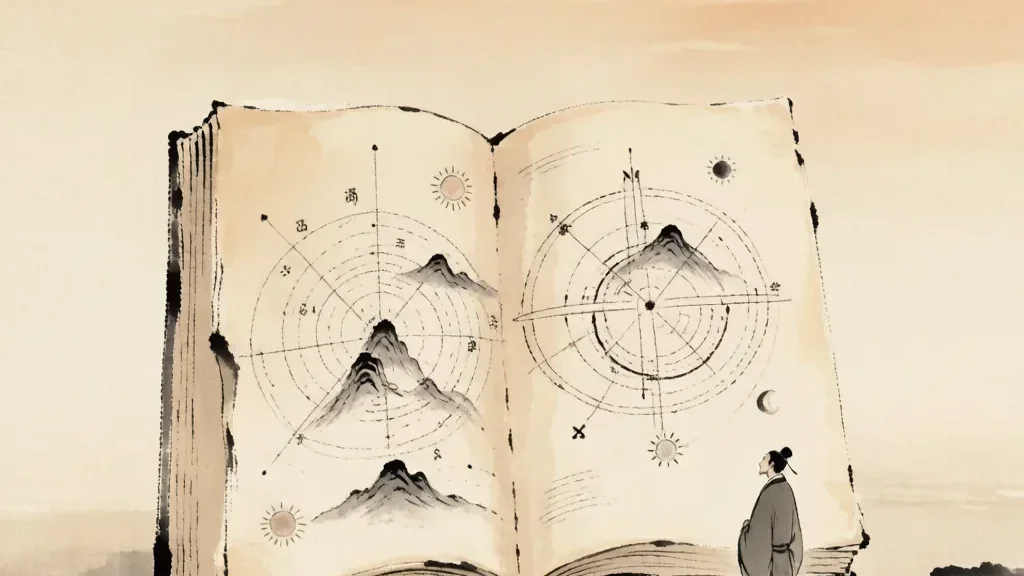
Imagine a book that is part geography, part bestiary, part mythological compendium, and part fever dream — a book that describes mountains no one has ever climbed, rivers no one has ever navigated, and creatures so strange that they seem to have crawled out of a world adjacent to our own. Such a book exists. It is called the "Classic of Mountains and Seas" (山海经, Shānhǎi Jīng), and it is one of the most extraordinary documents in the history of Chinese literature, if not world literature.
Compiled over centuries, from the Warring States period through the Han dynasty (roughly 4th century BCE to 1st century CE), the Shanhaijing is a window into the mythological imagination of ancient China. It describes hundreds of mountains, rivers, and lands, both real and imaginary, and populates them with thousands of beings — gods, monsters, spirits, and strange races of humans — each more bizarre than the last. It is, in many ways, the source text for Chinese mythology, the wellspring from which countless later stories, poems, and novels would draw.
A Book Without a Parallel
There is nothing quite like the Shanhaijing in any other literary tradition. It is not a narrative — there is no single story, no central character, no plot. Instead, it is structured as a kind of gazetteer, a geographical survey of the world as the ancient Chinese understood it. It is divided into eighteen sections, organized by cardinal direction: the mountains of the south, the mountains of the west, the mountains of the north, the mountains of the east, and then the lands beyond the seas, the lands beyond the great wilderness, and finally, the regions within the seas.
Each section follows a similar pattern. It describes a mountain or a region, names the plants and animals that live there, and records the gods or spirits that dwell upon it. The descriptions are terse, almost clinical — "Three hundred li further east is Mount X. On this mountain there is a beast whose form resembles a fox with nine tails..." — but they accumulate into a vision of a world so densely populated with the supernatural that the line between nature and mythology disappears entirely.
For centuries, scholars debated whether the book was a work of geography, a work of mythology, or something else entirely. Some took it literally, attempting to identify the mountains and rivers it described with real-world locations. Others dismissed it as pure fantasy, the product of a primitive imagination unmoored from reality. Modern scholars tend to see it as both: a text that combines genuine geographical knowledge with mythological elaboration, a map of the world as it was understood by the people of ancient China, where the natural and the supernatural were not separate realms but aspects of a single, continuous reality.
The Strange Creatures
The creatures of the Shanhaijing are its most famous and most beloved feature. There are hundreds of them, each described with the same matter-of-fact precision, as if the author were simply recording observations of the natural world. There are beasts with the bodies of one animal and the heads of another, birds with multiple heads or eyes on their backs, serpents with wings, fishes with human faces, and beings that defy any classification at all.
Among the most memorable is the Nine-Tailed Fox (九尾狐), a creature with the body of a fox and nine long tails. In the Shanhaijing, it is described as a beast that lives on Mount Qingqiu and whose cry sounds like a baby. It is a man-eater, but whoever eats it will be protected from poison. In later mythology, the Nine-Tailed Fox would evolve into a more complex figure — sometimes a benevolent omen, sometimes a dangerous seductress — but it begins here, in the sparse, eerie descriptions of the ancient text.
There is the Bixie, a winged lion-like creature that wards off evil. There is the Baren, a feathered people who live beyond the sea. There is the Di Jiang, a faceless, formless being that looks like a yellow sack, red as a fire, with six legs and four wings and no eyes or face, yet it can sing and dance. There is the Zhenniao, a poisonous bird whose feathers are used to make a deadly toxin. There are people with holes through their chests, people with one leg, people whose eyes grow in their armpits, people who fly on the backs of birds.
The sheer variety and strangeness of these creatures can be overwhelming. Reading the Shanhaijing is like wandering through a vast, dreamlike zoo, where every enclosure contains something you have never seen before and can barely imagine. But beneath the strangeness, there is a logic. Many of the creatures are associated with specific omens — their appearance foretells war, flood, drought, or peace. They are not merely monsters; they are signs, messages from the natural world about the state of human affairs.
The Myths Within
Scattered among the geographical descriptions and the bestiary entries are some of the most important myths in Chinese literature. The Shanhaijing is, in fact, the primary source for several stories that we have already explored in this collection, and it contains brief but crucial references to many more.
It is here that we find the story of Jingwei (精卫), the mythical bird born from the drowned daughter of the Yan Emperor. After Nüwa (not the mother goddess, but a princess of the Yan Emperor) drowned in the Eastern Sea, her spirit transformed into a small bird with a patterned head, a white beak, and red claws. This bird, named Jingwei, lived on Mount Fajiu and spent her days carrying twigs and stones from the mountain to drop into the sea — an impossible, quixotic quest to fill the ocean that had taken her life. The Shanhaijing describes this in just a few lines, but those lines have inspired poets and readers for over two thousand years, becoming a symbol of perseverance against impossible odds.
It is here, too, that we find the story of Kuafu (夸父), the giant who chased the sun. Kuafu, dissatisfied with the sun's movement across the sky, set out to catch it. He ran faster and faster, growing thirsty as the sun beat down upon him. He drank the Yellow River and the Wei River dry, but it was not enough. He turned north, seeking the great lake called Daze, but he died of thirst before he could reach it. The staff he carried, dropped where he fell, grew into a vast forest of peach trees called Denglin. Like the story of Jingwei, Kuafu's tale is told in just a few lines, but it has become one of the most enduring symbols of ambition and the human drive to achieve the impossible.
The Shanhaijing also contains references to Xing Tian, the headless warrior; to Nüwa, the mother goddess; to Houyi, the divine archer; to the Yellow Emperor and his wars; and to countless other figures who would be developed more fully in later texts. It is, in a sense, the seed from which the entire garden of Chinese mythology grew.
A Vision of the World
What makes the Shanhaijing so valuable, beyond its individual stories and creatures, is the vision of the world it presents. In this text, the world is not a passive backdrop for human affairs. It is alive, aware, and full of meaning. Every mountain has its spirit, every river its guardian, every forest its denizens. The natural world and the supernatural world are not separate — they are the same world, seen from different angles.
This vision reflects a fundamentally different relationship between humanity and nature than the one that dominates modern thought. In the world of the Shanhaijing, humans are not the masters of nature, standing apart from it and manipulating it to their will. They are one species among many, living in a world that is far larger, stranger, and more dangerous than they can ever fully comprehend. The creatures they encounter are not resources to be exploited or obstacles to be overcome. They are fellow inhabitants of a shared world, with their own natures, their own purposes, their own relationships to the cosmos.
This is not to say that the Shanhaijing presents a romanticized or harmonious vision. Many of the creatures are dangerous. Many of the omens are dire. The world it describes is beautiful but terrifying, full of wonders that can kill you and spirits that must be propitiated. But it is a world in which everything has its place, in which the strange and the familiar coexist, and in which the boundaries between the natural and the supernatural are porous and permeable.
The Book That Would Not Die
The Shanhaijing has had a remarkable afterlife. For centuries after its compilation, it was consulted as a geographical reference, a mythological sourcebook, and a guide to the strange and the supernatural. It influenced poetry, painting, and literature, providing imagery and stories that would be reworked and reimagined by generations of artists. The great poet Tao Yuanming, whom we encountered in the story of Xing Tian, wrote a series of poems "Reading the Classic of Mountains and Seas" in which he meditated on the strange beings and distant lands the book described.
In the modern era, the Shanhaijing has experienced a renaissance. Its creatures have inspired countless works of fantasy literature, film, video games, and art. The 2016 animated film "Big Fish & Begonia" drew heavily on the book's mythology, as have numerous popular Chinese novels and television series. The strange creatures that populate its pages — the Nine-Tailed Fox, the Kunpeng (a fish that transforms into a bird of cosmic size), the Zhulong (a torch dragon whose opening and closing of eyes create day and night) — have become fixtures of contemporary Chinese fantasy, symbols of a mythological heritage that feels both ancient and endlessly renewable.
But perhaps the most remarkable thing about the Shanhaijing is that, after two thousand years, it still retains its power to astonish. Open it to any page, and you will find something you have never encountered before — a creature more bizarre than the last, a land more remote, a god more strange. It is a book that resists exhaustion, that always has another wonder waiting just around the corner. In a world that often feels fully mapped and explained, the Shanhaijing reminds us that there was a time when the world was a mystery, when every mountain might hide a god and every sea might contain a monster, and when the imagination was not a escape from reality but a way of engaging with it.
A Living Legacy
Today, the Shanhaijing is recognized as one of the foundational texts of Chinese culture. It has been translated into dozens of languages, studied by scholars around the world, and embraced by a new generation of readers who find in its pages a vision of wonder and strangeness that feels increasingly rare in our mapped and measured world. It is, in many ways, the perfect symbol of what mythology is for: not to explain the world, but to expand it, to remind us that reality is larger and stranger than we imagine, and that the boundaries of the possible are always further than we think.
The creatures of the Shanhaijing still dance at the edges of Chinese imagination. Jingwei still carries her twigs to the sea. Kuafu still runs toward the sun. The Nine-Tailed Fox still haunts the borders between the human and the divine. And the book that recorded them, that strange and wonderful encyclopedia of a world that never quite was and always might be, still waits to be opened, its wonders as fresh and as startling as they were two thousand years ago.
How the Shanhaijing Was Compiled
The Classic of Mountains and Seas was not written by a single author but built up over many centuries, likely from the Warring States period through the Han dynasty. Different hands added different sections, which is why its tone shifts from terse travel-log entries to rich mythological passages. Early bits may record the geographical knowledge and rites of the central states, while later additions gathered southern and frontier lore. Royal libraries collected and edited these layers, and by the Han the work had the eighteen-chapter shape we know today. Its anonymous, cumulative making helps explain why the book feels like a chorus rather than a single voice. Knowing it grew by accretion lets modern readers treat each line as a small window onto a different time and place in ancient China.
The Shanhaijing as Ancient Geography
Beneath its monsters, the Shanhaijing is structured as a gazetteer, a survey of real and imagined terrain organized by direction. It names hundreds of mountains and rivers, records local plants and minerals, and notes which beasts or spirits guard each place. For this reason some scholars have tried to match its routes to actual landscapes, arguing that it preserves genuine early knowledge of China's geography wrapped in myth. Others read the same lists as symbolic maps of a cosmos centered on the royal domain. Either way, the book treats space as meaningful: to name a mountain is to claim it, and to place a creature there is to populate the world with wonder. Its geography is less a map to be walked than a picture of a universe where every region hums with life.
❓ Frequently Asked Questions
📝 Chinese Vocabulary
山海经 — : "The Classic of Mountains and Seas" — the ancient Chinese text that catalogs the mythological geography and creatures of the world.
精卫 — : The mythical bird born from a drowned princess, who tirelessly carries twigs and stones to fill the sea; a symbol of perseverance.
夸父 — : The giant who chased the sun and died of thirst; a symbol of ambition and the pursuit of impossible goals.
神兽 — : "Divine beast" — the general term for the mythological creatures described in the Shanhaijing.
九尾狐 — : Nine-Tailed Fox, one of the most famous strange beasts described in the book.
烛龙 — : Torch Dragon, a creature whose opening and closing eyes create day and night.
鲲鹏 — : Kunpeng, a giant fish that transforms into a bird of cosmic size.
异兽 — : Strange or exotic beast, the general term for the creatures the text catalogs.
🎉 Fun Facts
- The Shanhaijing describes over 400 mythological creatures and beings, making it the most comprehensive bestiary in all of Chinese literature.
- The famous Nine-Tailed Fox (九尾狐), which appears in countless modern Chinese dramas and films, makes its first appearance in the Shanhaijing as a man-eating beast on Mount Qingqiu.
- The text is so old that its original author is unknown — scholars believe it was compiled from multiple sources over several centuries, with the earliest portions dating to the 4th century BCE.
- The 2016 animated film "Big Fish & Begonia" and many popular Chinese fantasy games draw their creature designs directly from the pages of the Shanhaijing, introducing these ancient beings to global audiences.
- The text divides its eighteen chapters by direction, surveying the mountains of the south, west, north, and east before turning to lands beyond the seas.
- Some scholars read the Shanhaijing as a record of real ancient geography mixed with myth, noting place names that may match actual rivers and ranges.
🐉 Discover Your Chinese Zodiac
The Shanhaijing is full of mythical creatures — but your own mythological connection is your Chinese zodiac animal. Find yours and uncover its meaning.
Find My Zodiac Animal →