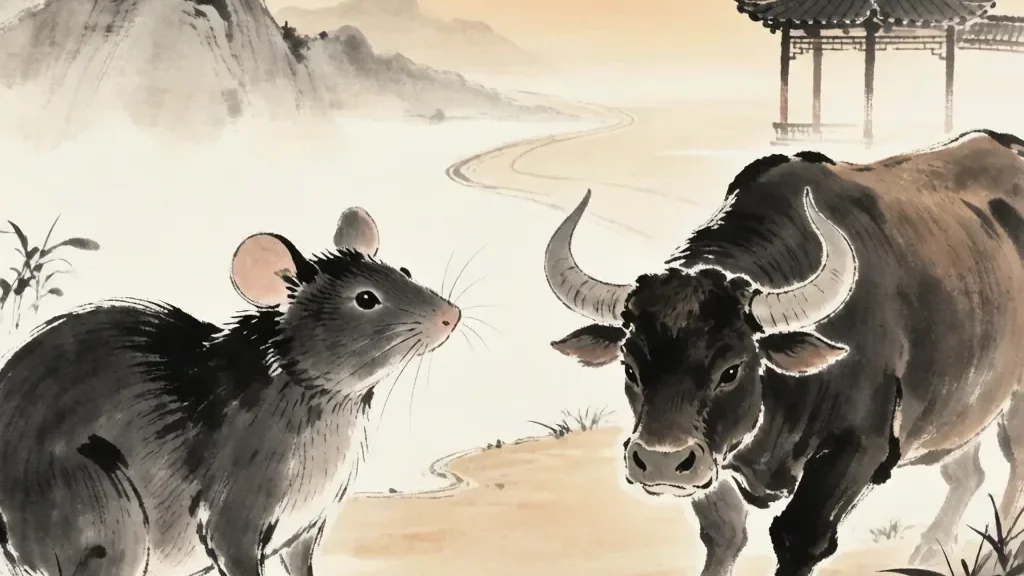
Why does the Year of the Rat come before the mighty Ox, and why is the Cat absent while the Pig trails last? Chinese tradition answers with one of its most charming tales: the story of the Great Zodiac Race (生肖起源 — ). Long ago, the Jade Emperor resolved to measure time by naming twelve animals as guardians of the years, and he summoned the creatures of the earth to a great race across a river. The order in which they finished would fix their place in the cycle forever. The race explains not only the sequence of the twelve signs but also the characters and friendships the Chinese still read into every birth year.
Why the Emperor Called a Race
The tale begins with a problem of order. The Jade Emperor, looking down at the confusion of days and seasons, decided that time itself should have guardians — twelve animals, one for each of the twelve branches used to count the years. To choose them fairly, he declared a race: all the beasts of field, forest, and stream were to gather at a riverbank and cross to the far shore; the first twelve to arrive would win the twelve places in the zodiac, in the order of their finish.
This framing turns a calendar into a story of character. The zodiac is not an arbitrary list but the recorded result of a contest, where cleverness, strength, and luck each played a part. By making the animals earn their ranks, the myth gives every sign a personality rooted in how it raced — the Rat's cunning, the Ox's steady power, the Tiger's force — so that the calendar becomes a gallery of traits.
The Rat and the Ox: A Secret Alliance
The first surprise of the race is how the smallest animal won. The industrious Ox was first to enter the water, strong and steady, sure to arrive ahead of all. The Rat, who could not swim well, asked the kindly Ox for a ride on his back, and the Ox agreed. But as they neared the far bank, the Rat leapt off the Ox's head and dashed across the finish line first. Thus the Ox, who did the work, took second place, and the Rat, who did the scheming, took first.
This opening set the tone for the whole zodiac: wit can outrun muscle. The Rat's victory is not condemned in the tale; it is noted as the natural result of quick thinking. The Ox's good-natured loss makes him the symbol of honest, uncomplaining effort. Together the first two signs teach that both cleverness and diligence have their place, and that the race rewards more than raw strength.
The Tiger, the Rabbit, and the Dragon
Behind them came the Tiger, exhausted from fighting the current but proud in third; the Rabbit, who hopped across on stepping-stones and a floating log to take fourth; and then the Dragon. The Dragon, who could have flown first, arrived only fifth because he paused to bring rain to a thirsty village and to blow the Rabbit's log to safety — a detail that paints the dragon as powerful yet kindly, more concerned with others than with winning.
The middle of the race shows the variety of the signs. The Tiger embodies reckless courage, the Rabbit gentle cleverness, the Dragon benevolent strength. Each finishes according to a trait the Chinese would later read into people born under that sign. The race, in other words, is the mythic origin of personality types, a folk psychology encoded in the order of arrival.
The Horse, the Goat, the Monkey, and the Rooster
Next came the Horse, galloping in sixth, with the Goat, Monkey, and Rooster close behind. In one version these three shared a raft, the Rooster having found the wood, the Monkey and Goat having pushed it into the stream, so they crossed together and were rewarded with seventh, eighth, and ninth places for their teamwork. The image of three animals cooperating to finish the river is a quiet lesson in friendship amid competition.
Their ranks reinforce the social reading of the signs. The Horse is free and swift; the Goat is gentle and yielding; the Monkey is clever and sociable; the Rooster is proud and punctual. By placing them in a cluster born of cooperation, the tale suggests that some virtues are best practiced in company, and that the middle of the zodiac belongs to the social, the helpful, and the loyal.
The Dog, the Pig, and the Missing Cat
The Dog arrived eleventh, having stopped to bathe in the river despite loving the water a little too much, and the Pig came last, having stopped to eat and nap along the way. As for the Cat — the great puzzle of the zodiac — the most popular explanation is that the Rat, who had been told of the race by the Cat, neglected to wake him, or even pushed him in, so the Cat overslept and was left out entirely. This is why, the story says, cats have hated rats ever since.
The absence of the Cat is the tale's most beloved twist. It explains a real cultural fact — the Chinese zodiac has no cat, unlike some neighboring traditions — by a piece of domestic drama. The Dog's lateness and the Pig's laziness round out the signs with a forgiving humor: even the last to finish earned a place, and the flaws of the animals are part of their charm rather than a disqualification.
The Zodiac and the Twelve Branches
Behind the folktale lies a real system. The twelve animals map onto the twelve Earthly Branches, an ancient way of counting the hours, days, and years, and onto the cycles of the calendar. Each animal rules a year in a repeating twelve-year cycle, and also an hour of the day and a direction. The story of the race is the popular wrapping around a sophisticated timekeeping method that Chinese society used for millennia.
What the myth does is give the system a soul. A boring list of branches becomes a cast of characters with grudges, friendships, and funny failures. By tying each branch to a racing animal, the zodiac entered daily life: people speak of being a "Tiger" or a "Rabbit," consult the signs for marriage and the new year, and read personality in the order the Jade Emperor once awarded beside the river.
Why the Zodiac Race Endures
The Great Race endures because it is both a clock and a comedy. It tells children the order of the years and, at the same time, a story of how brains beat brawn, how kindness can slow a dragon, and how a forgotten cat became an enemy. Few myths manage to be so useful and so entertaining at once, which is exactly why it survives in nurseries and New Year prints alike.
More deeply, the tale reflects a Chinese way of seeing time: not as an empty line but as a procession of living characters, each with a temperament. To know your sign is to know a small story about yourself, handed down from a race run at the beginning of the world. The Jade Emperor's contest turned the calendar into a family album of the animals, and everyone since has found their place in it.
The Zodiac Across Asia
Although the Great Race is told as a Chinese story, the twelve-animal cycle spread across East and Southeast Asia, where each culture adapted it to local taste. Japan, Korea, and Vietnam all use versions of the same animals, but the list is not identical everywhere. Vietnam notably places the cat where China has the rabbit, a shift often explained by the sound and species familiar to local farmers. In Tibet and Mongolia related but distinct animal cycles appear, shaped by Buddhist and steppe traditions. These variations show that the zodiac was never a fixed list but a flexible framework that traveled along trade and migration routes, picking up regional flavor while keeping its core structure. For the Chinese world the race remains the beloved origin myth, but the signs also belong to a wider Asian inheritance of timekeeping and storytelling that connects many peoples.
❓ Frequently Asked Questions
📝 Chinese Vocabulary
生肖 — : the zodiac, the twelve animal birth signs.
生肖起源 — : the origin of the zodiac, the Great Race.
鼠 — : the Rat, first of the twelve signs.
牛 — : the Ox, second of the twelve signs.
玉皇大帝 — : the Jade Emperor who called the race.
十二地支 — : The twelve Earthly Branches, the ancient cycle onto which the twelve zodiac animals are mapped.
猫 — : The cat, the animal famously absent from the Chinese zodiac because the rat failed to wake it for the race.
子 — : Zi, the first Earthly Branch, corresponding to the Rat and to the start of the two-hour night period.
🎉 Fun Facts
- The Rat won by riding the Ox across the river and jumping off at the last moment to finish first.
- The Chinese zodiac has no Cat, which the race-story explains by the Rat failing to wake his friend in time.
- The Dragon arrived only fifth because he stopped to make rain for a village and help the Rabbit.
- The twelve animals also map onto the twelve Earthly Branches and even onto two-hour periods of the day.
- Beyond years, each zodiac animal is also linked to a two-hour period of the day, so a person's birth hour as well as birth year can be read through the signs.
- Neighboring cultures adapted the cycle to local animals; the Vietnamese zodiac, for example, replaces the Rabbit with a cat, showing how the race traveled and changed across Asia.