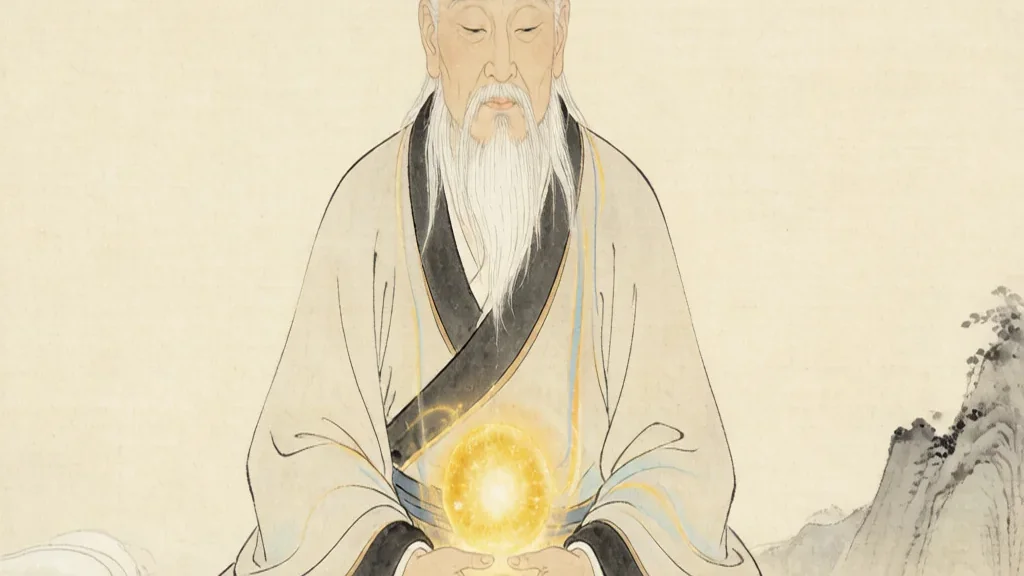
Internal Alchemy (内丹, Nèidān) is Daoism's great method of spiritual transformation, the quiet counterpoint to the furnace-and-crucible world of external alchemy. Rather than mixing cinnabar and mercury in a laboratory, the neidan practitioner refines the body's own living energies—essence (jing), breath (qi), and spirit (shen)—into an immortal pearl of vitality. Developed and systematized during the Tang and Song dynasties, neidan became the central practice of Daoist meditation, longevity arts, and the search for liberation. It is at once a physiology, a cosmology, and a discipline of attention, offering a map for turning the ordinary human body into a vessel of luminous awareness.
The Three Treasures
Neidan theory organizes human life around three treasures, the sanbao. Jing, or essence, is the deepest bodily substance, stored in the kidneys and governing vitality, growth, and reproduction; it is the raw fuel of life. Qi, or breath-energy, circulates through the meridians and powers every physiological function, the moving current that connects body and mind. Shen, or spirit, resides in the heart and the eyes and gives consciousness its brightness and clarity. The alchemical work is to gather these three, prevent their leakage, and cyclically transform them: coarse vitality is purified into refined energy, and energy is sublimated into radiant spirit. This upward movement is the core plot of internal alchemy.
Historical Roots in the Tang and Song
Although seed ideas appear in earlier Daoist meditation and in the Zhuangzi's tales of breathing and fasting, neidan crystallized as a distinct system between the seventh and twelfth centuries. The Tang witnessed a fusion of earlier visualization practices with the language of external alchemy, so that the furnace, the cauldron, lead and mercury became metaphors for bodily processes. By the Song, masters such as Zhang Boduan synthesized Buddhist contemplation, Confucian ethics, and Daoist physiology into complete systems. The southward and northern lineages of the later Jin and Yuan periods—Quanzhen in the north and the Tianxian, Zhong-Lü traditions in the south—gave neidan its mature school structure, complete with ordination, texts, and master-disciple transmission.
The Dantian: Three Elixir Fields
Central to practice are the three dantian, or "elixir fields," where the refined substances are gathered and cooked. The lower dantian, about three finger-widths below the navel, is the furnace of vitality where jing is stored and transformed; it is the anchor of posture, breath, and intention. The middle dantian, at the center of the chest, is associated with qi and the warmth of compassion and breath. The upper dantian, between and behind the eyebrows, is the court of shen, the seat of spirit and vision. Working with these centers, the adept learns to feel, move, and concentrate energy rather than merely think about it, making the body itself the laboratory of transformation.
The Microcosmic Orbit
One of the best-known neidan practices is the microcosmic orbit, or xiao zhoutian, in which the practitioner guides qi up the spine along the governing vessel and down the front of the body along the conception vessel in a continuous loop. Visualization, subtle breathing, and relaxed muscular control keep the current circulating. Over time this is said to open the two great channels, dissolve energetic blockages, and bathe the organs in warmth. More advanced work extends into the macrocosmic orbit, circulating energy through the limbs and the whole body, and finally into the "circulation of light," where attention itself becomes luminous and self-sustaining.
Breath, Visualization, and Stillness
Neidan is built on three interlocking skills. Breath training moves from coarse abdominal breathing to finely graded, almost imperceptible respiration in which the qi is "swallowed" and led downward to the lower dantian. Visualization uses images—a glowing ball, a rising sun, the mixing of fluids—to direct attention and energy to precise regions. Stillness, or ru jing, is the deepening of quiet in which the discriminating mind settles and the spontaneous movement of qi can be felt. None of these is mere imagination; together they train perception of the body's subtle currents, much as a musician trains the ear, until the practice becomes second nature.
The Alchemical Process: Refining Essence to Spirit
The classic formula is "refine essence into qi, refine qi into spirit, refine spirit to return to emptiness." In the early stage the adept conserves and transforms jing so that sexual and vital energy no longer drains away but rises as warm qi. In the middle stage this qi is stabilized and brightened into shen, bringing mental clarity and freedom from compulsive thought. In the highest stage even the subtle sense of a "spirit" or "self" is dissolved into emptiness, the undifferentiated source. The imagery is rich: the "lead" of vitality and the "mercury" of spirit are married in the cauldron; the "golden elixir" gestates in the lower dantian; the "embryo of sainthood" is nourished until it can be born.
From Waidan to Neidan: A Shift of Method
Early Daoist seekers pursued external alchemy, waidan, hoping that ingesting minerals would confer immortality. After centuries of poisoning, the tradition turned inward. The vocabulary of the laboratory was deliberately carried over—cauldron, furnace, lead, mercury, the firing times—but now referred to bodily processes. This was not a rejection of the goal but a change of means: the safest and most reliable elixir, teachers argued, is the one refined within. Neidan thus preserved the ambition of waidan while abandoning its toxic substances, and it absorbed influences from Buddhism's calm-abiding meditation and from classical Chinese medicine's understanding of the body.
Key Texts and Lineages
Neidan produced a vast literature written in poetry and cipher. The Cantong qi (Triplex Unity) is revered as the ancestor of alchemical writing; the Wuzhen pian (Awakening to Reality) of Zhang Boduan sets out the southern school's teachings in verse; the Zhong-Lü chuandao ji records dialogues between the adepts Zhongli Quan and Lü Dongbin. The Taiping jing and the Huangting jing (Scripture on the Yellow Court) shaped early visualization. In the twentieth century the Secret of the Golden Flower, translated and annotated with a psychological commentary by Richard Wilhelm and Carl Jung, introduced neidan to the West as a path of individuation and self-knowledge, revealing its resonance far beyond China.
Neidan in Daily Life and Modern Practice
Today neidan survives not only in Quanzhen and Zhengyi monastic settings but also in lay qigong, taijiquan, and meditation communities around the world. Its emphasis on posture, slow breath, and relaxed attention has been studied for stress reduction and health, though serious alchemical training still requires a qualified teacher to avoid "deviant qi" and attachment. Whether one reads the immortal spirit literally or as a metaphor for psychological wholeness, neidan offers a systematic, embodied path: a way to know the body from the inside, to quiet the mind, and to cultivate a steadiness that no external circumstance can easily shake. It remains one of Daoism's most durable gifts to the world.
Vocabulary
Fun Facts
Frequently Asked Questions
Q: What exactly is refined in internal alchemy?
A: The three treasures—jing (essence), qi (energy), and shen (spirit)—are gathered, conserved, and cyclically purified until vitality becomes spirit and spirit dissolves into emptiness.
Q: How is internal alchemy practiced?
A: Through regulated breath, meditation, visualization, and the circulation of energy in the body's dantian and channels, especially the microcosmic orbit.
Q: Why is neidan considered safer than external alchemy?
A: It requires no toxic minerals such as mercury or arsenic; the elixir is refined from the body's own energies through disciplined practice.
Q: What is the ultimate goal of neidan?
A: Traditionally, liberation as an immortal spirit; in modern terms, deep health, mental clarity, and freedom from the compulsions of ordinary consciousness.
Q: Can a beginner safely explore neidan?
A: Gentle breath and posture work is widely accessible, but advanced alchemical methods should be learned from a qualified teacher to avoid energetic imbalance.
Q: How does neidan relate to Chinese medicine and martial arts?
A: It shares the same model of qi, meridians, and dantian, and its principles underpin taijiquan, qigong, and many health-preserving arts.