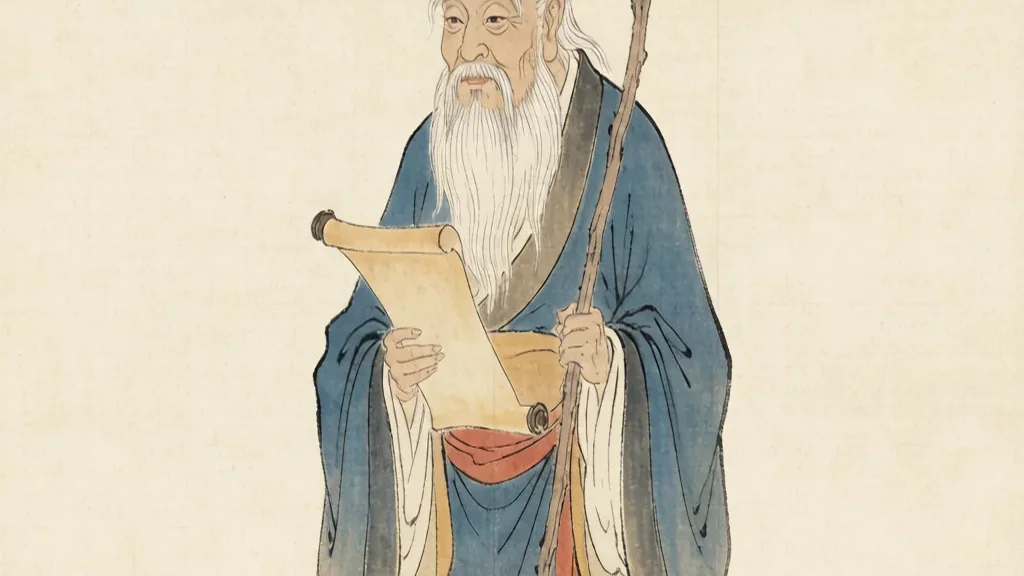
The Dao De Jing (道德经, Dàodé Jīng), the "Classic of the Way and Virtue," is the foundational scripture of Daoism and one of the most translated books in the history of the world. Traditionally attributed to the sage Laozi, its eighty-one short chapters—little more than five thousand Chinese characters in total—compress a complete philosophy of harmony, humility, and effortless action into verses that have been recited, carved on mountains, and argued over for more than two millennia. Its central claim is deceptively simple: align yourself with the Dao, the nameless source and pattern of all things, and life unfolds without strain. Few texts so brief have shaped the thought, art, and politics of a civilization so deeply.
Laozi and the Legend of the Book
Tradition holds that Laozi (老子, "Old Master") was an archivist in the Zhou royal library who, disillusioned by the moral decay of the age, rode west on a water buffalo toward the wilderness. At the pass, the border guardian Yin Xi begged him to leave a record of his wisdom; Laozi then wrote the Dao De Jing in a single sitting and vanished beyond the frontier. Whether this tale is history or myth, it captures the book's spirit: a teaching given freely at the edge of the world, then lost to official ambition.
Modern scholars doubt that a single author produced the text. The earliest copies—bamboo slips from Guodian (c. 4th century BCE) and silk manuscripts from Mawangdui (c. 2nd century BCE)—show the work took shape over time from earlier sayings. The figure of Laozi likely gathered several teachers and traditions into one symbolic name. What matters is that the text speaks with a single voice of serene authority.
The Dao: The Unnameable Source
The opening line is the most famous in Chinese philosophy: "The Dao that can be spoken is not the eternal Dao." The Dao (道) is the ground of being, the generative process behind heaven, earth, and the ten thousand things. It cannot be pinned down by names or concepts because it precedes all distinctions. Yet it is not a remote deity; it is immanent, flowing through rivers, breath, and the turning of the seasons.
To know the Dao is not to define it but to participate in it. The book repeatedly uses paradox—"the Dao is empty yet never exhausted," "great sound is silent"—to point beyond language toward direct, lived attunement. The Dao is both the "mother" of the universe and the humility of a valley that all streams flow into.
The De: Virtue as Flowing Power
The second word of the title, De (德), is usually translated "virtue" but means more like "power" or "integrity" that radiates from alignment with the Dao. Whereas Confucian de is moral excellence earned through effort, Daoist de is effortless—the fragrance a flower gives off without trying. The sage possesses de simply by dwelling in the Dao; it is not a possession but a by-product of non-grasping.
The relation of Dao and De is like root and fruit, or source and manifestation. The Dao is the hidden ground; De is its visible working in the world and in the person. Together they describe both ultimate reality and the practical art of living in accord with it—hence the book's balanced attention to cosmology and conduct.
Wu Wei: Effortless Action
The doctrine of wu wei (无为), "non-action" or "effortless action," is the practical core of the Dao De Jing. It does not counsel laziness but action that does not force—like water that nourishes all things without contention, or a good leader whose people scarcely notice him. The book says the soft overcomes the hard, the weak overcomes the strong, and the empty cup is useful precisely because it is empty.
For the ruler, wu wei means governing lightly, cutting taxes and interference so the people prosper of themselves. For the individual, it means abandoning cleverness and ambition that disturb natural rhythm. "Do nothing, and nothing is left undone" is the radical promise: by not forcing, one accomplishes more than by striving.
Softness, Emptiness, and the Feminine
The Dao De Jing consistently praises qualities the world undervalues. Water, the model of the sage, is soft yet wears away stone; the valley, low and empty, receives all; the female, yielding, outlasts the male in the sexual act. Chapter after chapter elevates the "feminine" (yin) principle not as inferior but as the quiet power that nurtures and endures. This was a striking countervoice to the assertive masculinity of much political culture.
Emptiness, too, is praised: a bowl, a window, a room are useful because of the empty space within. The sage keeps the mind empty and the desires few, making room for the Dao to move. In a society obsessed with filling and possessing, the book recommends the wisdom of the hollow.
The Sage and the Ideal Ruler
The "sage" (sheng ren) of the Dao De Jing is the perfected person who acts without claiming credit and teaches without words. The ideal ruler, likewise, governs so gently that the people say "we did it ourselves." Such a leader trusts the people, avoids excessive law and punishment, and refuses the display of wealth and force. The book is thus quietly political: a manual for kings disguised as mysticism.
Several chapters warn against the folly of conquest and the heaping up of treasures that only invite thieves. "Where troops have camped, brambles grow"—the Daoist distrust of war complements its preference for peace and minimal rule. The sage-king is feared by no one and loved by all because he does not compete.
Return and Reversal: The Movement of the Dao
A recurring motif is that the Dao moves by reversal: "Reversion is the movement of the Dao." Things turn into their opposites—growth becomes decay, success becomes failure—so the wise anticipate the turn and do not cling to any extreme. This cyclical view aligns the Dao De Jing with the Yijing (Book of Changes) and with the natural observation that all flourishing prepares its own decline.
Living by this insight means moderation: do not push any advantage to the brink, do not exhaust your strength, let things complete themselves. The book's famous "three treasures"—compassion, frugality, and refusal to claim precedence—are practical applications of reversal-wisdom, protecting the sage from the pride that precedes a fall.
The Dao De Jing and Other Traditions
The book stands in creative tension with Confucianism. Where Confucius urges ritual, learning, and active virtue, Laozi doubts that civilization's ornaments make people good; "the five colors blind the eye," he warns. Yet later Confucians borrowed its quietism, and Neo-Confucians absorbed its cosmology. Buddhism, arriving from India, found in the Dao a native counterpart to emptiness (sunyata), easing its Chinese reception.
The Dao De Jing also seeded religious Daoism (道教), whose practitioners read it as a scripture of meditation, longevity, and inner alchemy. Though the original text is philosophical rather than devotional, its imagery of the valley spirit and the undying breath became the language of later immortals and alchemists.
Enduring Influence and Global Reach
Few works match the Dao De Jing's diffusion. It has appeared in more than two hundred English translations alone—perhaps more than any other Chinese book—and in hundreds more across European and Asian languages. Its lines grace calligraphy scrolls, martial-arts studios, and boardrooms, quoted for everything from leadership to ecology. Its suspicion of restless consumption speaks directly to modern anxieties about growth and burnout.
From the painter who leaves empty space for the mist, to the strategist who wins without fighting, to the ordinary reader seeking calm, the Dao De Jing keeps offering the same quiet invitation: stop pushing, trust the current, and the Way will carry you. In barely five thousand characters, it opened a river that has not stopped flowing.
❓ Frequently Asked Questions
What is the central theme of the Dao De Jing?
It teaches living in harmony with the Dao, the unnameable source of all things, by means of yielding, simplicity, and non-forcing action (wu wei), rather than striving and contrivance.
Who wrote it?
Tradition names Laozi, a Zhou-dynasty archivist, but scholars see the text as layered, growing from earlier sayings into the form preserved on Warring-States and Han manuscripts.
What does "wu wei" mean?
Wu wei means "non-action" or "effortless action"—acting in tune with circumstances without forcing outcomes, like water that wears stone by flowing rather than striking.
Why is the Dao De Jing so widely translated?
Its brevity, poetic paradox, and universal themes of peace and naturalness give it cross-cultural appeal, making it one of the most translated works in world literature.
How does it differ from Confucianism?
It doubts that ritual and learning improve people and prefers spontaneous naturalness over prescribed duty, though later traditions borrowed from both.
Is the Dao De Jing a religious text?
Originally philosophical, it later became a scripture of religious Daoism, inspiring meditation, alchemy, and the cult of immortals, but its core is a philosophy of life, not a liturgy.