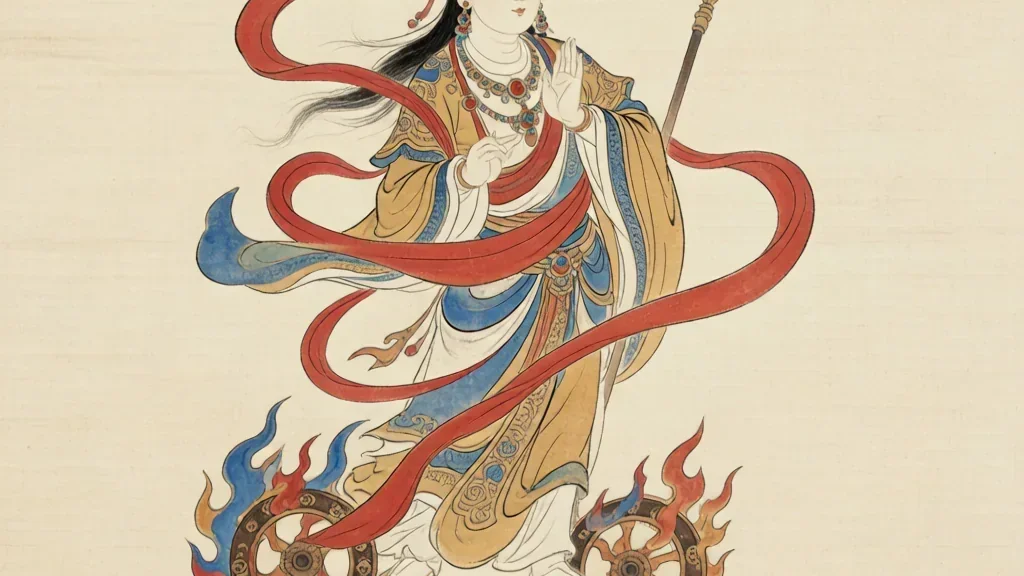
With flaming wheels under his feet, a red sash spinning like a storm, and a spear in his hand, a boy of three years wages war against dragons and destiny alike. He is 哪吒 (Né Zhā), the Youthful Protector, one of the most beloved and rebellious figures in Chinese mythology. Neither fully god nor ordinary child, Nezha is the patron of the young, the restless, and the defiant, a deity who died, was rebuilt from lotus, and returned stronger than before. This article tells the story of the child-hero whose revolt against his own father made him a symbol of liberation and protection.
Mythic Origins in the Cycle of Deification
Nezha's full legend comes to us chiefly through the late-Ming novel 封神演义 (Fēngshén Yǎnyì), the "Investiture of the Gods," and the related 西游记 (Xī Yóu Jì), Journey to the West, though fragments of his cult are older. He is the third son of Li Jing, a military commander later deified as the "Heavenly King" (托塔李天王, Tuōtǎ Lǐ Tiānwáng), and his mother conceived him after a strange dream of a heavenly messenger. He was born not as an infant but as a fleshy ball of light, from which emerged a child already able to speak and stride.
From birth Nezha bore celestial treasures: a universe ring (乾坤圈, qiánkūn quān) of gold, a red sash (混天绫, hùntiān líng) that could stir the sea, and later the wind-fire wheels (风火轮, fēnghuǒ lún) and a fiery spear. These were gifts of the immortal Taiyi Zhenren, who took the boy as a disciple. The toys of an ordinary child are, in Nezha's case, the weapons of a divine warrior, signaling that his playfulness and his potency are one and the same.
The Killing of the Dragon Prince
The turning point of Nezha's myth is his combat at the Eastern Sea. While bathing with his red sash, he disturbed the dragon palace; the dragon king's son, Ao Bing, came to punish him and was slain by Nezha, who even extracted his tendons. Enraged, the Dragon King threatened to flood the land and bring the boy before the heavenly court, intending to punish his family and region for the insult.
Faced with the consequence of his act, Nezha made the most famous sacrifice in Chinese folklore: rather than let his father's people suffer, he disemboweled himself, returned his flesh to his mother and his bones to his father, and died to sever the bond of kinship and guilt. This act of self-dismemberment is at once a confession of responsibility and a radical assertion of autonomy—he would owe nothing, not even his body, to a fate he had not chosen. It transforms a careless child into a tragic, free hero.
Rebirth from the Lotus
Nezha's story does not end in death. His master, the immortal Taiyi Zhenren, gathered lotus roots and leaves and fashioned from them a new, incorruptible body—a lotus-body that could not be bound by the blood-ties of flesh and was immune to many forms of harm. Reborn, Nezha returned with even greater powers, now beholden only to the Dao and to justice rather than to paternal authority.
This lotus rebirth is the myth's spiritual core. The lotus, rising pure from muddy water, symbolizes transcendence of defilement and conditioned existence; Nezha's reconstructed body means he is no longer a mere child of his parents but a self-created agent of heaven. Armed anew, he would later even battle his own father on the battlefield, until the Buddha (or in some versions the immortal Randeng) intervened and reconciled them by giving Li Jing a tower to keep the son in check. The reconciliation completes his journey from rebel to protector.
Nezha as a Protective Deity
Having been deified, Nezha became a youthful heavenly general, often depicted as a beautiful boy with a topknot, standing astride his wind-fire wheels, attended by his junior companions "Gold and Silver" or the "Thousand-Mile Eye" and "Wind-Following Ear." He serves under his father in the celestial army and is especially invoked for protection against demons, illness, and maritime peril.
Because he was a child who conquered death and defied injustice, Nezha became the patron of children, soldiers, and those in desperate straits. Parents once prayed to him for the health of sons; sailors and coastal communities honored him against storms and sea monsters. His temples, though fewer than those of major gods, are found especially in south China and Taiwan, where his image as a fearless boy-guardian still comforts the vulnerable and emboldens the young.
Nezha in Literature and Modern Culture
Nezha's rebellious charisma has kept him vivid across the centuries. In Journey to the West he fights the Monkey King to a standstill; in Investiture of the Gods he is a key general in the war that reorganizes the pantheon. His story of killing the dragon resonated with a peasant society that feared both floods and arbitrary authority, making him a folk hero of resistance.
In recent decades Nezha has enjoyed a spectacular revival in film and animation, most notably in the 2019 blockbuster "Ne Zha: Birth of the Demon Child," which reinterpreted his struggle as one of self-definition against fate—"I am the master of my own destiny." This modern retelling captured his enduring appeal: a deity who refuses the role assigned to him, remakes himself, and protects the weak. Few Chinese gods speak so directly to the modern promise that identity is not given but forged.
Nezha in Opera and Temple Art
Nezha has long been a favorite of Chinese opera and popular painting. On the stage he is played as a bright, acrobatic role, leaping on wheels and whirling the red sash, his topknot and bare feet marking him as eternally a boy. Temple sculpture places him among the celestial generals in the Hall of Heavenly Kings, usually astride his wind-fire wheels with the universe ring raised. Folk prints and new-year pictures carried his image into homes, where his fierce-yet-childlike form was thought to scare off demons while delighting children. The visual tradition delights in his mobility and color, the spinning sash and flaming wheels making him one of the most dynamic figures in the whole pantheon, a whirlwind of energy rather than a seated, solemn god.
The Psychology of the Rebellious Child
Nezha's enduring grip on the imagination comes from his status as the child who says no. He refuses the fate assigned to him, first by killing the dragon prince, then by dismembering himself to escape his father's authority, and finally by battling Li Jing on the field. His lotus rebirth is a fantasy of starting life over, free of the obligations of blood and birth. For audiences under strict family and state authority, this rebellion is pleasurable and safe, because it is contained inside a holy legend and ends in reconciliation. Modern retellings sharpen the theme into a statement of self-definition, but the core has always been the same: a small figure who, by sheer will, reshapes the story told about him. In Nezha, Chinese culture keeps a sanctioned space for defiance.
Nezha Across Asia
Nezha traveled with Chinese popular religion into the wider cultural sphere. In Taiwan and southeastern coastal communities he remains a loved child-protector with active temples, and his image appears in folk processions beside Mazu and the Door Gods. In Japan he entered the tradition as Nata Taishi, a youthful deity of the warrior class, and in Tibet a parallel child-protector appears in protective rites. The 2019 animated film gave him a global audience and reframed his struggle as one of destiny versus self-making, but the bones of the legend are old. Whether honored as a guardian of the threshold or reinvented as a symbol of autonomy, Nezha shows how a local Chinese folk hero can speak to universal questions of identity, family, and freedom.
❓ Frequently Asked Questions
📝 Chinese Vocabulary
哪吒 — : Nezha, the Youthful Protector.
风火轮 — : The wind-fire wheels on which he flies.
混天绫 — : The red sash that stirs the sea.
莲花化身 — : The lotus-body rebirth.
托塔李天王 — : Li Jing, the Pagoda-bearing Heavenly King, his father.
乾坤圈 — : The universe ring, Nezha's golden throwing hoop and signature weapon.
太乙真人 — : Taiyi Zhenren, the immortal master who teaches and rebirths Nezha from the lotus.
灵珠子 — : The Spirit Pearl, the divine embryo from which Nezha is born.
🎉 Fun Facts
- Nezha is often shown as a boy of only three years, yet he defeats adult dragons and heavenly generals alike.
- The 2019 film "Ne Zha" became one of the highest-grossing Chinese animated movies ever made.
- His lotus-body made him immune to attacks that work through blood and flesh, a unique advantage among gods.
- In some versions it is the Buddha who gives Li Jing a tower to control his rebellious son.
- Nezha's rebellion against his father made him a folk symbol of children who defy strict parents, and small statues were once placed in homes to give boys courage.
- In some regional operas Nezha appears with extra arms holding multiple weapons at once, a visual echo of the multi-limbed wrathful deities of esoteric Buddhism.