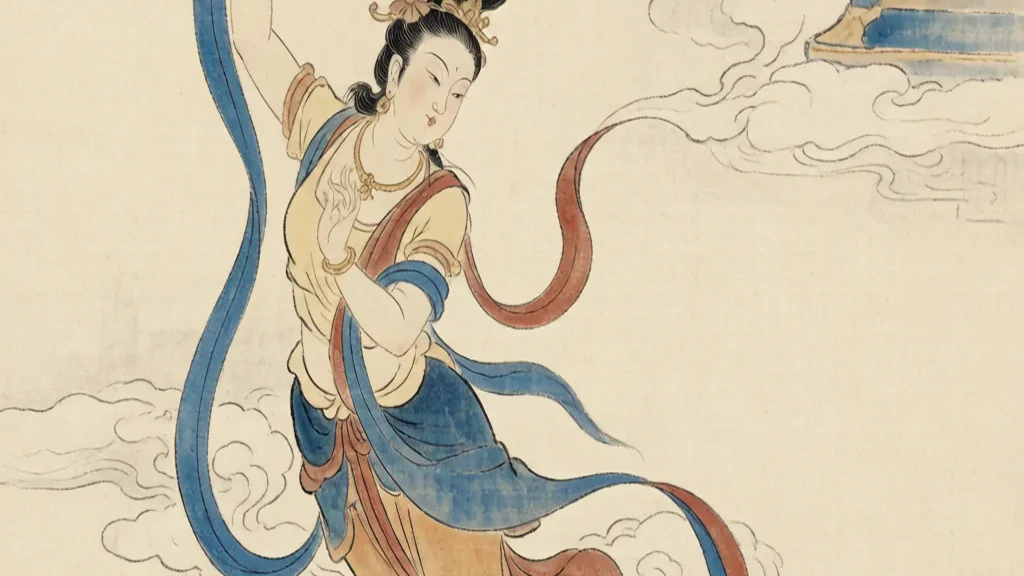
The flying immortal (飞仙, Fēixiān) is among the most enchanting images in Chinese religion and art. Dressed in flowing robes, riding cranes or colored clouds, these beings have transcended ordinary mortality and roam freely between heaven and earth. They embody the Daoist promise that a human being can refine body and spirit into something deathless and free. Neither gods nor ghosts, the immortals (仙, xiān) are perfected men and women who turned the fear of death into a vision of lightness, beauty, and endless wandering.
Immortals in Daoist Imagination
Chinese immortals are not deities in the Western sense; they were once ordinary people who achieved longevity and supernatural powers through cultivation. Some withdrew to misty mountains, others wandered markets disguised as beggars or wine-sellers. The flying immortal represents the highest grade — one who has shed the body's weight and can travel through the sky at will.
The character xiān is written with the radicals for "person" and "mountain," hinting that the immortal is a human who dwells among peaks. Yet the flying immortal goes further, leaving even the mountains behind. In art they are shown with trailing scarves that flutter upward, the very picture of a being no longer pulled down by gravity or care.
How to Become an Immortal
Ancient texts describe many roads to immortality. External alchemists sought it in cinnabar, gold, and elixirs; internal alchemists refined essence, breath, and spirit within the body. Others relied on breath-control (吐纳, tǔnà), dietary regimens, sexual hygiene, meditation, and the accumulation of moral merit.
All these paths shared a single belief: that the human being is a microcosm of the cosmos, capable of being perfected through disciplined practice. Death was not a fate to be accepted but a condition to be outgrown — the gross elements returned to their source while the subtle core ascended. The flying immortal is the symbol of that ascent fulfilled.
Cranes, Clouds, and Peach Banquets
In painting and poetry, immortals are carried by cranes, the birds of long life whose white plumage suggests snow and purity, or they ride multicolored clouds. The Queen Mother of the West (西王母, Xīwángmǔ) hosts banquets of peaches that ripen only once every three thousand years and grant eternal life to those who eat them — a scene painted countless times on screens and ceramics.
These images transformed mortality's terror into an aesthetic of flight. To picture the immortal was to rehearse one's own liberation: the heavy, anxious self dissolving into wind and light. The flying immortal thus functioned as both religious hope and artistic delight, gracing tombs, temples, and the homes of those who longed for more than a brief span.
The Eight Immortals
No group is more beloved than the Eight Immortals (八仙, Bāxiān), each a distinct personality with a magical attribute: Li Tieguai's gourd, Zhang Guolao's fish-drum, Han Xiangzi's flute, Lan Caihe's flower basket, He Xiangu's lotus, Lü Dongbin's sword, Cao Guojiu's castanets, and Zhongli Quan's fan. Together they teach that immortality is open to all walks of life.
The Eight roam the world testing the virtuous and confounding the proud, and their procession across the sea (八仙过海, bāxiān guòhǎi) is a favorite subject of opera and New Year prints. Each wields a treasure that subdues evil or bestows blessing, so that the flying immortal's freedom is always joined to compassion for the living.
External Alchemy: Cinnabar and Gold
The search for the elixir (不死药, bùsǐyào) drove centuries of laboratory work. Daoist alchemists (炼丹士, liàndānshì) heated cinnabar (mercuric sulfide) and other minerals, believing that gold and jade, being incorruptible, could confer incorruptibility on the body that consumed them. The practice was dangerous — mercury poisoning killed more than a few adepts and emperors.
Yet the dream was irresistible to rulers who feared death. Qin Shi Huang sent ships to the eastern islands for the herb of immortality, and Tang emperors famously died of elixirs. External alchemy (外丹, wàidān) eventually gave way to the safer inner work, but it left a rich vocabulary and a deep cultural association between the immortal and the glowing furnace.
Internal Alchemy: The Three Treasures
Internal alchemy (内丹, nèidān) relocated the laboratory inside the body. The adept refined the "three treasures" — essence (精, jīng), breath (气, qì), and spirit (神, shén) — circulating them through the energy channels until they crystallized into an immortal embryo. Breath and attention turned like the falun in the lower dantian.
The achievement was called "transformation by feather" (羽化, yǔhuà), as if the body grew wings of light. Some traditions spoke of "release by means of a corpse" (尸解, shījiě), in which the adept's body was a chrysalis left behind while the true self flew free. These metaphors kept the flying immortal close to lived practice rather than mere myth.
Flying Immortals in Dunhuang Art
The most luminous images of flight come from the caves of Dunhuang, where Buddhist donors and Daoist dreams met. The feitian (飞天), often called apsaras, are celestial beings who drift through the heavens scattering flowers, playing lutes, and trailing ribbons. Though Buddhist in origin, their weightless grace answers the same Chinese longing for effortless ascent.
Across a thousand years of mural painting, the flying figures grow lighter and more dynamic, until they seem to defy every law of gravity. They are the visual proof of a conviction shared by Daoist and Buddhist alike: that the spirit, properly cultivated, need not be earthbound — it can rise, scatter blossoms, and laugh among the clouds.
Immortals in Literature and Poetry
The theme runs through China's greatest literature. Zhuangzi tells of Liezi, who could "ride the wind" and wander beyond the seasons. The Classic of Mountains and Seas populates distant peaks with feather-clad beings. Tang poets like Li Bai drank wine with imaginary immortals and longed to visit the stars.
In these texts the flying immortal is rarely only a supernatural; he is a figure of spiritual freedom, the self liberated from convention, anxiety, and time. To "ride the wind" (御风, yùfēng) became a metaphor for the unbothered, spontaneous life that Daoism prizes — and that every reader, however earthbound, could taste in the reading.
Mountains of the Immortals
Where do the immortals live? Daoist geography placed them on blessed isles. Penglai (蓬莱), Fangzhang, and Yingzhou rose from the eastern sea, while Kunlun stood in the far west as the axis of the world, guarded by the Queen Mother. Pilgrims and emperors alike sought these peaks, some dispatching fleets that never returned.
These sacred mountains were more than places; they were states of being. To climb the inner mountain of cultivation was to arrive at Penglai within. The geography of the immortals thus doubled as a map of the disciplined heart — every summit a stage of refinement, every cloud a step nearer the sky.
The Enduring Dream of Flight
The flying immortal survives wherever people long to rise above the merely mortal. In opera, film, and martial-arts fantasy, the xianxia ("immortal heroes") genre lets modern audiences soar on swords and clouds, heirs to the same imagination that filled Dunhuang's ceilings. The dream of weightless freedom remains astonishingly alive.
Underneath the spectacle lies a serious claim: that human nature is not finished, that through cultivation the self can be lightened, clarified, and set free. The flying immortal is China's most beautiful answer to the question of death — not a resurrection of the body but a release of the spirit into the open sky, scattering flowers as it goes.
📝 Chinese Vocabulary
🎉 Fun Facts
❓ Frequently Asked Questions
Q: What is a flying immortal?
A: An adept who has shed the body's weight and cares to ascend, often shown with floating scarves, riding cranes or clouds.
Q: What is the goal of the flying immortal's practice?
A: Release from the heavy, mortal state into effortless freedom — the spirit set loose to wander the heavens.
Q: Where are flying immortals most often seen?
A: In the Dunhuang murals, where the apsaras (feitian) drift through the heavens scattering flowers and playing music.
Q: Are immortals the same as gods?
A: No. Immortals were once human; through cultivation they became perfected, deathless beings, not creator deities.
Q: What methods were believed to achieve immortality?
A: External alchemy (elixirs of cinnabar and gold), internal alchemy, breath-control, meditation, diet, and moral merit.
Q: Who are the Eight Immortals?
A: Ba Xian — eight beloved Daoist transcendents, each with a magical treasure, who symbolize that immortality is open to all.