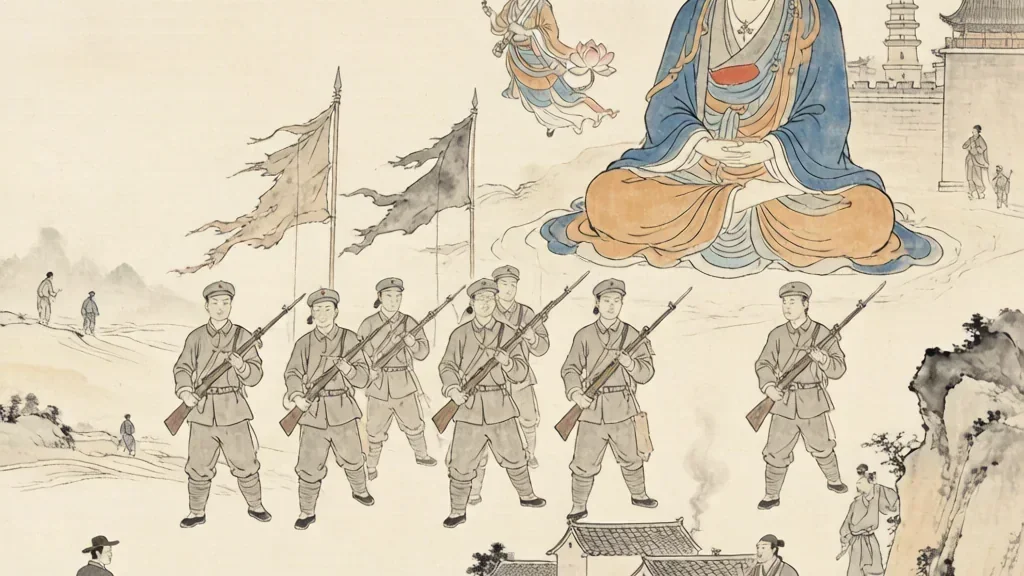
Few religious movements in Chinese history have been as resilient, as adaptable, and as feared by the authorities as the White Lotus (白莲教, Bailian Jiao). Emerging in the 12th century as a lay Buddhist society devoted to the Pure Land practice of chanting Amitabha Buddha's name, the White Lotus evolved over eight centuries into a sprawling network of folk religious communities that repeatedly mobilized peasants in massive uprisings against the imperial state. The White Lotus Rebellion of 1796-1804, which convulsed the Qing Empire at the height of its power, remains one of the largest popular insurrections in world history, costing an estimated 16 million lives and nearly bankrupting the imperial treasury. The movement's millenarian ideology — which prophesied the coming of the future Buddha Maitreya and the establishment of a new cosmic order — resonated deeply with marginalized populations and repeatedly provided a religious framework for political resistance.
Origins: From Pure Land Society to Millenarian Movement
The White Lotus movement traces its origins to the White Lotus Society founded in 402 CE by the Buddhist monk Huiyuan (334-416 CE) on Mount Lu in Jiangxi Province. Huiyuan gathered 123 monks and lay followers before an image of Amitabha Buddha and vowed to be reborn together in the Western Pure Land. However, the sect that would become known as the White Lotus Teaching emerged in the 12th century under the Song Dynasty monk Mao Ziyuan (circa 1096-1166 CE). Mao simplified Pure Land practice for lay audiences, teaching that even ten recitations of Amitabha's name could ensure rebirth in the Pure Land. The Song government, suspicious of unauthorized religious assemblies, banned Mao's movement in 1133 CE. The suppression paradoxically strengthened the movement, as its decentralized structure allowed it to survive underground and its persecution narrative enhanced its appeal to the disenfranchised.
The relationship between the White Lotus and orthodox Pure Land Buddhism was complex and often contentious. Pure Land Buddhism, one of the most widely practiced schools of East Asian Buddhism, centers on faith in Amitabha Buddha and the aspiration to be reborn in his Western Paradise, a pure realm free from suffering where enlightenment can be attained more easily. Orthodox Pure Land practitioners rejected the White Lotus's apocalyptic teachings and its worship of the Unborn Venerable Mother, considering these innovations to be heretical departures from Buddhist doctrine. Prominent Buddhist monks of the Ming and Qing dynasties wrote polemics against the White Lotus, accusing them of misleading the faithful with false prophecies. Nevertheless, the White Lotus retained the core Pure Land practice of nianfo (reciting the Buddha's name), which provided its members with a familiar and accessible religious practice. This combination of orthodox practice with heterodox beliefs made the White Lotus particularly difficult for authorities to police, as its meetings could appear indistinguishable from legitimate Buddhist gatherings to outside observers.
White Lotus Religious Beliefs and Scriptures
The White Lotus developed a distinctive theological system that blended Pure Land Buddhism with indigenous Chinese folk beliefs, creating a syncretic religion that addressed both spiritual and material concerns. Central to White Lotus theology was the figure of the Unborn Venerable Mother (Wusheng Laomu), an eternal female creator deity who gave birth to all human souls and longed for their return to her heavenly home. This supreme goddess was believed to reside in the Eternal Mountain of Eternity, a paradise where the faithful would dwell after the apocalypse. The White Lotus eschatological framework divided cosmic history into three ages: the Age of Green Yang ruled by the Dipankara Buddha, the Age of Red Yang ruled by the Shakyamuni Buddha, and the Age of White Yang to be inaugurated by the future Buddha Maitreya. White Lotus adherents believed they lived in the final, degenerate age when only sincere faith could ensure salvation.
The primary scriptures of the White Lotus tradition were the baojuan (precious scrolls), vernacular religious texts written in a mixture of prose, verse, and colloquial language that made them accessible to semiliterate peasants. These scrolls, which began circulating in the 15th century, told elaborate stories of deities and bodhisattvas, explained complex cosmological doctrines in simple terms, and contained prayers and meditation instructions for daily practice. The Five-Section Precious Scroll and the Precious Scroll of the Dragon Flower Assembly were among the most widely circulated texts. By the Qing Dynasty, hundreds of baojuan had been produced, many of which were discovered by modern scholars in temple libraries and household shrines across northern China. These texts represent one of the largest bodies of popular religious literature in Chinese history and provide invaluable insights into the worldview of ordinary Chinese people who left few other written records.
The White Lotus and the Fall of the Yuan Dynasty
The White Lotus played a pivotal role in the collapse of the Mongol Yuan Dynasty. In the 1340s, as the Yuan government weakened under the strain of factional infighting, rampant inflation, and the devastating floods of the Yellow River, White Lotus preachers circulated prophecies of the coming of Maitreya and the restoration of native Han Chinese rule. The most famous of these preachers was Han Shantong (died 1351 CE), who proclaimed himself a descendant of the Song imperial house and declared that the empire is in utter chaos; Maitreya Buddha has descended to be reborn. In 1351, Han Shantong and his disciple Liu Futong mobilized thousands of Yellow River conscript laborers into the Red Turban Rebellion. The rebels wore red headbands symbolizing the fire element predicted to destroy the current age. Although Han Shantong was captured and executed, one of the rebel commanders — Zhu Yuanzhang, a former Buddhist novice — would emerge victorious, founding the Ming Dynasty in 1368.
The pattern of White Lotus involvement in rebellions established during the Yuan Dynasty would repeat throughout Chinese history. Each uprising followed a similar trajectory: economic hardship drove peasants to seek refuge in White Lotus communities, where millenarian teachings provided both comfort and a framework for resistance. Charismatic leaders emerged who claimed divine mandates, often declaring themselves to be embodiments of Maitreya or reincarnations of earlier rebel heroes. The rebellions typically began in remote mountain regions where government control was weak, then spread rapidly through networks of White Lotus congregations. While none of these uprisings succeeded in overthrowing the state, each one weakened the ruling dynasty and contributed to the long-term cycle of dynastic decline and renewal. The White Lotus tradition of rebellion thus became a permanent feature of Chinese political life, a shadow state that challenged the legitimacy of each successive dynasty.
White Lotus Suppression and the Pattern of Persecution
The Ming and Qing dynasties both considered the White Lotus an existential threat and pursued systematic campaigns to eradicate it, yet their efforts consistently backfired. The Ming founder Zhu Yuanzhang, himself a former member of the White Lotus-adjacent Red Turban movement, banned the sect shortly after establishing his dynasty, fearing that the millenarian ideology that had empowered his rise could be turned against him. The Ming legal code prescribed execution for White Lotus leaders and exile for followers. However, persecution pushed the movement deeper underground and into more remote regions, where its teachings became even more radicalized. During the Qing Dynasty, the Yongzheng Emperor (reigned 1722-1735) implemented a registration system for Buddhist and Daoist clergy specifically designed to identify White Lotus adherents, requiring all monks to carry identification certificates that were checked at periodic inspections.
The pattern of persecution and resurgence followed a predictable cycle: a period of social and economic crisis would drive peasants to seek solace in White Lotus communities; the growing size and visibility of these communities would alarm local officials; a crackdown would lead to mass arrests and executions; the survivors would flee deeper into the mountains, where their conviction that the imperial state was irredeemably evil would intensify; and a new rebellion would erupt, larger and more violent than the last. The Qing official Huang Yubian, in his 1838 work A Treatise on the Prevention of Heresy, advocated for a more nuanced approach, arguing that suppressing the White Lotus by force alone was futile and that the government should address the economic grievances that drove people to join. His advice went unheeded, and White Lotus rebellions continued to plague the dynasty until its final decades.
The White Lotus Rebellion of 1796-1804
The White Lotus Rebellion of 1796-1804 was the largest and most destructive White Lotus uprising in Chinese history. The rebellion originated in the mountainous borderlands of Hubei, Sichuan, and Shaanxi provinces, where impoverished migrants and displaced farmers found in White Lotus communities both material support and a religious vision that explained their suffering as the final tribulation before the dawn of a new age. The immediate catalyst was the Qing government's aggressive suppression campaign of 1794-1795, which arrested and executed hundreds of White Lotus leaders, inadvertently provoking the very uprising it sought to prevent. The rebels employed guerrilla tactics, using their knowledge of the rugged Qinling-Daba mountain terrain to evade Qing regular forces. The rebellion cost the Qing treasury an estimated 200 million taels of silver — equivalent to five years of imperial revenue — and exposed the decay of the Banner military system.
The White Lotus Legacy: Secret Societies and Modern Scholarship
After the 1804 rebellion, the White Lotus never again mobilized a rebellion on the same scale, but its organizational model and millenarian ideology influenced numerous successor movements. The Eight Trigrams uprising of 1813, which briefly penetrated the Forbidden City, was organized by White Lotus offshoots. The Taiping Heavenly Kingdom (1850-1864), though primarily Christian in its ideology, adopted organizational structures and millenarian rhetoric that echoed White Lotus precedents. The Boxer Uprising (1899-1901) drew on the martial arts and spirit-possession traditions cultivated within White Lotus-adjacent folk sects. Modern scholarship has fundamentally revised earlier dismissals of the White Lotus as a mere superstitious cult. The historian Susan Naquin, in her magisterial 1976 study Millenarian Rebellion in China, demonstrated that White Lotus ideology represented a coherent and internally rational worldview that addressed genuine social and spiritual needs.