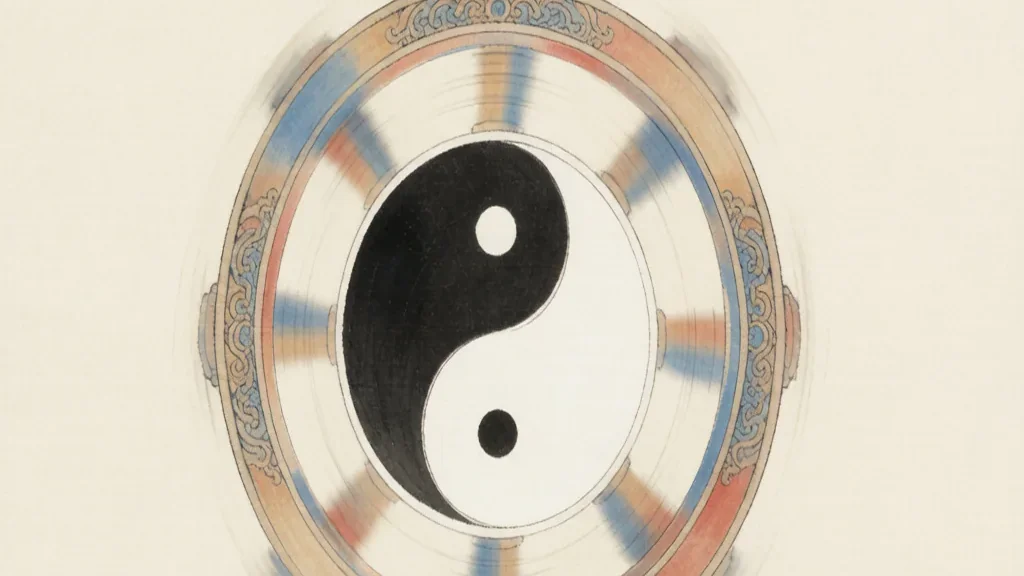
Taiji (太极) and Falun (法轮) are two of the most evocative symbols in Daoist cosmology and body cultivation. Together they describe the cosmic pattern of yin and yang and its refinement within the human being through meditation, movement, and breath. The taiji — the familiar circle of swirling black and white — pictures the whole world before it divides into opposites, while the falun, the "wheel of the law," names the turning centers of vital energy cultivated in the body. More than images, they are instructions for living in harmony with change.
Taiji: The Supreme Ultimate
The taiji symbol, a circle divided into interlocked black and white swirls, represents the dynamic interaction of yin (阴) and yang (阳) from which all things arise. The dark and light are not enemies but partners: each contains a seed of the other, and each flows ceaselessly into the other. Nothing is purely one or the other; all is relation and transition.
In Daoist practice taiji is not merely a diagram but a lived experience. The body learns to move, breathe, and think in accord with the alternating currents of expansion and contraction, activity and rest. To embody taiji is to stop resisting the natural turn of things and instead to ride it, like a boat carried by a current it cannot see but can trust.
Falun: The Wheel of Law
Falun, the "wheel of the dharma" or "wheel of law," appears in both Buddhist and Daoist contexts. In Buddhism it is the emblem of the Buddha's teaching, set turning at his first sermon. In body-centered Daoism it refers to energy centers or rotating fields of qi (气) in the abdomen and other parts of the body, visualized as slowly spinning wheels.
Practitioners imagine these wheels gathering, refining, and circulating vital energy during meditation. The rotation is said to draw in pure cosmic qi and expel turbidness, much as a mill wheel transforms grain. In this inner alchemy the human frame becomes a cosmos in miniature, its wheels turning in time with the greater wheel of heaven.
Movement and Stillness
Taijiquan (太极拳), the martial art built on taiji principles, translates these ideas into slow, continuous movement. Practitioners seek to relax deeply while keeping internal structure, allowing qi to flow without blockage. The form looks gentle, yet it trains balance, sensitivity, and the redirection of force.
Whether practiced for health, self-defense, or spiritual cultivation, taiji offers a practical method for embodying yin and yang. The famous saying "four ounces deflect a thousand pounds" captures its logic: rather than meeting strength with strength, one yields and guides the opponent's energy back on itself — the supreme ultimate expressed as technique.
The Philosophy of Yin and Yang
Behind the symbol lies a whole way of seeing. Yin and yang are the two fundamental modes of things: shadow and light, rest and motion, cool and warm, receptive and active. Health and harmony come from their balance, while illness and conflict come from their blockage or excess.
Crucially, yin and yang are not fixed substances but phases in a cycle. Day becomes night, summer turns to winter, exertion gives way to rest. The taiji teaches that wisdom lies in knowing which phase is arriving and adjusting accordingly — a responsiveness the Daoists called wuwei (无为), "non-forcing" action aligned with the grain of nature.
Taiji in the Yijing
The classic Book of Changes (易经, Yìjīng) gives the earliest literary expression of the idea. "The Changes have the Supreme Ultimate," it says, "which generates the two modes (两仪, liǎngyí)" — yin and yang — which in turn generate the four images and the eight trigrams. Taiji is thus the source before division, the unity that unfolds into the diversity of the world.
For centuries scholars and adepts read the Yijing as a manual of timing: by observing the patterns of change one could act at the right moment. The taiji circle became the visual shorthand for this teaching — a reminder that every situation contains its own turning point, if only one watches closely enough to see it.
Neidan and the Inner Wheel
In internal alchemy (内丹, nèidān) the falun is cultivated in the lower "cinnabar field" (丹田, dāntián) below the navel, where essence, breath, and spirit are refined into immortal vitality. The adept "turns the wheel" by circulating breath and attention in a slow orbit through the body's energy channels.
This microcosmic orbit mirrors the macrocosmic revolution of the heavens. The goal is not mystical escape but a restored wholeness: the scattered energies of ordinary life gathered back into the still center that the taiji pictures. In this sense the falun is the engine of the alchemist's inner work.
Taiji Quan Styles
What we call taiji today took recognizable shape in the Ming and Qing dynasties. The Chen family of Wenxian county developed the earliest documented form, said to draw partly on observing animal combat. In the nineteenth century Yang Luchan adapted it into the smooth, widely practiced Yang style, and later masters produced Wu, Sun, and Hao variations.
Each style keeps the same principles — slowness, continuity, relaxation, and spiral movement — while differing in posture and tempo. The name "taijiquan" was firmly attached to the art by the Yang lineage in the 1800s, giving a cosmic name to what had been a village martial craft.
Breath, Posture, and Qi
The technical heart of practice is "silk-reeling" (缠丝, chánsī) energy: a continuous, spiraling force that connects the feet to the hands through the waist. Posture stays upright yet rooted, the knees soft, the breath long and low. Attention rests in the dantian rather than the head.
Students are told to "sink the qi to the dantian" and to move from the center outward. The result is a body that is at once calm and alive, heavy yet light — the very paradox the taiji symbol depicts. Mastery is measured less by strength than by the quality of one's stillness in motion.
Falun in Buddhist and Daoist Usage
It is worth noting the symbol travels between traditions. In Buddhism the "turning of the wheel of the Dharma" (转法轮, zhuǎn fǎlún) marks the Buddha's first teaching, and the wheel (chakra) also names the energy centers of Indian yoga. Daoist body-cultivation borrowed and reshaped the term for its own inner geography.
This overlap shows how freely ideas moved along the Silk Road and within Chinese religion itself. A single image — a spinning wheel of sacred law — could mean the Buddha's sermon in one temple and the adept's inner energy center in another, yet both pointed to the same intuition: that reality turns, and the awakened person turns with it.
Taiji in Daily Health
Today taiji is practiced by millions chiefly as gentle exercise and moving meditation. Parks across China and the world fill at dawn with groups performing the slow form in unison. Studies associate regular practice with better balance, reduced stress, and improved vitality among older adults.
Its appeal lies precisely in its simplicity and depth: a practice that asks nothing but attention and breath, yet opens onto a cosmology. In a hurried modern life, the taiji circle offers a daily reminder that strength and softness, motion and stillness, are not opposites to choose between but rhythms to inhabit — the supreme ultimate made personal.
📝 Chinese Vocabulary
🎉 Fun Facts
❓ Frequently Asked Questions
Q: What is the taiji?
A: The swirling unity before the split into opposites, shown as the yin-yang circle — the supreme principle from which things unfold.
Q: Why is it called the "supreme ultimate"?
A: Because it is the highest principle, the source from which yin and yang and all phenomena arise.
Q: How is taiji used in practice?
A: In cosmology, martial arts (taijiquan), medicine, and meditation as the underlying pattern of change and balance.
Q: What does falun mean?
A: "Wheel of the law" — in Daoist body-cultivation, a rotating center of qi visualized in the abdomen during meditation.
Q: Is taiji a religion?
A: No. It is a philosophy and a practice rooted in Daoism, open to people of any faith as health and meditation training.
Q: Can beginners practice taiji?
A: Yes. Its slow, low-impact movements make it ideal for beginners and older adults seeking balance and calm.