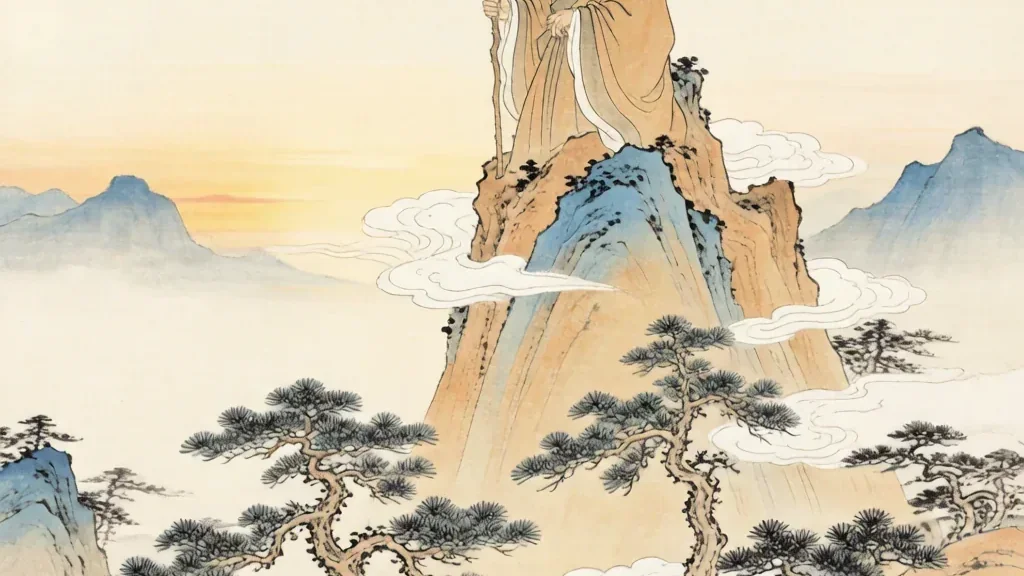
East of the ancient capitals, where the first light of the rising sun strikes the Chinese earth, rises a mountain that the Chinese once called the most sacred of all. This is 东岳 (Dōng Yuè), the Eastern Peak—Mount Tai—and its presiding god is the Great Mountain God of the East, 东岳大帝 (Dōng Yuè Dà Dì). More than a nature spirit, he was the celestial minister of life and death who kept the register of every human lifespan and judged souls after their demise. This article explores how a peak became a god, and how that god became the lord of fate itself.
Mount Tai and the God of the Eastern Peak
Mount Tai, in present-day Shandong, is the foremost of the Five Sacred Peaks (五岳, Wǔ Yuè) of China, the Eastern Peak among them. In early cosmology the east is the direction of sunrise, spring, birth, and the rising yang energy, so the Eastern Peak naturally became associated with life, renewal, and the beginning of the year's cycle. To climb Tai was, for two thousand years, the supreme act of royal communion with heaven.
Out of this reverence grew the deity 东岳大帝, the Great Emperor of the Eastern Peak, who personifies the mountain's power. He is envisioned as a majestic sovereign enthroned in a celestial court on the summit, surrounded by a bureaucracy of subordinate gods who administer the affairs of the living and the dead. As the east is first among directions, his court was considered first among the earthly divine administrations, the model and head of the spirit-government.
The God Who Controls Life and Death
The most solemn aspect of Dongyue Dadi is his jurisdiction over the human life-span. In Chinese popular religion, he holds the "register of life and death" (生死簿, shēngsǐ bù), the ledger in which each person's appointed years are recorded. To lengthen or shorten a life was within his court's authority, exercised through subordinate "officials of the eastern peak" who traveled the world noting births and deaths.
After death, the soul was believed to report to the Eastern Peak for judgment before moving on to the underworld proper. Dongyue thus stands at the threshold between the living world and the realms below, a figure of awesome impartiality. This dual role—giver and taker of life, receiver of the dead—made him both venerated and feared, and inspired a vast devotional and liturgical literature of petitions, penances, and prayers for a good end and a favorable judgment.
The Imperial Feng and Shan Sacrifices
No account of Dongyue is complete without the 封禅 (fēng shàn) rites, the supreme state sacrifices performed by emperors on Mount Tai. The "feng" was offered at the summit to Heaven, the "shan" on a lower hill to Earth; together they proclaimed the ruler's mandate and the harmony of heaven, earth, and humanity. Only an emperor of unquestioned legitimacy might perform them, and doing so validated a dynasty before the cosmos.
Historical records name rulers from the First Emperor of Qin to Emperor Wu of Han, and later Tang and Song sovereigns, who ascended Tai for these rites. The mountain's slopes still bear steles and altars from these ceremonies. By linking the god of the peak to the mandate of heaven, the state fused religion and politics: to honor Dongyue was to affirm the emperor's right to rule, and the god's court became a heavenly mirror of the earthly one.
Temples and the Eastern Peak Cult
Dongyue's worship centered on the 岱庙 (Dài Miào), the Temple of the God of Tai, at the foot of the mountain, a grand walled complex with halls, steles, and the famous "tribute" cypresses. Pilgrims would ascend from there to the summit's 玉皇顶 (Yùhuáng Dǐng), the Jade Emperor Peak, offering at each of the many way-stations of shrines along the sacred road.
Beyond Shandong, "Eastern Peak temples" (东岳庙, Dōngyuè Miào) were built in cities across China, each housing a miniature court of the god where people prayed for longevity, healing, and a peaceful death, and where annual festivals reenacted his procession. The largest, the Beijing Dongyue Miao, preserved an elaborate array of chambers depicting the afterlife bureaucracy. Through these urban temples the mountain god's court reached into every neighborhood.
Dongyue in the Underworld Bureaucracy
In the fully developed "bureaucracy of hell" so characteristic of Chinese religion, Dongyue Dadi presides over the first and highest court, while the ten kings of the underworld (十殿阎罗, shí diàn Yánluó) judge particular offenses below him. The Eastern Peak thus heads the judicial pyramid of the dead, a celestial magistrate whose verdicts set the soul's course through purgatory and rebirth.
This administrative vision reflects a deep cultural habit of imagining the cosmos as a mirror of the imperial state, with ranks, reports, and petitions. Dongyue's enduring lesson is that life and death are not random but governed by a moral order, and that human conduct is recorded and weighed. For the faithful, the god was both a comfort—because the order is just—and a warning, because the register is kept without error. In honoring him, they honored the sacred structure of existence itself.
Pilgrimage to the Summit
For two thousand years the climb up Mount Tai has been a journey charged with meaning, not merely a hike. Pilgrims and emperors alike ascended from the Dai Miao at the foot, pausing at each gate, shrine, and inscribed stone to offer incense and petition the god of the peak. The route threads through dozens of stations, from the Middle Gate of the Azure Clouds to the final push toward the Jade Emperor Peak, where the summit rites once confirmed a ruler's mandate. Ordinary travelers today still wake before dawn to reach the top for sunrise, continuing a practice that blends devotion with the simple awe of standing above the plain. In this way the mountain itself became a ladder between earth and heaven, and each step a small act of communion with the power that Dongyue represents.
Dongyue in Local Festivals
Beyond the imperial ceremonies on the summit, the Eastern Peak god was honored in the daily and seasonal life of cities through the network of Dongyue temples. On his festival days, neighborhoods staged processions in which the deity's image was carried through the streets, accompanied by opera, music, and offerings for longevity and a peaceful death. These local cults let villagers and townspeople approach the great god not as a distant cosmic clerk but as a nearby protector who could be asked for healing, a good harvest, or a favorable judgment after life. The Beijing Dongyue Miao, with its halls depicting the afterlife court, made the bureaucracy of the dead vivid and tangible to ordinary worshipers. Through such festivals the mountain god's court left the summit and entered the rhythm of community life.
The Sacred Geography of the Five Peaks
Dongyue is one of the Five Sacred Peaks, the Wuyue, a system that maps China's cardinal directions onto holy mountains. The Eastern Peak is Mount Tai, the Western is Huashan, the Southern Hengshan, the Northern Hengshan, and the Central Songshan, each guarded by its own deity and each associated with a season, element, and virtue. Together they form a sacred geography that mirrors the administrative and cosmic order, with the Eastern Peak first among equals because the east leads the year. Emperors toured or symbolically honored all five peaks to claim harmony with the whole realm, and Daoist and folk cults wove them into a single ritual landscape. Dongyue's preeminence thus rests not only on Mount Tai's height but on its place as the eastern keystone of this national scheme of holy mountains.
❓ Frequently Asked Questions
📝 Chinese Vocabulary
东岳大帝 — : The Great Emperor of the Eastern Peak.
东岳 — : The Eastern Peak (Mount Tai).
五岳 — : The Five Sacred Peaks of China.
封禅 — : The imperial summit sacrifices to Heaven and Earth.
生死簿 — : The register of life and death.
泰山 — : Mount Tai, the sacred Eastern Peak in Shandong and the earthly seat of the Great Mountain God.
岱庙 — : The Dai Miao, the grand temple complex at the foot of Mount Tai dedicated to the Eastern Peak god.
十殿阎罗 — : The Ten Kings of the Underworld, who judge specific offenses beneath Dongyue's highest court.
🎉 Fun Facts
- Mount Tai has more inscribed stones and steles than perhaps any other mountain in the world, from emperors across two millennia.
- Only emperors deemed fully legitimate were permitted to perform the feng and shan rites on the summit.
- Dongyue's "register of life and death" made him the original cosmic bureaucrat of human fate.
- The Beijing Dongyue Miao once displayed chambers depicting the entire afterlife court in graphic detail.
- Climbing Mount Tai to watch the sunrise from the summit is a centuries-old pilgrimage, and on major holidays thousands of visitors begin the ascent before dawn to greet the first light.
- The sacred route up Tai includes more than six thousand stone steps and dozens of gates, shrines, and steles placed along the way as stations of devotion.