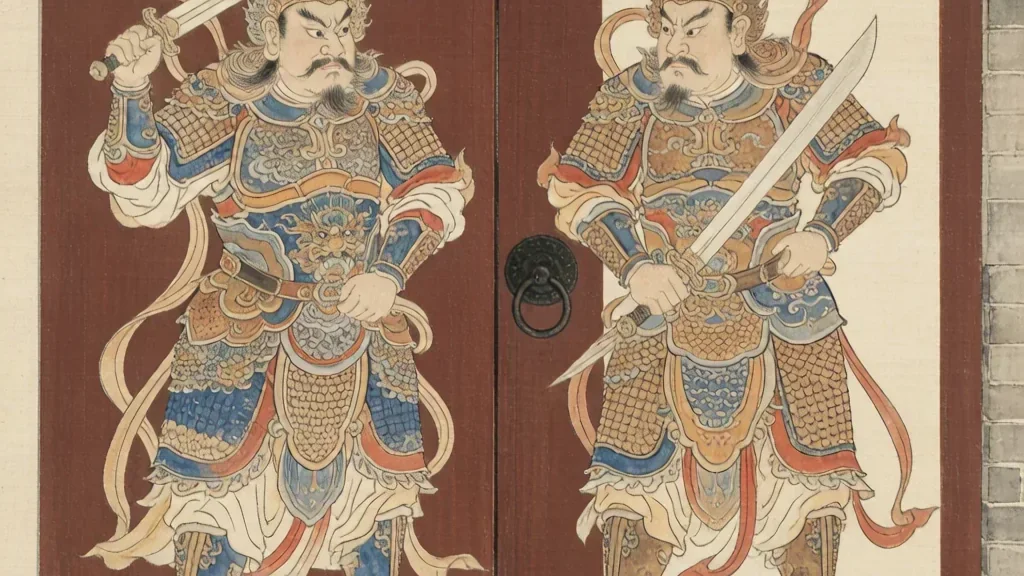
Menshen (门神, "door gods") are the divine guardians pasted, painted, or carved on the doors of Chinese homes, temples, and palaces to ward off evil, disease, and misfortune. Among the oldest and most ubiquitous figures in Chinese folk religion, they belong to a vast class of boundary spirits who protect the threshold — the liminal zone where the household meets the outside world. Depicted as a pair of martial, often armored figures glaring outward with weapons in hand, door gods transform a simple wooden portal into a defended gateway. Their cult blends ancient exorcistic ritual, popular veneration of loyal historical generals, and the festive customs of the Lunar New Year, and their images remain a living part of Chinese visual culture from village courtyards to the vermilion gates of the Forbidden City.
Ancient Origins: the Rite of Exorcism
The roots of door-guardian belief reach back to the Han dynasty and earlier, within a wider complex of seasonal exorcism. The Book of Rites and Han-era texts record the "Great Exorcism" (nuo, 傩) performed at year's end, in which masked performers drove out pestilence-causing demons. Two creatures, "Thunder" (Lei) and "Turtle-shell" (Yu), were charged with watching the gate against the escaped spirits of the slain.
By the Later Han, these apotropaic gate-wardens crystallized into named divine figures. The historian Ying Shao's Fengsu Tongyi tells of the brothers Shentu (神荼) and Yulei (郁垒), who in myth stood beneath a giant peach tree on Mount Dushuo and bound harmful ghosts with reed ropes to feed to tigers — the first legendary door gods.
The Legend of Shentu and Yulei
According to the Han account, on the mythical Mount Dushuo (度朔山) grew a peach tree whose branches arched over a gap through which ghosts passed. The brothers Shentu and Yulei watched this passage and, catching malicious spirits, tied them with reed cords and fed them to tigers. To imitate this, people carved the brothers' names or images onto peach wood and hung it on doors.
This is the origin of the "peach-charm" (taofu, 桃符) — slips of peach wood inscribed with their names — which were the direct ancestors of the printed door-god pictures. The peach tree's own apotropaic reputation reinforced the charm, and the custom persisted for over a millennium before giving way to paper prints.
From Peach Charms to Printed Pictures
During the Tang and Song dynasties, carved peach-wood charms gradually yielded to painted and, later, woodblock-printed images of human guardians. By the Song period, New Year "door-god pictures" (menshen hua, 门神画) were a recognized genre, sold in markets and pasted afresh each spring to renew the household's protection.
The technological shift to woodblock printing in the Ming and Qing made door gods a genuinely mass art. Regional workshops — above all those of Yangliuqing, Taohuawu, and Weifang — produced brilliantly colored prints in huge numbers, spreading standardized iconography to every stratum of society.
The Two Generals: Qin Shubao and Yuchi Jingde
The most famous door-god pair are the Tang dynasty generals Qin Shubao (秦叔宝) and Yuchi Jingde (尉迟敬德). Legend, recorded in the Tang court anecdote Chaoye Qianzai, holds that Emperor Taizong suffered nightmares of ghosts wailing outside his palace. The two loyal generals stood armed guard at his door all night, and the emperor slept in peace.
In gratitude the emperor had their portraits painted on the palace gates, and the custom spread to officials and commoners. Because they began as historical defenders of the realm, this pair embodies the theme of loyalty-made-divine that runs through later door-god worship, and they remain the standard "martial door gods" (wu menshen).
Civil and Martial Door Gods
Door gods divide broadly into martial (wu) and civil (wen) types. The martial pair — usually Qin and Yuchi, or the Tang general Zhenguo — are armed and fearsome, suited to the outer gates where physical protection is paramount. Their scowls and weapons are meant to terrify intruders, human or spectral.
Civil door gods, by contrast, are gentle, robed officials holding ruyi scepters or scrolls, associated with bringing prosperity, harmony, and literary success. Popular civil pairs include the Tang ministers Wei Zheng and Xu Maogong, or the gods of wealth and rank. The choice of pair thus encoded the family's aspirations as well as its need for defense.
Regional Styles and Famous Pairs
Beyond the standard generals, local traditions produced distinctive guardian pairs. Zhong Kui (钟馗), the demon-queller, sometimes appears alone as a door protector, especially on the inner door. The "Cheng and Yao" brothers, or the child-gods "double immortals of harmony and union" (Heshen and Heshu), guard bedroom or inner doors symbolizing conjugal bliss.
Regional print centers developed recognizable styles: Yangliuqing in Tianjin favored fine linework and soft tones; Weifang in Shandong used bold primary colors; Taohuawu near Suzhou produced refined, narrative-rich designs. These workshops turned door gods into a sophisticated folk-art tradition with strong local identity.
Door Gods in the Imperial Palace
The protective logic of the door god scaled upward to the state. At the Qing imperial court, large painted door-god panels were mounted on the gates of the Forbidden City and the summer resorts, and eunuch-led workshops produced them according to ritual specification. The "Book of Rites" ideal of the guarded threshold applied as much to the emperor as to the peasant.
Imperial door gods were often rendered on a grand scale in mineral pigments, depicting the generals in golden armor amid swirling clouds and auspicious beasts. Their presence on the vermilion gates broadcast both spiritual protection and the majesty of the throne, linking popular apotropaic custom to imperial ideology.
Symbolism and Protective Function
Door gods work by a logic of sympathetic and deterrent magic: the image of the vigilant guardian standing at the threshold discourages the entry of baleful influences just as a real guard would. Their weapons, glaring eyes, and often bare feet (to kick away demons) are functional, not decorative.
Their placement obeys a strict etiquette. Facing pairs must be mounted so the gods look outward, and the senior figure stands on the viewer's left (the east, or "upper" side). Replacing them at the New Year is itself a renewal rite, sweeping out the old year's accumulated misfortune along with the old, faded prints.
Modern Survival and Collecting
Today door-god prints survive strongly in rural China, in overseas Chinese communities, and as collectible folk art. The New Year custom of pasting fresh pairs on entry doors continues, and museum and private collections preserve historical blocks and prints from the great workshops.
Scholars treat menshen imagery as a window into popular cosmology, class aspiration, and the history of printing. Far from being mere decoration, the glowering guardians at China's thresholds remain one of the longest-lived embodiments of the human wish to mark a safeguarded boundary between the safe inside and the dangerous world beyond.
❓ Frequently Asked Questions
What are Chinese door gods?
Menshen are divine guardians depicted on gates and doors to block evil spirits, illness, and misfortune. Usually shown as a martial pair, they turn the threshold into a defended boundary between the safe household and the outside world.
Who were the first door gods?
The earliest were the mythic brothers Shentu and Yulei, who in legend bound malicious ghosts with reeds and fed them to tigers beneath a peach tree on Mount Dushuo; their names were later inscribed on peach-wood charms.
Why are Qin Shubao and Yuchi Jingde so common?
A Tang anecdote says these two generals stood armed watch at Emperor Taizong's door to end his ghost-haunted nightmares; the emperor had their portraits painted on the gates, and the custom spread to households everywhere.
What is the difference between civil and martial door gods?
Martial door gods are armed generals for outer gates, meant to terrify intruders; civil door gods are robed officials holding scepters or scrolls, associated with prosperity, harmony, and scholarly success for inner doors.
How are door gods placed on a door?
They are pasted as a facing pair looking outward, with the senior figure on the viewer's left (east) side, and are traditionally replaced with fresh prints at the Lunar New Year as a renewal of protection.
Are door gods still used today?
Yes — the custom of pasting new pairs at the New Year continues in rural China and overseas Chinese communities, and historical prints are now valued as folk art and studied as a record of popular cosmology.