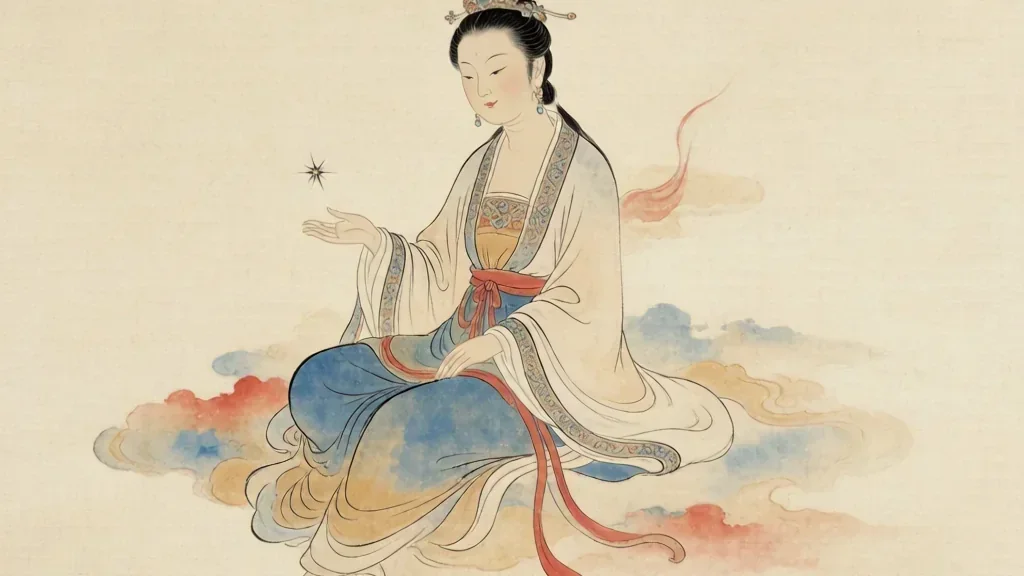
Doumu (斗母, "Mother of the Dippers"), also honored as Doumu Yuanjun (斗母元君) and identified with the cosmic goddess Marici (Molizhi Tian, 摩利支天), is one of the most exalted yet least familiar deities of the Chinese celestial bureaucracy. Revered as the mother of the nine stars of the Northern Dipper (Ursa Major) and, by extension, the ancestor of all the star gods who govern human destiny, she sits at the junction of indigenous Chinese astral religion and imported Buddhist tantric devotion. From the Song dynasty onward she became a focus of lay and monastic worship alike, invoked for longevity, the protection of children, and the sweeping away of misfortune. Her image — a many-armed, crowned figure seated atop a lotus — fuses Daoist star lore with the iconography of a Buddhist bodhisattva, making her a vivid example of the syncretic texture of later imperial Chinese religion.
Origins in the Northern Dipper Cult
The worship of the Northern Dipper (Beidou, 北斗) is among the oldest strands of Chinese astral religion. In early texts the seven visible stars of Ursa Major were conceived not merely as lights but as celestial officials who kept the register of life and death, determining the length of each person's span. To "pass the Dipper" (buguo, 步罡踏斗) through ritual procession was to align oneself with these powers and plead for an extension of years.
Doumu emerges as the personification and mother of this constellation. Whereas the individual dipper stars were male "officials," their cosmic source was imagined as a feminine, generative principle — the primordial qi from which the numbered stars were born. This gendering of the astral womb reflects a broader Chinese cosmological habit of pairing creative Yang structures with a hidden Yin source.
Identification with Marici (Molizhi Tian)
During the Tang and Song periods, the Buddhist deity Marici — a protective goddess of light and invisibility in the Esoteric (Vajrayana) traditions of India and Tibet — entered China as Molizhi Tian (摩利支天). Her cult emphasized her power to render devotees invisible to enemies and to illuminate the darkness of ignorance.
Chinese religiosity gradually fused Marici with the native Dipper Mother. The two shared a reputation for protective light and a maternal, star-linked identity. By the Song dynasty the equivalence was largely fixed: the many-armed, radiant goddess of Esoteric Buddhism became the visual and devotional form through which Doumu was pictured and worshipped in both monastery and household shrine.
Scripture and the "Doumu Jing"
Central to her cult is the Doumu Jing (斗母经, "Scripture of the Dipper Mother"), a popular apocryphal scripture that circulates in many vernacular recensions. It narrates her descent to save suffering beings, her vows to protect the living, and the benefits of chanting her name and the names of the dipper stars.
The text is less a philosophical treatise than a practical manual of merit and protection. It promises that reverence toward Doumu averts calamity, cures illness, and secures offspring. Such promises made the scripture a staple of lay piety, recited at home altars and in temple halls during the lunar festivals tied to the stars.
Iconography: The Many-Armed Goddess
Doumu is typically depicted with three eyes on each of several faces and with multiple arms, often eighteen or twenty-four, holding implements of salvation and cosmic order: the sun and moon discs, pearls, the wheel of the law, and lotus blossoms. She is enthroned upon a lotus that floats above a representation of the Dipper itself.
This imagery deliberately parallels that of Buddhist goddesses such as CundI (准提) and Marici, while the lotus-and-dipper setting anchors her in Chinese star religion. The sun and moon she cradles symbolize the two great luminaries balanced within the cosmic womb, and the pearls stand for the countless star-souls she brings to birth.
Role in the Daoist Pantheon
Within organized Daoism, Doumu holds a high place among the "numinous officials" (lingguan) of the celestial administration. She is venerated especially in the Zhengyi (天师道) and other liturgical traditions that maintain elaborate star-rite liturgies. Her chapels often stand adjacent to those of the Three Pure Ones (Sanqing) and the Pole Star deities.
Daoist priests perform the "Dipper Penitence" (douchan, 斗懺) and related retreats in her name, in which the adept walks the constellation's pattern on a cosmic chart laid upon the floor. These rites aim at the confession of sins, the restoration of vital energy, and the lengthening of life — goals that made Doumu a patron of both individual devotees and the imperial court.
Festivals and Popular Worship
Doumu's principal observances cluster around the lunar ninth month and around the dates associated with the Dipper's turning points in the agricultural and ritual calendar. Households and temple communities offer incense, lamps, and vegetarian fare, and light rows of small oil lamps arranged in the shape of the dipper to mirror her star-children.
In folk practice she is closely linked to the protection of mothers and children. Women seeking safe childbirth or the health of infants have long turned to her, and her "Lamp of the Dipper" rite (dou-eng, 斗灯) — a basin of water, a lamp, and grains set beneath swords and a mirror — is a enduring feature of southern Chinese communal rituals.
Star Lanterns and the "Dipper Lamp" Rite
A distinctive expression of Doumu devotion is the "dipper lamp" (dou deng, 斗灯): a wooden or ceramic basin filled with rice or water, crowned by a burning lamp, flanked by a sword, a mirror, and umbrellas of paper, and heaped with grains and coins. Each element encodes a protective function against demonic affliction.
The rite is commonly conducted during the Lunar New Year and at funerals and communally sponsored "peace ceremonies" (jiao, 醮). The basin represents the cosmic womb; the lamp is Doumu's starlight guiding the soul; the sword and mirror ward off the baleful influences of wandering spirits. It is one of the most visually striking survivals of her cult in contemporary Taiwan and parts of Southeast Asia.
Doumu in Lineage with Other Star Gods
Doumu's children are enumerated as the Nine Luminaries (Jiuyao, 九曜) and, more popularly, the "Doumu and the Seven Stars" who govern the registers of destiny. Beneath her authority stand the "Four Superintendents" and the "Sixty Jiazi Generals" — the cycle of sixty year-lords who each preside over one year in the sexagenary calendar.
This elaborate descent mirrors the bureaucratic model of the cosmos that animates much of Chinese popular religion: a single maternal source radiating an administrative hierarchy of star-officials. To worship Doumu is, in effect, to address the head of the department that holds one's personal life-record.
Modern Legacy and Temples
Today Doumu is worshipped most visibly in Taiwan, Hong Kong, and among overseas Chinese communities in Southeast Asia, where "Doumu Gong" (斗母宫, "Palace of the Dipper Mother") temples serve both as centers of star-rite performance and as community focal points. The Leng Buai Ia Am temple in Bangkok, for instance, is a well-known center of her cult among the Thai-Chinese.
Though less prominent on the mainland after the twentieth century's disruptions, her imagery persists in Daoist art, temple murals, and the continuing practice of lighting dipper-lamps at the New Year. Scholars also value her as a paraded example of how Chinese religion continually re-absorbed foreign deities into its own astral and maternal idioms.
❓ Frequently Asked Questions
Who is Doumu in Chinese religion?
Doumu, the "Mother of the Dippers," is a goddess regarded as the mother of the Northern Dipper stars and, by extension, of the star officials who govern human destiny. She is also identified with the Buddhist goddess Marici.
How did Doumu become associated with Marici?
During the Tang and Song dynasties the Esoteric Buddhist deity Marici (Molizhi Tian) entered China, and her protective, light-giving, maternal qualities led Chinese devotees to equate her with the native Dipper Mother, merging their imagery and worship.
What is the Dipper Lamp rite?
The "dou deng" is a basin filled with rice or water, crowned by a lamp and flanked by a sword, mirror, and paper umbrellas, used in protective ceremonies for the New Year, funerals, and community peace rites.
Why are the Northern Dipper stars important?
From early times the seven stars of Ursa Major were seen as celestial officials holding the register of life and death, able to determine and extend a person's lifespan, which made them central to longevity and protection rites.
Where is Doumu worshipped today?
Her cult is most visible in Taiwan, Hong Kong, and Southeast Asian Chinese communities, where "Doumu Gong" temples perform star rites; her imagery also survives in Daoist art and New Year lamp ceremonies.
What does the Doumu Jing teach?
The popular Scripture of the Dipper Mother promises that reverence, chanting her name, and honoring the dipper stars averts calamity, cures illness, and secures offspring, functioning as a practical manual of merit rather than philosophy.