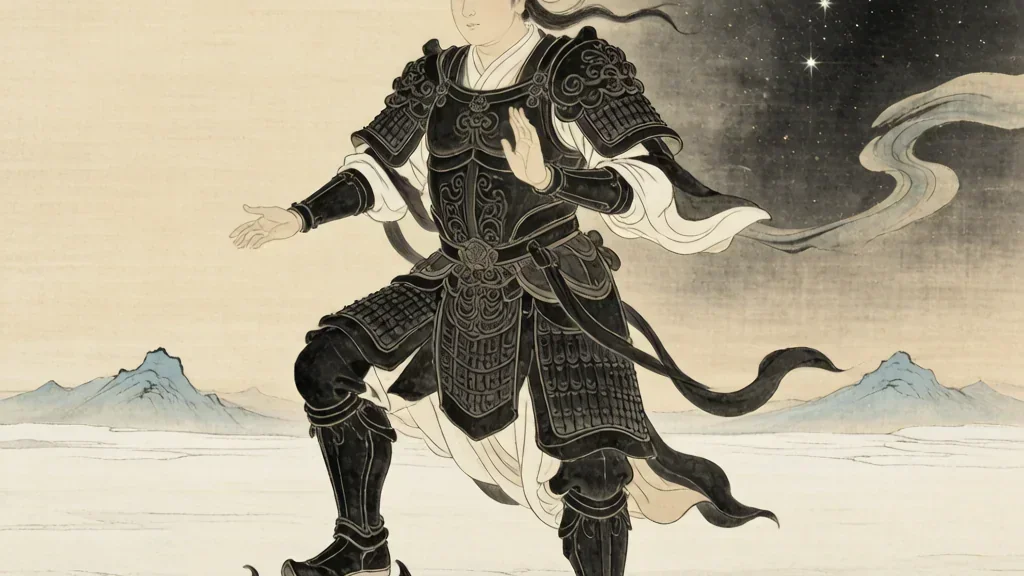
In the frozen north of the cosmos stands a warrior clad in black armor, one foot trampling a serpent and the other a tortoise, a sword of divine judgment in his hand. He is 真武大帝 (Zhēn Wǔ Dà Dì), the Perfected Warrior, one of the most beloved and powerful protective deities of Chinese religion. Born of myth as a prince who abandoned his throne for cultivation, he became the god who quells demons, guards the empire, and commands the northern scriptures of thunder. This article explores how Zhenwu rose from a Daoist ascetic ideal to a national patron honored by emperors and households alike.
Origins as the Dark Warrior of the North
Zhenwu's roots lie in the ancient constellation lore of the four celestial symbols, where the north is governed by the 玄武 (Xuánwǔ), the "Dark Warrior," visualized as a tortoise entwined with a snake. As a cardinal guardian he protected the northern quarter and the winter season, associated with water and the color black. Over time this astral emblem of the north absorbed Daoist and popular elements and grew into a personal deity.
By the Song and Yuan periods the Dark Warrior had been transformed into the Perfected Warrior, a fully anthropomorphic god with a salvation biography. The name Zhenwu, "Perfected Warrior," reflects his identity as one who has perfected the Dao through martial discipline and spiritual conquest. His association with the north and with water made him a natural patron against floods, fires, and the chaos of demons, while his armor and sword marked him as the ultimate celestial general.
The Legend of the Cultivating Prince
The richest account of Zhenwu tells of a prince of the kingdom of Jing, who from childhood cared nothing for his royal inheritance and longed only to cultivate the Dao. Defying his parents' wishes for him to marry and rule, he fled to Mount Wudang and devoted himself to austerities. For decades he practiced meditation in caves and on cliffs, resisting temptations sent by demons and enduring harsh cold.
In one famous episode, weary and doubting after long practice, he turned to leave the mountain, only to meet an old woman grinding an iron bar by the river. Asked what she was doing, she replied she intended to make a needle—teaching that perseverance transforms even the hardest task. Shamed, the prince returned and eventually attained complete awakening. In a dramatic final vision, his own abdomen split open and his intestines and stomach transformed into the demons he had conquered, which he then subdued as the tortoise and snake beneath his feet, symbols of his purified inner nature.
Zhenwu and Mount Wudang
Zhenwu's sacred home is 武当山 (Wǔdāng Shān), the Mount Wudang range in Hubei, which became the foremost Daoist mountain dedicated to him. Legend says he attained the Dao there, and from the Yuan onward the mountain was developed into a vast complex of temples, palaces, and monasteries oriented to his worship. The golden shrine on the peak, containing a gilded statue of the god, became a major pilgrimage goal.
In the early fifteenth century, the Yongle Emperor of the Ming dynasty, who credited Zhenwu with helping him seize the throne, launched a massive reconstruction of Wudang, building the "nine palaces and thirty-six monasteries" and stationing Taoist priests as a kind of celestial garrison. The emperor declared Wudang the "supreme peak under heaven" for Daoist cultivation and promoted Zhenwu as a guardian of the state. Today Wudang remains famous both for Zhenwu devotion and for its martial arts tradition, the two linked by the ideal of the disciplined, perfected body.
Protector of the Empire and the Home
Zhenwu's appeal was both imperial and domestic. Ming and Qing emperors formally bestowed grand titles upon him and enrolled him as a defender of the realm, especially against rebellion and invasion from the north. His image appears on city gates, in military camps, and in the Forbidden City's religious architecture, where he safeguarded the emperor's person and the dynasty's fortune.
Ordinary families, meanwhile, set up small shrines to Zhenwu for protection against illness, fire, and nocturnal demons. His statues—black-robed, sword in hand, trampling the serpent and tortoise—were placed at northern walls and thresholds. As a god who had conquered his own weaknesses through discipline, he offered believers a model of self-mastery and a powerful ally against the forces of disorder, making him one of the most universally honored figures in the Chinese pantheon.
Rituals, Symbols, and Modern Devotion
Zhenwu's emblems are rich with meaning. The tortoise and snake represent primordial yin chaos subdued by yang discipline; the sword is the "demon-subduing blade" of discernment; the black robe and bare feet recall his ascetic origins. His festivals, especially his birthday on the third day of the third lunar month, draw pilgrims to Wudang and other temples for chanting, procession, and the offering of incense.
In contemporary China and the Chinese diaspora, Zhenwu remains actively worshipped, particularly through the Wudang network of priests and the global practice of Wudang taiji and qigong, which trace their spiritual lineage to his mountain. Whether approached as a cosmic general, a patron of martial cultivation, or a household guardian, the Perfected Warrior continues to embody the Daoist ideal that true power begins with mastering oneself—and that the greatest conquest is the conquest of one's own inner demons.
Zhenwu in Daoist Scripture and the Thunder Rites
Zhenwu occupies a central place in the liturgical life of Daoism, especially within the Zhengyi and Quanzhen traditions that flourished around Mount Wudang. Medieval Daoist texts such as the Scriptures of the Northern Emperor present him as a cosmic general who commands the armies of heaven and the ministries of thunder, charged with purging the world of demonic affliction. In the thunder rites, priests visualize Zhenwu as the inner guardian of their own body, using his sword and seal to summon thunder, a form of internal alchemy in which spiritual impurities are dissolved like storms. This scriptural identity explains the references in his mythology to the northern scriptures of thunder and shows how a popular protective god was also a focus of elite ritual expertise. Even today, Wudang priests recite his litanies during exorcistic ceremonies that blend meditation, chanting, and gesture.
Zhenwu and the Art of Taiji
The martial arts of Mount Wudang are inseparable from Zhenwu's legend, for the god is remembered as an ascetic whose mastery came through disciplined, patient cultivation, exactly the principle behind Wudang taiji and qigong. Practitioners often open training by honoring Zhenwu, seeing the slow, circular movements of taiji as a bodily expression of his conquest of chaos: just as he subdued the tortoise and snake within, the student learns to still the agitated energy of body and mind. The black robe, bare feet, and sword of his iconography reappear as training ideals, softness overcoming force and stillness generating power. Spread by Wudang masters across China and the world, this living tradition carries his spiritual lineage far beyond the temple, making Zhenwu not only a deity of the scriptures but a silent partner in the daily practice of millions who may never set foot on his mountain.
Zhenwu in Regional Folk Opera
Beyond temples and scriptures, Zhenwu's drama of humiliation and vindication has long animated Chinese regional theatre. In the operatic repertoire of Hubei, where Mount Wudang stands, plays recount the prince's austerities, his meeting with the old woman at the river, and his triumphant return as a god, mixing acrobatics, martial posturing, and comic demonic roles. Temple fairs on his birthday traditionally paired such performances with processions, turning doctrine into popular spectacle that even illiterate villagers could absorb. Storytellers and shadow-puppet troupes carried variants of the tale along trade routes, so local accents and jokes reshaped the legend without changing its core, the rejected scholar who becomes humanity's defender. This folk theatrical life explains why Zhenwu feels both awesome and intimate to believers, a god encountered as much in the laughter and drums of a village stage as in the smoke of incense.
❓ Frequently Asked Questions
📝 Chinese Vocabulary
真武大帝 — : The Perfected Warrior, a supreme Daoist god.
玄武 — : The Dark Warrior, the northern celestial symbol (tortoise-snake).
武当山 — : Mount Wudang, Zhenwu's sacred mountain in Hubei.
真武 — : "Perfected Warrior," his abbreviated title.
荡魔 — : Subduing demons, his characteristic act.
玄天上帝 — : Supreme Emperor of the Dark Heaven, one of Zhenwu's most common honorific titles in southern Chinese Daoist temples.
北帝 — : Northern Emperor, a popular name for Zhenwu in Guangdong and Hong Kong, where many temples are dedicated to him under this title.
龟蛇 — : The tortoise and snake, the symbols of conquered passion and demonic chaos that lie subdued beneath Zhenwu's feet.
🎉 Fun Facts
- The Yongle Emperor credited Zhenwu with his victory and built Wudang's golden shrine to house a gilded statue of the god.
- The "iron bar ground into a needle" story attached to Zhenwu is a classic Chinese lesson in perseverance.
- Wudang martial arts, including taiji, are spiritually linked to Zhenwu's ideal of the perfected, disciplined body.
- Zhenwu's third-day-third-month birthday is still a major pilgrimage festival on Mount Wudang.
- Zhenwu's black armor and his northern association with water made him a popular patron against fires, and some Ming-era fire brigades invoked him as their guardian.
- In southern China, especially Guangdong, Zhenwu is widely worshipped as the Northern Emperor (Beidi), and numerous temples there still bear that name rather than his formal title.