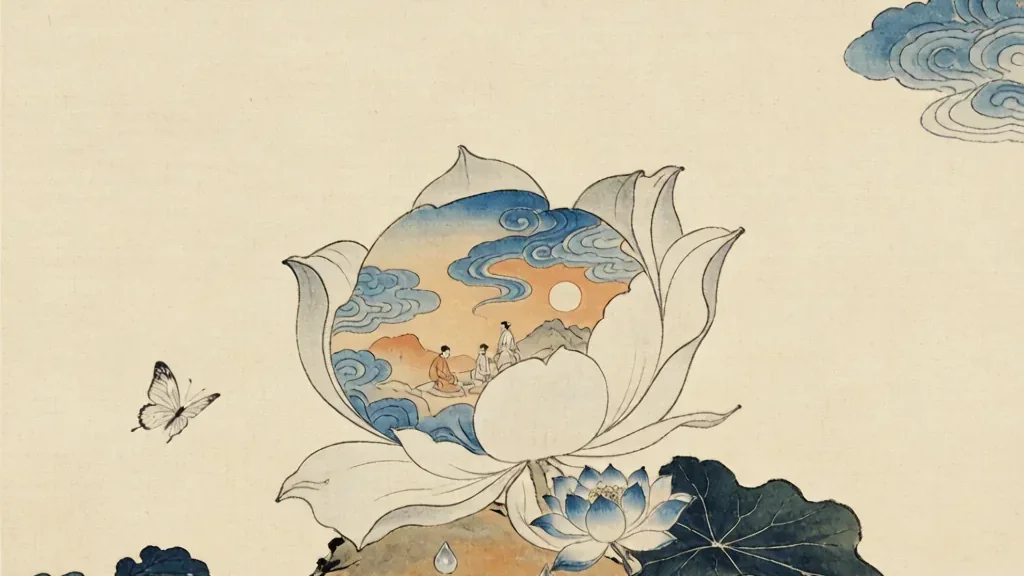
How can a single flower contain the entire universe, and a single moment of thought embrace both hell and enlightenment? These are the questions at the heart of 天台宗 (Tiān Tái Zōng), the Tiantai school, the first distinctly Chinese system of Buddhist philosophy. Founded on the slopes of Mount Tiantai in Zhejiang, it offered a grand map of reality that reconciled the confusing diversity of Buddhist scriptures into one harmonious vision. More than any other school, Tiantai shaped how Chinese Buddhists organized their practice and understood the mind. This article traces how a tradition built on the Lotus Sutra became a comprehensive science of the heart, influencing every later school from Chan to Pure Land.
The Founder Zhiyi and Mount Tiantai
Tiantai is traditionally founded by the monk Zhiyi, who lived from 538 to 597 CE and is honored as the third patriarch though effectively its creator. Born into a turbulent era of divided China, Zhiyi retired to Mount Tiantai (天台山), whose name the school adopted. A brilliant synthesizer and a gifted meditator, he produced systematic works that remain foundational, including the "Great Calming and Contemplation" (Mohe Zhiguan) and the "Profound Meaning of the Lotus Sutra."
Zhiyi's achievement was to organize the vast and contradictory body of Buddhist teaching into a coherent whole. He taught that all sutras are the Buddha's word, but they were spoken at different times, for different audiences, and with different intentions. Rather than declaring some texts false, he ranked them by pedagogical depth, placing the Lotus Sutra at the summit as the Buddha's final, conclusive teaching. This "classification of teachings" gave Chinese Buddhists a way to honor the whole canon without contradiction, an approach later schools adapted in their own ways.
The Five Periods and Eight Teachings
Zhiyi's "doctrine of the five periods" arranges the Buddha's career into stages of teaching. First came the Avatamsaka (Flower Garland) period, too profound for most hearers; then the Agama teachings for beginners; next the Vaipulya expansions; then the Prajna wisdom discourses; and finally the Lotus and Nirvana period, the definitive culmination. Each period meets the listener where they are, like a physician prescribing different remedies for different illnesses.
Complementing this is the "eight teachings," split into the four "doctrinal" teachings (Tripitaka, Common, Distinct, and Perfect) and the four "method" teachings (gradual, sudden, secret, and indeterminate). The crowning category is the "Perfect Teaching" (圆教, yuán jiào), which declares that every phenomenon is already imbued with the ultimate truth and that even a single thought contains the whole of enlightenment. This perfect teaching is the special province of the Lotus Sutra and the distinctive insight Tiantai contributed to Buddhist thought.
The Threefold Truth and the Nature of Reality
At the philosophical core of Tiantai lies the "Threefold Truth": emptiness (空, kōng), conventional existence (假, jiǎ), and the middle (中, zhōng). Emptiness teaches that all things lack independent self-nature; conventional existence affirms that they still appear and function in the everyday world; the middle transcends the one-sided clinging to either view. Unlike earlier interpretations that treated the middle as a mere negation of the two extremes, Tiantai insisted that the three truths are simultaneously true of any single thing.
This leads to the famous formula of "three thousand realms in a single thought-moment" (一念三千, yī niàn sān qiān). Through an elaborate calculation based on the worlds of beings, the realms of desire, form and formlessness, and the six degrees of dependence and correspondence, Zhiyi concluded that in one instant of mental activity, all three thousand aspects of existence are present. Nothing is excluded; even a thought of anger already contains the whole cosmos. This radical non-dualism became Tiantai's signature insight and a profound basis for meditation practice.
Calming and Contemplation in Practice
Tiantai is not only philosophy but a practical method, crystallized in Zhiyi's "Great Calming and Contemplation." "Calming" (止, zhǐ) settles and concentrates the mind; "contemplation" (观, guān) penetrates the true nature of phenomena. The text lays out twenty-five expedient means and ten modes of contemplation, guiding the practitioner from posture and breathing through progressive insight into the threefold truth.
A beloved Tiantai practice is the "Lotus Repentance" (法华忏, Fǎhuá chàn), a ritual of confession and worship based on the Lotus Sutra, often performed over twenty-one days. Tiantai monasteries also developed elaborate ceremonial observances that blended chanting, prostration, and visualization. The school's emphasis on integrating study, ritual, and meditation made it a model of balanced Buddhist life and deeply influenced the liturgical forms still used in Chinese temples today.
Tiantai's Enduring Influence
Although the original Tiantai lineage on Mount Tiantai declined after the Tang persecutions of Buddhism and the chaos of later dynasties, its ideas never disappeared. The school was transmitted to Japan, where it became the formidable Tendai tradition founded by Saicho on Mount Hiei, and from Tendai sprang both the Pure Land founder Honen and the Nichiren school devoted to the Lotus Sutra. In Korea, Tiantai (Cheontae) was revived as a distinct order in the twentieth century and remains active.
Within China itself, Tiantai thought was absorbed into the bloodstream of every other school. Chan masters quoted its classification schemes; Pure Land teachers used its repentance rites; Huayan borrowed its logic of interpenetration. The Tiantai synthesis demonstrated that Chinese Buddhism could be both philosophically rigorous and devotionally warm, a total culture of awakening rather than a single sectarian path. Its vision of a universe coiled within a single thought continues to inspire practitioners who seek not to escape the world but to perceive its already-enlightened nature.
Mount Tiantai as Sacred Landscape
Tiantai takes its name from the mountain in Zhejiang where Zhiyi settled, a range of rounded peaks and rushing streams long prized for seclusion. The school made the mountain its headquarters, and its monasteries, waterfalls, and hermit caves became a landscape of practice as much as a place of residence. Scholar-officials of later dynasties retired there to escape court life, and the region developed a noted tea culture that monks tended on terraced slopes. For Tiantai Buddhists the mountain was more than a backdrop; it embodied the teaching that the whole cosmos is present in a single spot, so that meditating on Mount Tiantai could be a meditation on the universe. The site remains a living center of practice and a symbol of Chinese Buddhist synthesis.
Tiantai's Influence on Chan and Pure Land
Although the Tiantai order itself declined after the Tang persecutions, its ideas became the shared grammar of later Chinese Buddhism. Chan masters adopted its classification of teachings to place their own sudden approach within the broader canon, and Tiantai's scheme of the five periods still frames how Chinese monks narrate the Buddha's life. Pure Land teachers borrowed its repentance rites, especially the Lotus Repentance, and Huayan absorbed its logic of interpenetration. In Japan, Saicho's Tendai carried Tiantai methods to Mount Hiei and from there spawned both Honen's Pure Land and Nichiren's Lotus devotion. Few schools have shaped so much while keeping so small an institutional footprint; Tiantai's genius was to organize, not to dominate, leaving its synthesis embedded in nearly every other path.
The Lotus Sutra and the Promise of Buddhahood
Tiantai's devotion to the Lotus Sutra rests on that text's bold promise: that all beings, without exception, carry the capacity for buddhahood. Where earlier sutras seemed to reserve enlightenment for monks or for distant ages, the Lotus declares the Buddha's teaching to be a single, conclusive vehicle in which even the lowly and the fallen can awaken. This democratic claim suited a school bent on reconciling contradictions, and it gave ordinary believers a hope absent from sterner doctrines. Tiantai built its whole system around this assurance, teaching that the seed of buddhahood is already present in every thought. The sutra thus became not just a scripture to chant but the proof that the universe itself is on the side of awakening, a message that spread far beyond Tiantai's own monasteries.
❓ Frequently Asked Questions
📝 Chinese Vocabulary
天台宗 — : The Tiantai school of Chinese Buddhism.
止观 — : Calming and contemplation, the core meditation method.
一念三千 — : Three thousand realms in a single thought-moment.
圆教 — : The Perfect Teaching, Tiantai's highest classification.
法华经 — : The Lotus Sutra, the school's central scripture.
智顗 — : Zhiyi, the founder who systematized the Tiantai teachings on Mount Tiantai.
法华忏 — : The Lotus Repentance, a Tiantai rite of confession and worship based on the Lotus Sutra.
五时八教 — : The five periods and eight teachings, Tiantai's classification of the Buddha's career.
🎉 Fun Facts
- Mount Tiantai is also celebrated as the birthplace of Chinese Tiantai tea culture and was a favored retreat for scholar-officials.
- Zhiyi is said to have dictated his masterwork "Great Calming and Contemplation" to a scribe over a single intensive period of teaching.
- The Japanese Tendai school founded by Saicho later gave rise to both Pure Land and Nichiren Buddhism.
- Tiantai's "classification of teachings" was so useful that rival schools borrowed and adapted it for their own doctrinal maps.
- Tiantai's five periods map the Buddha's life as a physician prescribing different remedies for different patients, an image still used to teach the progress of doctrine.
- The Lotus Sutra, Tiantai's central text, opens with a vision of a stupa rising from the earth, a scene often depicted in East Asian Buddhist art.