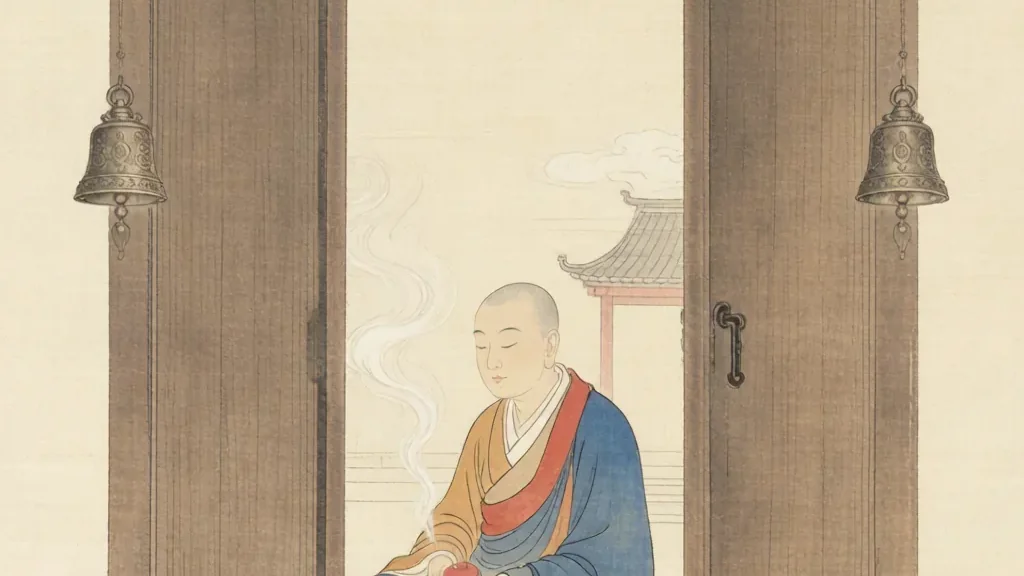
Behind closed temple doors, amid the scent of incense and the ring of vajra bells, a monk whispers a secret mantra, visualizes himself as a fearsome yet compassionate deity, and traces mystic hand gestures in the air. This is 密宗 (Mì Zōng), the Esoteric or "Secret" school of Buddhism, known in Sanskrit as Vajrayana. Arriving in China from India and the Himalayan borderlands during the Tang dynasty, Esoteric Buddhism offered a swift, ritual-rich path to awakening built on initiation, sacred sound, and the transformation of body, speech, and mind. Though its Chinese line largely faded, it seeded the tantric traditions of Tibet and Japan. This article uncovers what made the "thunderbolt vehicle" so powerful and so carefully guarded.
Arrival in Tang China and the Zhenyan Lineage
Esoteric Buddhism entered China through a series of remarkable missionary monks. The most important was Śubhakarasiṃha, who arrived in Chang'an in 716 and translated the foundational Mahavairocana Sutra; Vajrabodhi, who brought the Vajrasekhara teachings; and his pupil Amoghavajra, perhaps the most influential of all, who served several Tang emperors and built a vast translation and ritual enterprise. Their lineage is called Zhenyan, the "True Word" school, the Chinese form of Mantrayana.
Unlike the philosophical schools, Zhenyan depended on direct master-to-disciple transmission. A student could not simply read a text; the meaning of the mantras, the construction of mandalas, and the correct postures had to be conferred in person by an authorized teacher through an initiation ceremony called abhiṣeka, the "sprinkling" of consecrated water. This requirement of esoteric empowerment is what earned the school its name as the "secret" teaching, reserved for those who had taken the vow and received the rites.
Mandalas, Mantras, and Mudras
The three core instruments of Esoteric practice are often called the "three mysteries" of body, speech, and mind. The body is aligned through mudras, the symbolic hand gestures that embody the presence of a buddha or the performance of a rite. Speech is sanctified through mantras, the sacred syllables whose vibration is believed to carry the actual energy of enlightenment; the best known is the syllable "om," along with seed syllables such as "hum" and "ah." Mind is focused through the contemplation of mandalas, the geometric maps of the buddha-realm.
The twin mandalas of Esoteric Buddhism are the Womb Realm (Garbhadhatu) and the Diamond Realm (Vajradhatu), representing wisdom and compassion, the phenomenal and the absolute. By visualizing oneself seated within these sacred diagrams and identifying with the central deity Mahavairocana, the "Great Sun Buddha," the practitioner dissolves the false separation between ordinary self and enlightened cosmos. Sound, gesture, and image thus become vehicles not merely of devotion but of ontological transformation.
Deities and the Role of the Guru
Esoteric Buddhism populates its world with a rich pantheon of peaceful and wrathful deities, each a personification of a particular wisdom or power. Central is Mahavairocana, the illuminating Buddha of the cosmos; around him stand the "Five Wisdom Buddhas" and countless bodhisattvas, guardian kings, and dharma protectors. Wrathful forms such as Yamantaka or the fierce protectors are not demons but compassionate energies that shatter ignorance and fear.
The indispensable human link in this chain is the guru, the tantric master who holds the living transmission. The disciple surrenders to the teacher's guidance, receives the empowerments, and is instructed in a personal deity (yidam) practice suited to his or her temperament. This close, hierarchical relationship, guarded by vows of secrecy, distinguished Esoteric Buddhism from the more open, scripture-based schools and helped preserve its methods intact across centuries and cultures.
Why the Chinese Line Declined
The Chinese Zhenyan school reached its height under Amoghavajra in the mid-eighth century, enjoying imperial patronage and even participation in state rites for protection and rain. Yet its fortunes reversed with the Great Anti-Buddhist Persecution of 845 under Emperor Wuzong, which destroyed monasteries and dispersed the ordained clergy. Because Esoteric practice depended on unbroken lineages and physical ritual objects held in temples, the loss of institutions dealt it a near-fatal blow in the heartland.
Surviving elements were absorbed into other Chinese schools: mantras such as the "Great Compassion Mantra" (大悲咒, Dàbēi zhòu) of Avalokiteshvara and the "Shurangama Mantra" entered the daily liturgy of nearly every Chan and Pure Land monastery. The esoteric flavor of popular practice—protective charms, hungry-ghost rites, and the veneration of fierce protectors—never disappeared from Chinese folk Buddhism. But as a separate, initiated order, Zhenyan largely vanished from the mainland even as it flourished elsewhere.
Legacy in Tibet and Japan
The most extraordinary offspring of Esoteric Buddhism are the Tibetan traditions. Tantric teachings transmitted from India to Tibet from the eighth century onward grew into the rich Vajrayana of the four major schools—Nyingma, Kagyu, Sakya, and Gelug—preserving the full apparatus of mandala, mantra, and initiation that China had lost. The Dalai Lamas' lineage descends from this tantric stream, and the elaborate rituals of Tibetan Buddhism are direct cousins of Tang-dynasty Zhenyan.
In Japan, Esoteric Buddhism survived spectacularly as Shingon, founded by Kukai (Kobo Daishi), who studied in China in the early ninth century and brought the Zhenyan teachings home. Shingon remains a major Japanese school centered on Mount Koya, with its two-mandala cosmology and elaborate rites intact. Thus the "secret" school, though brief in its Chinese heyday, became one of Buddhism's most far-reaching branches, carrying the thunderbolt vehicle from the Tang capital to the roofs of the Himalayas and the cedars of Koyasan.
The Abhisheka Initiation
Central to Esoteric Buddhism is abhisheka, the initiation rite that opens access to a tantric practice. The word means sprinkling, referring to the consecrated water poured over the disciple's head by the guru, symbolizing purification and the planting of buddhahood. Without this empowerment, the texts taught, a practitioner could not rightly visualize a deity or recite its mantra, for the living transmission was held to be more important than any written scripture. The ceremony bound master and disciple in a solemn relationship of vow and secrecy, and it graded the student through successive levels of teaching. This requirement of personal transmission is exactly what made the school esoteric and, in the end, what made its Chinese line so vulnerable: when temples fell in the 845 persecution, the unbroken lineages could not survive the loss of their holders.
Seed Syllables and the Sound of Reality
Esoteric practice treats sound as a vehicle of realization, not merely a symbol. Each deity is linked to a seed syllable, a single sacred sound such as hum or ah that is understood to embody the very energy of enlightenment. When a practitioner repeats a mantra, the teaching holds, the vibration aligns body, speech, and mind with the buddha being, dissolving the ordinary sense of a separate self. The famous syllable om opens many rituals as the sound of primordial unity, while longer dharani strings were chanted for protection, healing, and the welfare of the dead. This confidence in the creative power of sound connects Esoteric Buddhism to older Indian ideas about the efficacy of the spoken word, and it explains why mantra recitation remained one of its most durable gifts to Chinese popular Buddhism.
Esoteric Ritual in Daily Temple Life
Although the Chinese Esoteric order faded as a separate school, its rituals quietly entered the routine of ordinary temples. The Great Compassion Mantra and the Shurangama Mantra became fixed parts of daily and monthly liturgies, chanted for protection and purification. Monks performed homa fire offerings and hungry-ghost rites drawn from tantric sources, and fierce protector deities found places on altar walls beside gentle bodhisattvas. Lay people adopted the use of mantras and the wearing of esoteric amulets for safety and healing. In this sense Esoteric Buddhism did not disappear so much as dissolve into the broader stream of Chinese Buddhism, where its flavor of sound, image, and empowerment still seasons the practice of millions who may never have heard the name Zhenyan.
❓ Frequently Asked Questions
📝 Chinese Vocabulary
密宗 — : The Esoteric or "Secret" school of Buddhism.
真言 — : True Word, the Chinese name for Mantrayana.
曼荼罗 — : Mandala, the sacred cosmic diagram.
手印 — : Mudra, the ritual hand gesture.
大日如来 — : Mahavairocana, the Great Sun Buddha.
阿阇梨 — : The acharya, the tantric guru who confers initiation and transmits the rites.
金刚杵 — : The vajra thunderbolt, a ritual scepter symbolizing indestructible enlightenment.
胎藏界 — : The Womb Realm mandala, one of the two great Esoteric cosmograms representing compassion.
🎉 Fun Facts
- Amoghavajra was so trusted by the Tang court that he was granted noble titles and allowed to perform state rituals for rain and protection.
- The "Great Compassion Mantra" of Avalokiteshvara, of Indian Esoteric origin, is still chanted daily in Chinese temples.
- Shingon's central monastery on Mount Koya, founded by Kukai, has been continuously active for over twelve hundred years.
- The vajra, a ritual thunderbolt scepter, symbolizes the indivisible and indestructible nature of enlightened wisdom.
- The Esoteric fire ritual offered burned offerings to deities for protection and prosperity, a practice still performed at major Tibetan and Japanese temples.
- Kukai, founder of Japanese Shingon, is also revered as a master of calligraphy and is said to have brought the secrets of writing as well as of mantra from China.