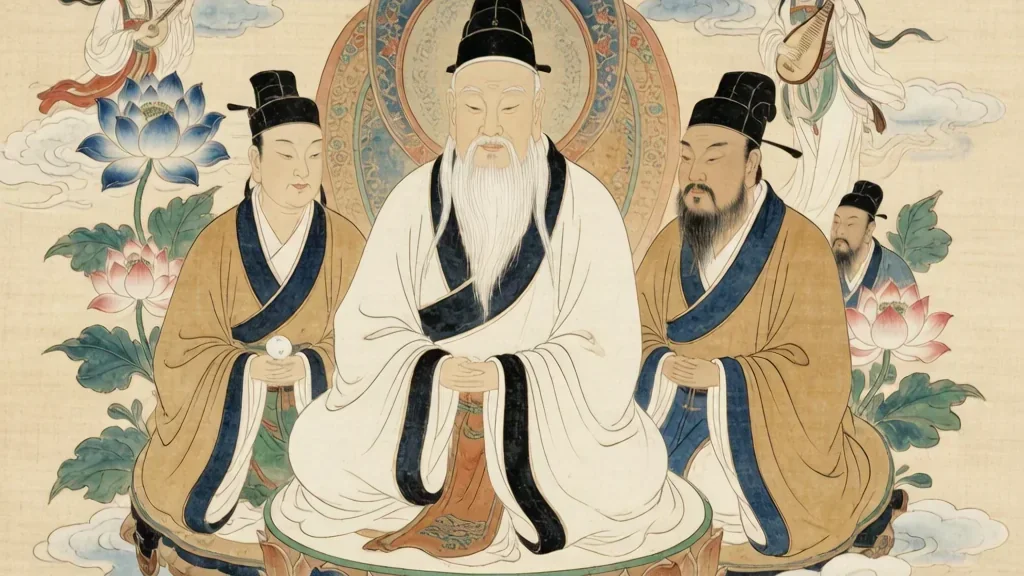
At the summit of the Daoist cosmos sit three venerable figures, enthroned in the highest heavens, who together preside over the origin, the formation, and the revelation of all things. They are 三清 (Sān Qīng), the Three Pure Ones, the supreme deities of organized Daoism. More than mere gods, they are the three primordial manifestations of the Dao itself, the ultimate reality behind the universe. To understand the Three Pure Ones is to understand how Daoism envisioned the structure of heaven and the source of its scriptures. This article introduces these majestic figures and the celestial world they govern.
The Meaning of "Three Pure Ones"
The Chinese term 三清 literally means "Three Purities" or "Three Clarities," referring both to the three highest heavenly realms and to the three supreme gods who dwell there. In Daoist theology the Dao, being formless and ineffable, unfolds into three distinguishable yet inseparable aspects, each associated with a stage in the cosmic process and a heaven of its own. The three are usually named the Celestial Worthy of the Primordial Beginning, the Celestial Worthy of the Numinous Treasure, and the Celestial Worthy of the Dao and Its Power.
These three are not separate creators in competition but three expressions of one undifferentiated source, much as light, warmth, and radiance might be distinguished within a single sun. The doctrine reflects the Daoist conviction that the ultimate is both transcendent and immanent, both beyond description and present in the ordered workings of the world. In temple halls, the Three Pure Ones are typically enshrined together on the highest altar, centrally and above all other deities, marking their status as the apex of the Daoist pantheon.
The Jade Purity: Yuanshi Tianzun
The first of the three is 元始天尊 (Yuánshǐ Tiānzūn), the Celestial Worthy of the Primordial Beginning, who dwells in the heaven of Jade Purity (玉清, Yùqīng). He represents the first stirring of the Dao out of undifferentiated chaos, the seed from which all worlds emanate. Often depicted as a serene figure holding a precious jewel or the sun and moon, he is honored as the source of the first revelation and the lord of the highest heaven.
Yuanshi Tianzun is particularly associated with the " scriptures of the primordial beginning," the heavenly texts said to exist before the world and to be revealed in later ages for the salvation of beings. In Daoist cosmology he sits at the center of the Jade Purity heaven, surrounded by hosts of celestial beings. Devotees address him when seeking the fundamental blessing of existence itself and the opening of the spiritual path, for he embodies the uncreated source prior to all names and forms.
The Highest Purity: Lingbao Tianzun
The second figure is 灵宝天尊 (Língbǎo Tiānzūn), the Celestial Worthy of the Numinous Treasure, enthroned in the heaven of Highest Purity (上清, Shàngqīng). He embodies the Dao as it begins to take form and differentiation, the treasure of spiritual potency through which the cosmos is ordered and living things receive their vital breath. He is often shown holding a feather fan or the "gem of the numinous treasure," and he presides over the transmission of the Lingbao scriptures.
The Lingbao revelation, which flourished in the fourth and fifth centuries, greatly expanded Daoist ritual with elaborate ceremonies for cosmic renewal, salvation of the dead, and the communal offering of liturgy. Lingbao Tianzun thus stands for the Dao in its active, beautifying, and restorative mode—the power that fills the world with sacred presence and makes the liturgy effective. He bridges the silent origin of Yuanshi and the teaching mission of Daode Tianzun.
The Supreme Purity: Daode Tianzun
The third is 道德天尊 (Dàodé Tiānzūn), the Celestial Worthy of the Dao and Its Power, who resides in the heaven of Supreme Purity (太清, Tàiqīng) and is widely identified with 太上老君 (Tài Shàng Lǎo Jūn), the deified Laozi. He represents the Dao made accessible through teaching, the compassionate descent of the supreme reality into human history to deliver the Dao De Jing and guide humanity. Of the three, he is the most personal and the most active in the world.
Because Daode Tianzun is linked to Laozi, the legendary author of the Dao De Jing, he carries a special role as the teacher of humanity and the patron of Daoist priests. He is usually portrayed as an aged sage with a long white beard, riding a water buffalo or holding a scroll. While the other two Pure Ones remain in distant majesty, Daode Tianzun repeatedly appears in legend to teach emperors, reveal scriptures, and protect the faithful, making the abstract Dao tangible as a living master.
The Three Pure Ones in Daoist Worship
In the daily and festival life of Daoism, the Three Pure Ones receive the deepest reverence. The morning liturgy opens by invoking the three heavens; major rites such as the "Grand Offering" (大醮, dà jiào) are performed expressly to honor them and seek cosmic harmony. Daoist priests wear robes and perform mudra-like hand gestures that correspond to the three, and the highest consecration is understood as a return of the devotee's spirit to the purity of the three heavens.
The theology of the Three Pure Ones also shaped Daoist art and architecture. The top tier of a Daoist altar, the central niche of a grotto temple, and the upper storeys of a multi-level shrine are reserved for them. Their triad mirrors the Buddhist Three Jewels and reflects a broader East Asian love of triads, yet it remains distinctly Daoist in teaching that the many gods and the whole universe flow forth from a single ineffable source. In honoring the Three Pure Ones, the believer honors the Dao in its most exalted and most merciful aspects.
The Scriptures of the Three Heavens
Each of the Three Pure Ones is linked to a body of revealed scripture. Yuanshi Tianzun presides over the primordial texts said to exist before the world, the heavenly writings from which all doctrine flows. Lingbao Tianzun is the patron of the Lingbao scriptures, the elaborate liturgies of cosmic renewal and salvation that expanded Daoist ritual in the fourth and fifth centuries. Daode Tianzun is credited with delivering the Dao De Jing and the many later texts associated with the deified Laozi. Together these corpora map the Dao's self-disclosure, from silent origin, through formative potency, to teachable word. Devotees therefore approach the three not only as gods to honor but as sources of the books that structure Daoist practice, study, and ceremony.
The Three Pure Ones in Daoist Art
In painting and sculpture the Three Pure Ones are rendered as serene, richly robed celestial worthies, usually seated and crowned, set on the uppermost tier of an altar or the central niche of a grotto. Artists distinguish them by their emblems and by subtle differences of posture and halo: Yuanshi often holds a jewel, Lingbao a feather fan, and Daode the scroll of the Dao De Jing or a peach of immortality. Their placement above the Jade Emperor and the other gods visually teaches the hierarchy of heaven. The triad also answers the Buddhist Three Jewels, offering a distinctly Daoist counterpart in form as well as meaning. From cliff temples to imperial altars, the image of the three enthroned figures became the standard icon of high Daoist worship across China.
Emanation and the One Dao
The Three Pure Ones express a central Daoist insight: the many gods are not separate powers but unfoldments of a single reality. The Dao, formless and beyond name, is said to emanate as Yuanshi, the first stirring; then as Lingbao, the power that gives form and orders the world; and finally as Daode, the teaching that enters human history. This is likened to one light dividing into three hues, or a single source flowing into three streams. The doctrine reassures the believer that the crowded Daoist pantheon is not chaos but a family of manifestations of the ineffable, and that to venerate any god is ultimately to honor the Dao. In this way the Three Pure Ones reconcile polytheism with the mystic unity at the heart of Daoism.
❓ Frequently Asked Questions
📝 Chinese Vocabulary
三清 — : The Three Pure Ones, supreme Daoist deities.
元始天尊 — : The Celestial Worthy of the Primordial Beginning.
灵宝天尊 — : The Celestial Worthy of the Numinous Treasure.
道德天尊 — : The Celestial Worthy of the Dao and Its Power (deified Laozi).
玉清 — : Jade Purity, the highest of the three heavens.
上清 — : The Highest Purity heaven where Lingbao Tianzun dwells.
太清 — : The Supreme Purity heaven of Daode Tianzun.
大罗天 — : The formless highest heaven that encloses the three purity realms.
🎉 Fun Facts
- The Three Pure Ones are usually depicted on the highest altar, above even the Jade Emperor, reflecting their status as the source of all gods.
- Yuanshi Tianzun is said to have revealed the first scriptures from within a cloud of primordial vapor before the world began.
- The "three purity" heavens parallel the Daoist ideal of returning the spirit to its original undifferentiated source.
- Daode Tianzun's identification with Laozi made him the only one of the three to walk visibly among humans in legend.
- The three figures are often shown each holding a different emblem, a jewel, a feather fan, and a scroll, allowing worshippers to tell them apart at a glance.
- In Daoist cosmic myth the Three Pure Ones emanate in sequence, like light dividing into colors, an image used to explain how one Dao becomes many gods.