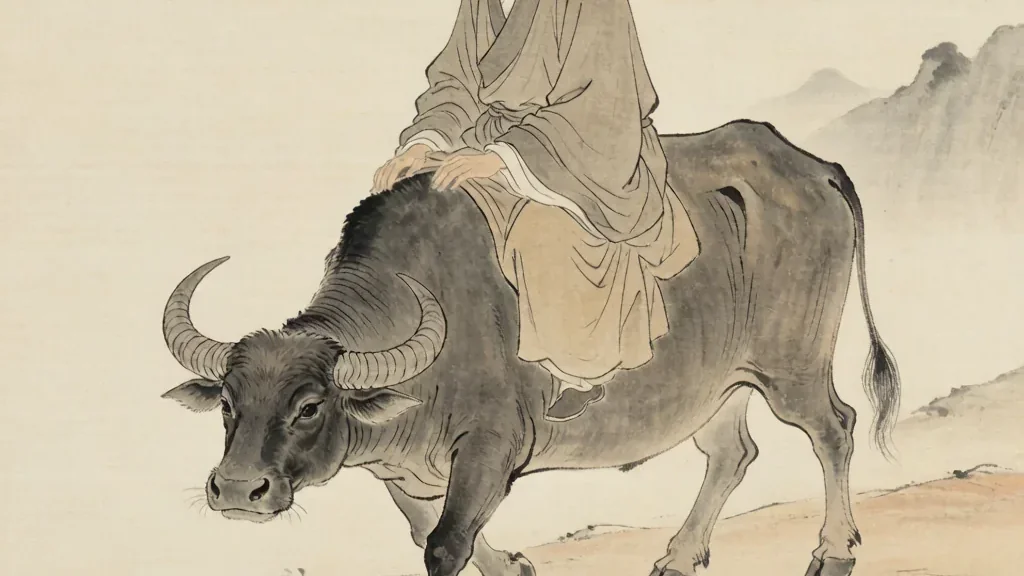
Long before he became a god, he was a man who rode a water buffalo westward through a mountain pass and dictated a slim book of five thousand characters that would shape Chinese thought for two millennia. That man was Laozi, and as 太上老君 (Tài Shàng Lǎo Jūn), the "Supreme Old Lord," he became one of the most revered deities of Daoism. The bridge from humble philosopher to supreme celestial worthy reveals how Daoism turned its founding wisdom into living worship. This article follows the extraordinary transformation of Laozi into Tai Shang Lao Jun, the teacher of emperors and the patron of every Daoist priest.
From the Historical Laozi to a Legendary Sage
The historical Laozi, whose name means "Old Master," is traditionally dated to the sixth century BCE and credited as the author of the Dao De Jing (道德经), the foundational text of Daoist philosophy. Sima Qian's Records of the Grand Historian describes him as a keeper of archives in the Zhou court who, disillusioned with the dynasty's decline, departed westward; at the Hangu Pass the guard asked him to record his teachings, and he produced the Dao De Jing before vanishing into the west.
Almost immediately, legend began to accumulate around him. Tales told of his birth from a shooting star, of his ability to transform his body, and of his appearances across centuries under different names to teach humanity. By the Han dynasty, Laozi was already being worshipped as an immortal, and a cult centered on him grew among those seeking longevity and divine protection. The line between the philosopher and the god blurred, preparing the way for his full deification.
Deification as Tai Shang Lao Jun
During the later Han and especially under the Tang dynasty, Laozi's elevation accelerated dramatically. The Tang imperial house claimed descent from him, and Emperor Gaozu and his successors promoted his cult as a state religion, building grand temples and conferring ever-grander titles. He was honored as 太上老君 (Tài Shàng Lǎo Jūn), often translated "Most High Old Lord" or "Supreme Venerable Sovereign," a name that signals both supreme authority and venerable age.
In developed Daoist theology, Tai Shang Lao Jun is identified with Daode Tianzun, the third of the Three Pure Ones, the manifestation of the Dao that descends to teach. He thus stands at the very apex of the pantheon as one of the three supreme beings, yet uniquely among them he is the one who walks among humans, reveals scriptures, and answers prayers. This dual identity—philosopher-sage and celestial worthy—makes him the most approachable face of the high Daoist gods.
Role as the Teacher and Revealer
Tai Shang Lao Jun's defining activity is teaching. Scriptures recount that he repeatedly descended to earth to deliver revealed texts and correct the age. Most famous is the legend of the "transformation of Laozi into the Buddha," a later polemical tale in which he is said to have traveled west and taught among the barbarians, a story reflecting the competitive dialogue between Daoism and Buddhism in medieval China.
More central to worship is his role as the source of Daoist scripture and priestly authority. Daoist ordination rites often invoke him as the original master who transmitted the celestial registers and talismans to humanity. He is the patron of internal alchemy (内丹, nèidān), the subtle discipline of cultivating the body's energies toward immortality, and of the liturgical tradition itself. To be a Daoist priest is, in a sense, to be a junior heir of the teachings Lao Jun first set down at the Hangu Pass.
Iconography and Worship
In art, Tai Shang Lao Jun is almost always shown as a gentle, white-bearded elder, sometimes riding a green water buffalo, sometimes seated and holding the Dao De Jing or a peach of immortality. He may wear the crown of a celestial worthy and sit upon a lotus or cloud throne when depicted among the Three Pure Ones. His long eyebrows and calm smile convey wisdom undisturbed by the world's turmoil.
Devotees honor him with incense, the chanting of the Dao De Jing, and rites seeking health, longevity, and protection. His birthday, observed on the fifteenth day of the second lunar month, is celebrated in many Daoist temples with special ceremonies. Because he embodies the Dao made teachable, common people have long turned to him not only for blessing but for practical guidance, copying his sayings on scrolls and invoking his name in times of trouble.
Tai Shang Lao Jun in Popular Culture
Beyond the altar, Tai Shang Lao Jun enjoys a vivid afterlife in Chinese folklore and fiction. In the great novel Journey to the West, he appears as a somewhat befuddled but powerful celestial who keeps the elixir of immortality in his furnace—the very furnace whose flames forge the invulnerable body of the Monkey King. His alchemical laboratory, with its cauldrons and golden pills, became a stock image of Daoist magic in literature and opera.
This playful popular image sits comfortably beside his solemn liturgical role, showing how thoroughly Lao Jun permeates Chinese culture at every level, from the philosophical to the fantastical. Whether quoted for his wisdom about yielding like water, petitioned for a long life, or conjured in a novel's comedy, Tai Shang Lao Jun remains the enduring human face of the Dao: ancient, compassionate, and tirelessly teaching the way back to harmony.
Laozi in the Dao De Jing
The Dao De Jing attributed to Laozi is one of the shortest yet most influential books in world philosophy, a work of about five thousand characters built from paradox and image. It teaches that the Dao is the nameless source of all things and that the wise ruler and person act through non-action, yielding like water and remaining humble. Its famous lines, such as the soft overcomes the hard, shaped not only Daoism but Chinese statecraft, medicine, and art for two millennia. Whether or not the historical Laozi wrote every line, the text became his voice, and the deified Tai Shang Lao Jun is honored precisely as the one who first set this teaching down. To read the Dao De Jing is, in Daoist eyes, to hear Lao Jun speaking across the ages.
Lao Jun and the Art of Alchemy
Tai Shang Lao Jun is the patron of alchemy, the craft of refining the elixir of immortality. In legend his furnace produces golden pills that grant invulnerability and long life, and in Journey to the West the Monkey King gains his fiery eyes there by accident. Behind the folklore lies a real tradition: outer alchemy sought physical elixirs from minerals and herbs, while inner alchemy, which Lao Jun also oversees, cultivated the body's breath and spirit toward transformation. Lao Jun's cauldron thus became the supreme symbol of refinement, the place where base human nature is purged and turned to gold. Even today Daoist priests invoke him at the opening of alchemical and meditation rites, asking the Old Lord to bless the work of turning the lead of ordinary life into the gold of the spirit.
Lao Jun in Temple Liturgy
In living Daoist worship Tai Shang Lao Jun receives daily homage as the revealer of the scriptures and the original master of the priesthood. Morning and evening rites open with homage to the Three Pure Ones, among whom he sits as Daode Tianzun, and priests recite the Dao De Jing as a core liturgical act. His birthday on the fifteenth of the second lunar month is kept with special ceremonies, offerings of incense, and the chanting of his titles. Ordination rituals invoke him as the source of the celestial registers and talismans granted to new clergy, so that every Daoist priest stands in his lineage. For ordinary devotees he is the most approachable of the high gods, the gentle old master one can petition for health and guidance, copying his sayings in times of trouble.
❓ Frequently Asked Questions
📝 Chinese Vocabulary
太上老君 — : The Supreme Old Lord, deified Laozi.
老子 — : Laozi, the "Old Master," philosopher author of the Dao De Jing.
道德经 — : The Classic of the Way and Its Power.
内丹 — : Internal alchemy, the energy-cultivation path he patronizes.
道德天尊 — : The Celestial Worthy of the Dao and Its Power (his Pure One identity).
函谷关 — : The Hangu Pass where Laozi is said to have dictated the Dao De Jing before vanishing west.
炼丹 — : Alchemy, the craft of refining elixirs of immortality associated with Lao Jun.
青牛 — : The green water buffalo that Tai Shang Lao Jun rides as a gentle emblem of his teaching.
🎉 Fun Facts
- The Tang emperors claimed Laozi as their ancestor and made Daoism a state-preferred religion over Buddhism for a time.
- In Journey to the West, the Monkey King's fiery golden eyes come from Lao Jun's alchemy furnace.
- Laozi's legendary departure through the Hangu Pass is one of the most painted scenes in Chinese art.
- His birthday is celebrated on the fifteenth day of the second lunar month in many Daoist temples.
- Laozi is credited in legend with fathering several branches of Chinese boxing and breathing arts, a reason some martial schools honor him as a patron.
- In folk talisman practice, the Lao Jun decree formula is written on protective charms, invoking his authority to dispel illness and misfortune.