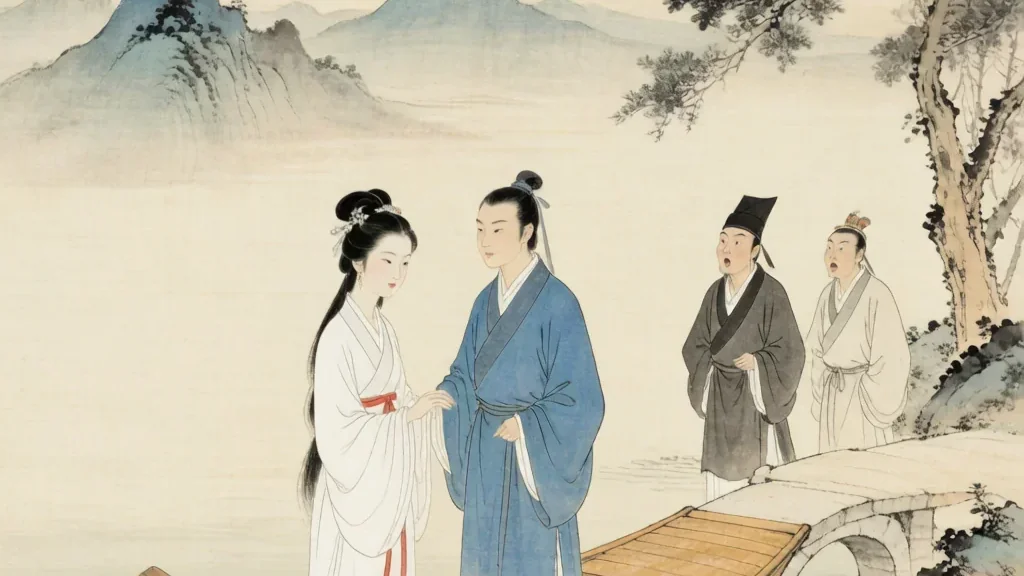
Among all the stories in Chinese folklore, few have captured hearts across centuries and continents quite like the Legend of the White Snake. Recognized as one of China's "Four Great Folktales" alongside The Butterfly Lovers, The Cowherd and the Weaver Girl, and Lady Meng Jiang, this sweeping tale of forbidden love between a snake spirit and a mortal man has inspired countless operas, films, television dramas, and works of art. It is a story about love that transcends the boundaries between species, between heaven and earth, and ultimately between life and death itself.
The Legend of the White Snake (白蛇传) originated during the Tang Dynasty over a thousand years ago, but the version most widely known today crystallized during the Ming Dynasty. What makes this story so enduring is its complexity — it refuses to present a simple battle between good and evil. Instead, it asks profound questions about the nature of love, the meaning of humanity, and whether the laws of heaven should bend before the power of a devoted heart.
The White Snake's Origin
Long ago, a small white snake lived in the mountains, cultivating her spiritual energy through centuries of meditation and virtuous living. In the world of Chinese mythology, animals can achieve spiritual awakening and even immortality through dedicated practice — a concept rooted in both Daoist and Buddhist traditions. After a thousand years of cultivation, the white snake had accumulated enough spiritual power to take human form. She chose the name Bai Suzhen (白素贞) — "Bai" meaning white, and "Suzhen" suggesting purity and truth.
Bai Suzhen was not alone in her journey. She had a companion — a green snake spirit named Xiao Qing (小青), who had also cultivated for centuries and could transform into a young woman. Xiao Qing became Bai Suzhen's devoted sister and confidante, loyal to the point of risking her own existence for Bai Suzhen's happiness. Together, the two snake sisters descended from their mountain home to explore the human world, their curiosity about mortal life burning bright after centuries of isolation.
They arrived in the beautiful city of Hangzhou, with its famous West Lake and misty hills. It was there, by the shores of the lake on a rainy spring day during the Qingming Festival, that Bai Suzhen's fate would be sealed forever.
A Fateful Meeting at West Lake
The rain came suddenly, as spring rains often do in Hangzhou. Bai Suzhen and Xiao Qing took shelter under a willow tree by the Broken Bridge, a famous landmark on West Lake. As they waited for the rain to pass, a young man approached — Xu Xian, a kind-hearted but poor apprentice at a local medicine shop. He was carrying an umbrella, and when he saw the two women stranded in the rain, he offered to share it with them.
It was a simple act of kindness, but for Bai Suzhen, it was transformative. She had observed humans for centuries, but she had never experienced such gentle, unassuming goodness directed at herself. Xu Xian was not rich or powerful or exceptionally handsome — he was simply good, in a way that was rare and precious. Bai Suzhen fell in love with him in that moment, under the shared umbrella in the spring rain.
With Xiao Qing's help, Bai Suzhen arranged to meet Xu Xian again. Their romance blossomed quickly and naturally. Bai Suzhen was beautiful, intelligent, and elegant; Xu Xian was sincere, hardworking, and utterly captivated. Before long, they were married, and Bai Suzhen used her supernatural abilities to help her new husband open his own medicine shop. She would secretly prepare remedies using her spiritual powers, and the shop quickly gained a reputation for curing even the most stubborn illnesses. The couple was happy, prosperous, and deeply in love.
But in Chinese folklore, happiness that defies the natural order cannot last unchallenged. Heaven was watching.
The Monk Fahai Arrives
Fahai was a powerful Buddhist monk from Jinshan Temple, a man of formidable spiritual power and rigid conviction. To him, the universe was governed by immutable laws — humans belonged in the human realm, spirits belonged in the spirit realm, and any mixing of the two was an abomination. When he learned that a snake spirit had married a mortal man and was living as his wife, he saw it not as a love story but as a violation of cosmic order that had to be corrected.
Fahai approached Xu Xian and revealed the truth about his wife. At first, Xu Xian refused to believe it. How could Bai Suzhen — gentle, loving, devoted Bai Suzhen — be anything other than the woman she appeared to be? But Fahai was persistent and persuasive. He told Xu Xian to serve his wife realgar wine during the Dragon Boat Festival, a drink that would force any spirit to reveal its true form.
Xu Xian, torn between love and doubt, followed the monk's instructions. Bai Suzhen, despite knowing the danger, drank the wine to please her husband. The effect was immediate and terrible — she transformed into a massive white serpent, her true form revealed. Xu Xian, seeing his beloved wife as a giant snake, died of shock on the spot.
Bai Suzhen's grief was immeasurable, but her love was stronger. She embarked on a desperate journey to Mount Emei, where she risked her very existence to steal a magical herb guarded by celestial warriors. The herb could restore life to the dead. She succeeded, though at great personal cost, and brought Xu Xian back to life. When he awoke, she had returned to her human form, and she begged him to look past what he had seen and trust in her love.
Xu Xian, to his credit, chose love over fear. He accepted Bai Suzhen for who she truly was — not despite her serpent nature, but because he had seen the lengths she would go to for him. Their marriage survived this first test, and for a time, they found happiness again.
The Flood at Jinshan Temple
But Fahai was not finished. Seeing that Xu Xian had not been turned against his wife, the monk took more drastic measures. He captured Xu Xian and imprisoned him within Jinshan Temple, refusing to release him until he renounced his demon wife. Xu Xian, terrified and confused, could not bring himself to do so — but neither could he escape.
Bai Suzhen and Xiao Qing arrived at Jinshan Temple to demand Xu Xian's release. Fahai refused. What happened next is one of the most dramatic scenes in all of Chinese folklore. Bai Suzhen, her love and desperation overcoming all restraint, summoned the waters of the great river to flood Jinshan Temple. Waves crashed against the temple walls as she and Xiao Qing fought Fahai and his warrior monks in a supernatural battle of epic proportions.
The flood caused terrible destruction, drowning innocent people in the surrounding villages. This is a crucial moral turning point in the story — Bai Suzhen's love, pure though it was, had led her to commit acts that caused immense suffering. Fahai, for all his rigidity and cruelty, was not entirely wrong to oppose her. The story refuses to give us easy answers about who is right and who is wrong.
In the end, Bai Suzhen was defeated. Her spiritual powers, though formidable, were no match for Fahai's Buddhist magic and the divine forces he could command. She was captured and imprisoned beneath Leifeng Pagoda, a stone tower on the shores of West Lake — the very place where her love story had begun. Xiao Qing escaped and fled back to the mountains to continue her cultivation, vowing to return one day and free her sister.
Redemption and Reunion
For years, Bai Suzhen languished beneath Leifeng Pagoda. Xu Xian, grief-stricken and guilt-ridden, became a monk himself, spending his remaining years in prayer and repentance. But Xiao Qing kept her promise. After centuries of intensive cultivation, she returned more powerful than ever before. She confronted Fahai, defeated him in battle, and shattered Leifeng Pagoda, freeing Bai Suzhen at last.
By this time, Bai Suzhen's son — born before her imprisonment — had grown up and become a distinguished scholar, having passed the imperial examinations with the highest honors. Mother and son were reunited in a scene of overwhelming emotion. Bai Suzhen, having atoned for the suffering caused by the flood and proven the purity of her heart through years of patient endurance, was finally recognized by heaven. She was granted true immortality and ascended as a goddess, her love having been tested and found worthy.
In some versions of the tale, she is reunited with Xu Xian in the celestial realms. In others, she finds peace in her divine status, watching over her descendants from above. In all versions, her story stands as a testament to the power of love that refuses to be defined or confined by the rules of gods or men.
Why This Story Endures
The Legend of the White Snake has remained popular for over a thousand years because it refuses to be simple. Fahai is not a cartoon villain — he genuinely believes he is protecting the natural order and saving Xu Xian's soul. Bai Suzhen is not a perfect heroine — her love leads her to destructive actions that harm innocents. Xu Xian is not a classic hero — he is an ordinary man caught in extraordinary circumstances, sometimes weak, sometimes brave, always human.
This moral complexity makes the story feel modern even today. It asks whether love justifies any action taken in its name. It questions whether divine law should be absolute or whether mercy can sometimes transcend rules. It explores what it truly means to be "human" — and suggests that a snake spirit who loves deeply and sacrifices willingly may be more human than many who walk on two legs.
The imagery of the story is also deeply embedded in Chinese culture. West Lake in Hangzhou remains one of China's most romantic destinations, and the Broken Bridge where Bai Suzhen and Xu Xian first met is a pilgrimage site for lovers. Leifeng Pagoda, rebuilt in 2002 after the original collapsed in 1924, stands as a monument to the enduring power of this tale. Every Chinese person knows this story, and each generation finds new meaning in it.
The Legend in Chinese Opera
The Legend of the White Snake has been one of the most performed stories on the Chinese stage for centuries, surviving in many regional operatic forms. In Yue opera, Kunqu, and Peking opera the tale is staged as a multi-act drama, with the meeting at the Broken Bridge and the flooding of Jinshan Temple as the emotional peaks. Performers use stylized movement, flowing sleeves, and acrobatic combat to show the struggle between Bai Suzhen's magic and Fahai's monks. Because the story blends romance, fantasy, and moral ambiguity, it gives actors rich room for expression, especially in the roles of the devoted Bai Suzhen and the rigid Fahai. Modern productions continue to reinterpret the opera, sometimes shifting sympathy toward Fahai or toward Xiao Qing. Through the stage the legend reaches audiences who may never read the written tale, keeping its music, gestures, and themes alive as a living performing art.
West Lake as a Shrine to Love
West Lake in Hangzhou is more than the setting of the White Snake story; it has become a real place of memory where fiction and landscape blend. The Broken Bridge, where Bai Suzhen and Xu Xian shared an umbrella in the spring rain, is today one of the lake's most visited spots, crowded with couples. Nearby Leifeng Pagoda, rebuilt in 2002 on the site where Bai Suzhen was imprisoned, draws visitors who associate it with the lovers' endurance. Local boatmen, guides, and teahouses retell the story to tourists, and the surrounding gardens are planted and named to evoke the tale. In this way the myth has shaped how a city presents itself and how people experience it, turning a body of water into a cultural shrine to love that ordinary visitors can walk through.
❓ Frequently Asked Questions
📝 Chinese Vocabulary
白蛇传 — : "Legend of the White Snake" — one of China's Four Great Folktales.
白素贞 — : The white snake spirit who takes human form; the heroine of the story.
许仙 — : The mortal man who marries Bai Suzhen; a kind-hearted medicine shop apprentice.
法海 — : The powerful Buddhist monk who opposes Bai Suzhen and Xu Xian's marriage.
雷峰塔 — : Leifeng Pagoda, the tower on West Lake where Bai Suzhen was imprisoned.
小青 — : Xiao Qing, the green snake spirit and loyal companion of Bai Suzhen in the Legend of the White Snake.
断桥 — : The Broken Bridge on Hangzhou's West Lake, where Bai Suzhen and Xu Xian first met in the spring rain.
金山寺 — : Jinshan Temple, the monastery of the monk Fahai where Xu Xian was imprisoned and the great flood was fought.
🎉 Fun Facts
- The original Leifeng Pagoda collapsed in 1924, and many people rushed to collect bricks from the ruins, believing they contained Bai Suzhen's spiritual energy. The pagoda was rebuilt in 2002 and now includes an elevator.
- The story has been adapted into over 20 films and television series, including the 1992 classic "New Legend of Madame White Snake," which is still beloved by audiences across Asia.
- During the Dragon Boat Festival, it is traditional to drink realgar wine — the very substance that revealed Bai Suzhen's true form — as protection against snakes, insects, and evil spirits.
- The story is a staple of Chinese opera, especially Yue opera and Peking opera, where the flooding of Jinshan Temple is a highlight performed with elaborate water and combat choreography.
- Hangzhou's West Lake and the Broken Bridge remain a favorite spot for couples, who visit the places tied to the legend as a kind of romantic pilgrimage.
- In some regional operatic endings, Bai Suzhen is fully reunited with Xu Xian in the human world rather than ascending as a goddess, giving the tale a happy mortal resolution.
💞 Check Your Compatibility
Just as Bai Suzhen and Xu Xian defied the odds, your own love story might be written in the stars. Use our Chinese Zodiac Compatibility tool to discover your romantic destiny.
Check Compatibility →