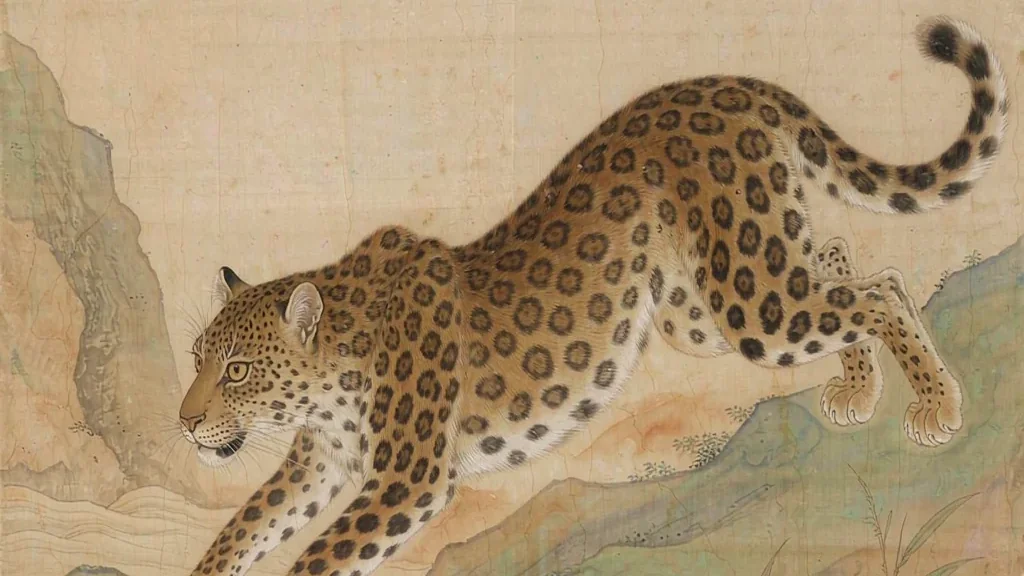
Leopard Style, or Bao Quan, is one of the five classic southern animal styles of Chinese martial arts, prized for its speed, precision, and explosive short-range power. Where the tiger relies on overwhelming strength, the leopard emphasizes quickness, agility, and the ability to strike many times in rapid succession with the rigid "leopard fist." It trains the bones and tendons for snapping force and develops a lighter, more mobile stance than the tiger's deep root. The style is a favorite for students who want speed and efficiency over brute power, embodying the idea that a smaller, faster fighter can overcome a larger opponent.
Position Among the Five Animals
In the five-animal scheme, the leopard corresponds to tendon and speed, complementing the tiger's bone and strength and the crane's spirit and balance. Each animal develops a different physical quality, and the leopard's is velocity.
The leopard is sometimes linked to the metal element and the lungs in five-phase theory, associating its rapid, breath-coordinated striking with respiratory and tendon health in traditional Chinese medicine.
Because it teaches speed and multiple strikes, Leopard Style is often taught after the tiger, so the student already has root and power to refine into quicker, lighter expression.
Symbolism of the Leopard
The leopard is a solitary, agile predator—stealthy, precise, and lethal in short bursts. Unlike the showy tiger, the leopard strikes and disappears, a model for the efficient fighter who wastes no motion.
In martial symbolism the leopard represents "jing" (tendon power) and the ability to explode from stillness. Its spots are sometimes said to remind students of focused, distributed power across the body.
The style's spirit is calm alertness: the leopard watches, then acts with total commitment for a brief moment, then resets. This rhythm of coiled stillness and sudden burst defines the training.
The Leopard Fist
The signature hand is the "bao quan" (leopard fist): the fingers curled tightly so the second knuckles protrude, forming a rigid striking surface. Unlike a normal fist, it concentrates force on a small point for penetration.
This shape targets vulnerable points—the temple, ribs, solar plexus—where a small, hard surface does more damage than a broad punch. Accuracy is therefore paramount, and much training is devoted to precise aiming.
The leopard fist is held loosely until the instant of impact, then snapped rigid, combining relaxation with sudden hardness. This "spring" quality lets the strikes fly faster than a constantly clenched fist.
Speed and Multiple Strikes
The core tactic is "lian huan" (chain strikes): delivering a flurry of leopard-fist blows too fast to block individually. Rather than one big hit, the leopard overwhelms with tempo and volume.
Because the stance is lighter than the tiger's, the body can shift between strikes, changing angle so the opponent cannot settle. Footwork is quick and narrow, keeping the fighter mobile and hard to pin.
Breath and rhythm are trained so the strikes come in timed bursts, each exhale marking a blow. The result is a machine-gun-like quality that gives the style its reputation for speed.
Stances and Mobility
Leopard Style uses shorter, more mobile stances than Tiger Style—a moderate horse stance and a quick cat-like step that lets the fighter dart in and out. The base is stable enough for power but light enough for speed.
The "bao bu" (leopard step) is a short, springy advance that covers ground efficiently without telegraphing. It supports the rapid entries needed for chain striking at close range.
Balance is trained so the stylist can strike on the move, since a speed-based art is useless if every blow requires a planted stance. Weight shifts are kept minimal and continuous.
Conditioning and Tendon Training
The style develops "jin" (tendon/bundle power) through repetitive striking and stretching that strengthens the connective tissues. The leopard's power is said to come from sinew, not muscle bulk.
Forearm and knuckle conditioning hardens the striking surface, while tendon-stretching exercises keep the body springy. The aim is a whip-like transmission of force through resilient tissue.
Speed drills—such as striking a hanging target repeatedly—build the nervous-system pace needed for chain strikes. As with all animal styles, consistency over months produces the attribute.
Forms and Applications
The leopard form is brisk and angular, with rapid combinations and sudden direction changes. It looks busier than the tiger form, reflecting the style's emphasis on tempo over massive single movements.
Two-person drills practice the chain strikes against pads and moving partners, teaching the student to maintain speed while the target resists and moves. Timing the flurry to an opening is the key skill.
Applications stress efficiency: every technique should have a clear target and a follow-up, with no wasted motion. The leopard's economy is a deliberate contrast to the tiger's mass.
Philosophy and Legacy
Leopard Style expresses the principle that speed and precision can defeat size. It appeals to smaller or lighter practitioners who cannot match an opponent's strength but can out-tempo them.
The style survives within southern curricula and as a standalone animal method, often paired pedagogically with tiger and crane so students experience strength, speed, and balance in sequence.
Ultimately the leopard teaches restraint of force: not pouring everything into one blow, but delivering just enough, just in time, again and again—a disciplined economy that is itself a kind of power.
Leopard and the Five-Phase Framework
Within the five-phase system, the leopard is associated with the metal element and the lungs, linking its rapid, breath-coordinated striking to respiratory health and the "qi" gathered with each sharp exhalation of a chain combination.
This connection is practical: because leopard training relies on quick, repeated bursts, correct breathing is essential, and traditional teachers tied the art's tempo to the rhythm of the lungs, warning that holding breath would both sap speed and harm the organ.
The metal association also places the leopard after wood (tiger) in the generative cycle, a neat pedagogical echo of how students typically learn tiger strength first and then refine it into leopard speed, the harder element sharpening the softer one.
❓ Frequently Asked Questions
What is Leopard Style kung fu?
It is one of the five southern animal styles, emphasizing speed, precision, and rapid chain strikes with the rigid leopard fist, using light mobility rather than brute strength.
How is it different from Tiger Style?
Tiger uses deep root and massive committed power; leopard uses lighter stances and fast repeated strikes, trading strength for speed and efficiency.
What is the leopard fist?
It is a fist with the second knuckles protruding, forming a small hard surface for penetrating strikes to vulnerable points, snapped rigid only at impact.
Why is tendon training important?
The leopard's power is attributed to sinew (jin) rather than muscle, so stretching and striking drills strengthen the connective tissue for springy force.
Is it suitable for smaller people?
Yes; its core lesson is that speed and precision can overcome size, making it popular with lighter or smaller practitioners.
What does "chain strikes" mean?
It means delivering a flurry of leopard-fist blows too fast to block individually, overwhelming the opponent with tempo and volume rather than one heavy hit.