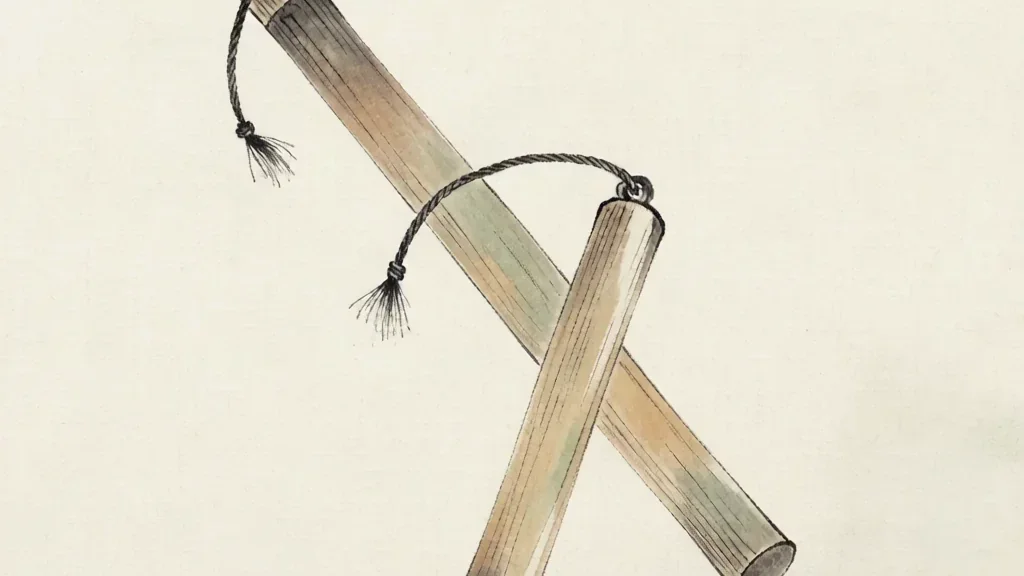
Few weapons are as instantly recognizable—or as misunderstood—as the nunchaku (双节棍, ), the two-section staff linked by a short cord or chain. Thanks largely to Bruce Lee, it became a global symbol of kung fu, whirling in films with hypnotic speed. It matters here because, while its deepest historical roots lie in the Ryukyu Kingdom (Okinawa), the nunchaku was adopted, adapted, and popularized within Chinese martial arts and cinema, becoming a genuine part of the Chinese wushu weapon repertoire. Understanding it means separating fact from movie myth and appreciating a simple tool's surprising depth.
Origins: Okinawa, Not China
Scholars broadly agree the nunchaku originated in the Ryukyu Islands, especially Okinawa, not on the Chinese mainland. The most common theory holds that it evolved from a flail-like agricultural tool used for threshing grain—two sticks joined by rope that separated rice from husk. Under the Japanese samurai ban on weapons in Okinawa, such "farm tools" could be carried without arousing suspicion and were later refined into a combat implement within Okinawan te and, later, karate.
What complicates the China story is the long cultural exchange between Okinawa and the Fujian coast. Ryukyu was a tributary state with deep ties to Ming and Qing China, and Chinese martial influences flowed into Okinawan arts. Some therefore speculate about Chinese antecedents for the linked-staff idea. Regardless of the exact lineage, the honest conclusion is that the nunchaku is Okinawan in origin and was carried into the Chinese imagination mainly through film and the global martial arts exchange of the twentieth century.
Construction: Two Sections and a Link
A traditional nunchaku consists of two roughly equal wooden bars, each about the length of the forearm, connected near the ends by a cord (historically horsehair or hemp) or, in modern versions, a metal chain. The proportions matter: too long and the weapon is slow; too short and it loses reach and momentum. The connecting link lets the second section swing freely, storing and releasing speed in an arc.
Modern training versions use foam or lightweight wood for safety, while demonstration pieces may be heavier or made of metal. The grip section is held firmly; the free section is the striking end. Because the link allows the free bar to wrap around guards and limbs, the weapon can attack from unexpected angles and even strike behind a block. That versatility is exactly what makes it effective—and what makes it dangerous to the untrained.
Technique: Flow, Momentum, and Control
Using the nunchaku is fundamentally about managing a swinging mass. The practitioner builds circular momentum—around the body, over the shoulder, under the arm, behind the back—and converts that spin into a strike at the right instant. The free end accelerates through the arc, so even a light weapon can deliver a sharp impact. Control means knowing exactly where the free bar is at every moment; losing track is how beginners hit themselves.
Key techniques include the figure-eight swing, the horizontal and vertical spins, the "horse" grip that lets the weapon pivot around the hand, and strikes aimed at the head, limbs, and joints. Advanced users employ the linking cord to trap or entangle an opponent's weapon, and to strike around guards. The art demands relaxed wrists and precise timing; tension makes the swings erratic. In this sense the nunchaku rewards the same relaxation and whole-body coordination prized in Chinese internal and external arts alike.
Bruce Lee and the Cinematic Explosion
No single figure did more for the nunchaku's fame than Bruce Lee. In films such as Enter the Dragon and Way of the Dragon, his fluid, blurring nunchaku routines turned a modest Okinawan farm tool into a worldwide emblem of kung fu cool. Lee's speed and showmanship inspired millions to pick up the weapon, and Chinese-language martial cinema quickly absorbed it as a stock skill of the heroic fighter.
This cinematic life is double-edged. Movies show the nunchaku as a blur of invincible motion, masking how much practice it takes and how easily it can injure the user. Real mastery is quiet and controlled, not a frantic whirl. Still, the screen exposure did something lasting: it folded the nunchaku into the popular definition of "Chinese martial arts," so that today it is taught in wushu schools and demonstrated at Chinese cultural events worldwide, regardless of its Okinawan birth.
Training, Safety, and Modern Sport
Training begins, necessarily, with safety. Beginners use foam-covered or very light nunchaku and practice slow swings, learning to keep the free end in view and to stop it on command. Only after the basic figure-eights are reliable do strikes, rolls, and transitions enter the routine. Many schools drill "dead stops"—halting the swing instantly—because the ability to control the weapon is the mark of competence.
In the modern era the nunchaku has found competitive form. Freestyle nunchaku routines, set to music and judged on technique and flow, are performed at wushu and martial-arts exhibitions, and some countries hold dedicated championships. There is also a growing sport of "nunchaku dueling" with padded weapons. These developments keep the tool relevant and disciplined, channeling its flashiness into structured practice rather than reckless spinning.
Cultural Meaning and the Myth vs. Reality
The nunchaku's story is a useful corrective to the tidy nationalism sometimes attached to martial arts. Weapons and techniques traveled across East Asia—Okinawa, China, Japan, Korea—constantly borrowing and blending. The nunchaku embodies that mobility: born in Okinawa, shaped by Chinese and global cinema, and now a shared icon. Treating it honestly as a regional weapon adopted into Chinese wushu is more instructive than claiming it outright.
For the cultural learner, the nunchaku also teaches caution about movie mythology. Its real skill lies in patient, repetitive control of a swinging weight—humble training, not movie magic. Yet its journey from threshing flail to film icon captures something true about martial arts generally: a simple tool, practiced with dedication, can become a symbol of an entire culture's ingenuity and spirit. That is the genuine lesson of the two-section staff.
From Farm Tool To Fighting Weapon
The most widely accepted origin story for the nunchaku traces it to the Okinawan rice flail, a handheld tool used to thresh grain by beating it against a board. Peasants familiar with the flail's swinging motion adapted its design into a concealed self-defense implement during periods when weapons were restricted. Two short hardwood sticks were joined by cord or chain, letting the user generate surprising speed and reach through rotation while keeping the tool seeming harmless. The design spread through the Ryukyu martial arts and later into mainland Asian systems through cultural contact. What began as farm equipment thus became one of the most recognizable flexible weapons in the world. This humble origin explains both its practicality and its democratic appeal: it required no forge or rank, only the everyday object already in a worker's hands.
Safety And Modern Sport Use
Because the nunchaku's free-swinging stick can strike the user as easily as an opponent, modern training stresses controlled drills, padded practice weapons, and gradual progression from stationary swings to flowing combinations. Sport organizations now hold forms competitions where practitioners perform choreographed routines judged on rhythm, control, and precision rather than on combat. Many jurisdictions regulate or restrict public possession of nunchaku, so responsible schools focus on demonstration and fitness applications. Beginners are taught to keep the occupied stick in motion and to protect the striking hand, building the wrist timing that makes the weapon safe. While movies portray it as flashy and chaotic, serious study is repetitive and disciplined. Approached correctly, the nunchaku remains a vivid example of how a simple linked implement can teach coordination, rhythm, and respect for a live tool.
❓ Frequently Asked Questions
📝 Chinese Vocabulary
双节棍 — : two-section staff, the Chinese name for nunchaku.
棍 — : staff or stick.
琉球 — : Ryukyu, the Okinawan kingdom of origin.
空手道 — : karate, the Okinawan art that uses the weapon.
武术 — : wushu, the Chinese martial arts umbrella.
连枷 — : flail, the agricultural threshing tool from which the nunchaku is said to descend
流球 — : Ryukyu, the Okinawan kingdom where the weapon was developed
中段 — : the center section, the safe grip area between the two sticks
🎉 Fun Facts
- The nunchaku most likely began as an Okinawan grain-threshing flail before becoming a weapon under samurai weapon bans.
- Bruce Lee's film routines in the 1970s are the main reason the nunchaku is now seen worldwide as a kung-fu icon.
- The biggest beginner hazard is striking oneself; that is why "dead stop" control drills come before speed work.
- Despite its Okinawan roots, the nunchaku is now performed in Chinese wushu demonstrations and freestyle competitions globally.
- Many historians believe the nunchaku evolved from a rice-flailing tool rather than being invented as a weapon.
- In Okinawa the two sticks were originally connected by horsehair rope before modern versions used chain.