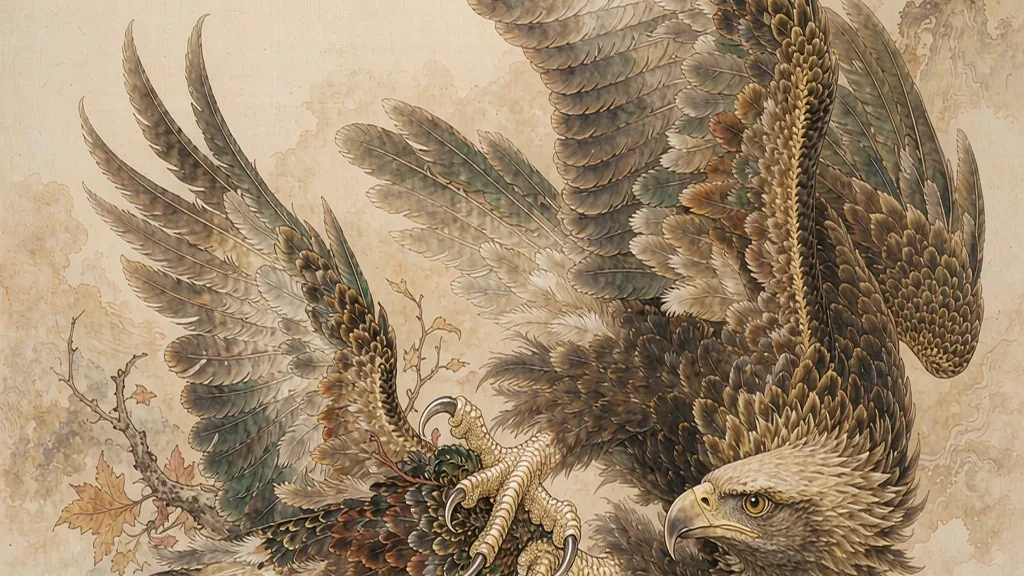
Eagle Claw boxing, or Yingzhao Quan, is a distinctive northern Chinese martial art built around the gripping, seizing, and locking actions of an eagle's talons. Rather than meeting force with force, the style captures an opponent's limb, controls the joint, and breaks the body's structure through precise grabbing techniques. With its roots often linked to the Song-era general Yue Fei and later systematized by the Lai family of Hebei, Eagle Claw blends striking with wrestling-like controls. This article examines the art's history, its signature hand shapes, training methods, and the philosophy of using the opponent's energy against them.
Historical Roots of Eagle Claw
The style's origin is popularly attributed to Yue Fei, a revered Song-dynasty general celebrated for loyalty and martial skill, though such founding legends are common across Chinese boxing and should be read as tradition rather than strict record.
What is clearer is that the art was preserved and shaped by the Lai family of Xiongxian in Hebei province, who passed down a method combining the "capturing" techniques of an older system with the striking of northern long-fist boxing.
During the twentieth century the style spread beyond Hebei as teachers migrated, and it became recognized as one of the characteristic grabbing-based arts of northern China.
The Eagle Claw Hand Shape
The defining feature is the claw, formed by curling the fingers while keeping the thumb opposed, so the hand can hook, squeeze, and twist. The shape is held loosely until contact, then tightens like a talon.
Practitioners train the grip by repeated opening and closing, and by grabbing implements, so the fingers gain the strength to control a wrist or ankle. The wrist itself stays flexible to whip the claw into position.
Though the claw is the signature, the hand also uses palm strikes, punches, and the back of the wrist, making the style more rounded than its name alone suggests.
Principles of Seizing and Controlling
Eagle Claw is built on "na," or seizing: the moment you touch an opponent's arm, you aim to lock the joint and unbalance them before they can strike. Control precedes power.
The art pairs grabbing with "qinna"-like joint manipulation, using levers at the elbow, shoulder, and wrist to force a submission. A small torque on the right joint can neutralize a much larger attacker.
Strikes are used to set up the grab; for example a palm to the face draws the hands up, creating an opening to seize the arm. Attack and control flow into one another.
Stance and Footwork
Eagle Claw uses the stable, grounded stances of northern boxing — horse stance, bow stance, and cat stance — so the body can root while the arms work. A low center makes the grabs harder to escape.
Footwork is direct: step in along the opponent's line to close the distance for a clinch or lock, then pivot to use body weight against the joint. Turning the waist adds torque to every seize.
Mobility still matters, because the stylist must close range quickly; a claw is useless at a distance, so footwork is the bridge that brings the hand to its target.
Training Forms and Drills
Students learn set routines that chain strikes and claws into flowing sequences, preserving the art's techniques. These forms are performed with crisp, snapping movements to build the wrist action.
Two-person drills teach the timing of a real grab: one partner offers a wrist or attacks, and the other practices seizing and controlling with measured force. Such paired work is the heart of the style.
Grip conditioning — squeezing balls, poles, or practicing on a post — hardens the fingers so the claw can actually hold under resistance.
Eagle Claw and Qinna
The style overlaps closely with qinna, the broader family of Chinese joint-locking and seizing arts. Many Eagle Claw techniques are essentially qinna applied through the claw hand.
Teachers often present the two together, since the same lever principles appear in both; a student of Eagle Claw naturally learns a working vocabulary of locks and releases.
This connection explains why the art feels as much like a grappling method as a striking one, blending stand-up control with the timing of a boxer.
Health and Conditioning Benefits
The repeated gripping and wrist circling strengthens the hands and forearms, while the stances build leg strength and balance. Many older practitioners value the art for keeping the joints mobile.
Because the style demands relaxation until the moment of contact, it also trains the nervous system to respond rather than tense, a useful skill for everyday poise.
Breath coordination — exhaling on the seize — links the physical work to the calm, focused mindset shared by many Chinese internal and external arts.
Eagle Claw in the Modern World
Today the style is taught both as a traditional martial art and as part of wushu demonstration, where its distinctive claw shapes read clearly to an audience. Some schools emphasize self-defense, others aesthetics.
Diaspora communities, especially in parts of North America, have kept the Lai-family lineage alive through dedicated instructors who trace their teaching back through the family line.
While competition has stylized some forms, traditional teachers still stress the grabbing logic, reminding students that the claw exists to control, not merely to look fierce.
Learning Eagle Claw as a Beginner
A newcomer should start with stance training and basic claw formation, practicing the open-close action daily to build finger strength before attempting locks on a partner.
Safety is essential in paired drills: partners agree on light contact and clear stop signals, since joint locks can injure if forced. A qualified instructor is strongly recommended.
With steady practice the student learns the style's core lesson — that sensitivity and timing defeat raw strength, and that the eagle wins by catching, not by colliding.
❓ Frequently Asked Questions
What is Eagle Claw boxing?
It is a northern Chinese style centered on gripping, seizing, and joint-locking using a hooked claw hand shape.
Who founded the style?
Tradition credits the Song general Yue Fei, but the art was clearly preserved and shaped by the Lai family of Hebei.
Is Eagle Claw a striking or grappling art?
It is both: strikes set up the grab, and the grabs control or lock the opponent, blending the two.
How does it relate to qinna?
Its seizing techniques are essentially qinna applied through the claw, so students learn many joint locks naturally.
Is it safe to train the locks?
With a qualified teacher and agreed light contact, yes; forced joint locks on a partner should always be avoided.
What does training develop?
It builds finger and forearm strength, stable stances, timing, and the habit of relaxed, responsive movement.