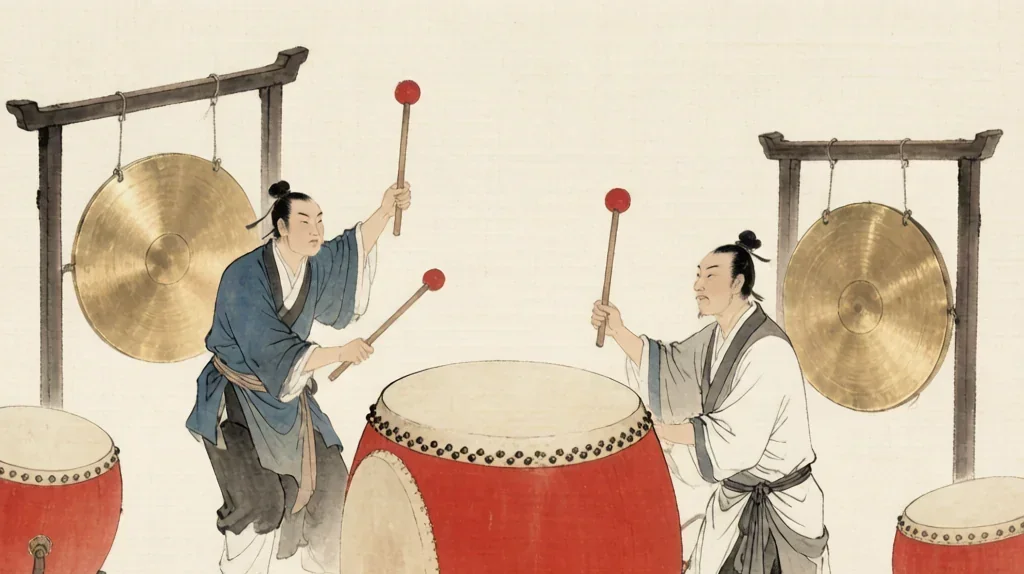
Close your eyes and imagine the sound: a single deep beat, then another, then a cascade of strikes building to a thunderous crescendo that vibrates through your chest. This is the sound of Chinese drum music, one of the oldest and most powerful musical traditions in the world. For over 4,000 years, drums have been the heartbeat of Chinese civilization — calling armies to battle, summoning the gods in temple rituals, marking the rhythms of agricultural life, and celebrating the joys of festival. The Chinese drum is not merely an instrument; it is a voice — the voice of thunder brought down to earth.
The First Drums: Clay, Bronze, and Thunder
Archaeological evidence suggests that drums were among the earliest musical instruments in China, dating back to the Neolithic period over 7,000 years ago. The earliest drums were simple clay pots covered with animal skins, beaten with sticks or hands. By the Shang Dynasty (1600–1046 BC), bronze drums had appeared, their resonant metal bodies producing sounds that carried across great distances. These bronze drums, particularly those of the Dian culture in what is now Yunnan Province, were decorated with elaborate scenes of ritual and warfare — the drum itself was both instrument and artifact, a record of the culture that produced it.
In ancient Chinese cosmology, the drum was associated with thunder and the life-giving power of spring. The legendary first emperor, Fu Xi, was said to have invented the drum after hearing thunder roll across the sky. The drum's voice was understood as the voice of heaven itself — a sound that could communicate with gods, awaken the spirits of ancestors, and drive away malevolent forces. This cosmological significance made drums central to ritual practice from the earliest periods of Chinese history.
War Drums: The Sound of Battle
For millennia, the drum was the primary instrument of military command in China. Before radios and field telephones, the only way to coordinate thousands of soldiers across a chaotic battlefield was through drum signals. Different rhythms conveyed different orders: advance, retreat, flank left, hold position. The phrase "beat the drum and advance" (击鼓进军) remains in the Chinese language today as a metaphor for launching any concerted effort.
The war drum was enormous — often mounted on a cart and pulled by horses — and its sound was designed to carry for miles. The great military strategist Sun Tzu wrote of the drum's importance in "The Art of War," describing how drum signals must be clear and unambiguous, as confusion in the drum corps meant confusion in the army. The war drum was also a psychological weapon: its thunderous sound boosted the morale of one's own troops while striking fear into the enemy. Chinese military music, built around drums and brass, developed into a sophisticated system of battlefield communication that remained in use well into the modern era.
Temple Drums: The Voice of the Divine
In Buddhist and Taoist temples, drums serve as ritual instruments of profound significance. The morning drum and evening bell (晨钟暮鼓) mark the rhythm of monastic life, the deep reverberation of the drum calling monks to meditation and prayer. In Buddhist temples, the drum is often paired with the bell — the bell representing wisdom, the drum representing compassion, the two together symbolizing the complete spiritual path.
The temple drum is played with a distinctive technique: the drummer strikes the center of the drumhead for deep, resonant tones and the edge for sharper, higher sounds. Complex rhythmic patterns accompany chanting and ritual movements. During major ceremonies, the drumming can build to an intensity that fills the entire temple complex, the sound waves physically felt by worshippers as a kind of sonic blessing. The "Dharma Drum" (法鼓) is particularly important, its beat representing the spread of Buddhist teachings throughout the world.
Jiangzhou Drum: Thunder from Shanxi
Among the many regional drum traditions of China, Jiangzhou drum music (绛州鼓乐) from Shanxi Province is perhaps the most renowned. Dating back over a thousand years, Jiangzhou drumming is characterized by its scale, intensity, and virtuosity. Performances can involve dozens of drummers playing an array of drums of different sizes, from small hand drums to enormous barrel drums that stand taller than a person.
The signature Jiangzhou piece is "The King of Qin Breaks the Battle Formations" (秦王破阵乐), a work that dates to the Tang Dynasty and commemorates the military victories of Emperor Taizong. The piece is a tour de force of rhythmic complexity and dramatic power, the drummers' movements choreographed as precisely as dancers'. Players leap, spin, and strike their drums in patterns that are as visually spectacular as they are musically powerful. The piece builds from a single drumbeat to a full-ensemble climax that leaves audiences breathless.
Jiangzhou drumming has been recognized as a National Intangible Cultural Heritage, and troupes from the region have performed worldwide, bringing the thunder of Shanxi to international audiences. The tradition continues to evolve, with contemporary composers creating new works that blend traditional techniques with modern sensibilities.
The 24 Festive Drums: Modern Tradition
One of the most exciting developments in Chinese drum culture is the 24 Festive Drums (二十四节令鼓), a performance art form created in Malaysia in 1988 by Chinese-Malaysian artists Chen Huichong and Tan Chai Puan. The concept is brilliant in its simplicity: 24 drums, one for each of the 24 solar terms of the Chinese agricultural calendar, played by 24 drummers in choreographed formations that combine martial arts movements with drumming technique.
The 24 Festive Drums have spread rapidly throughout the Chinese diaspora and back to China itself, becoming one of the most visible contemporary expressions of Chinese drum culture. Performances are dramatic and athletic, the drummers moving in unison, their sticks flashing in patterns that reference calligraphy strokes and martial arts forms. The sound ranges from whisper-quiet to thunderous, following the cycle of the agricultural year from the quiet of winter to the explosive energy of spring planting and summer growth.
Drums in Daily Life and Festival
Beyond the concert stage and temple hall, drums remain an integral part of Chinese community life. During Chinese New Year, lion dance troupes parade through streets accompanied by drums, cymbals, and gongs — the rhythmic cacophony believed to drive away evil spirits and welcome good fortune. At dragon boat races during the Duanwu Festival, a drummer sits in the prow of each boat, beating a rhythm that synchronizes the paddlers' strokes. In rural areas, drums still mark weddings and funerals, harvests and planting seasons, the eternal cycles of human life.
The drum's enduring power lies in its directness. You do not need musical training to feel a drumbeat — it bypasses the intellect and speaks directly to the body. The pulse of the drum matches the pulse of the heart, the rhythm of breathing, the fundamental patterns of life. In a world of increasingly abstract and digital experience, the physical vibration of the drum remains irreducibly real — a connection to the most ancient and essential form of human expression. When Chinese drummers raise their sticks and strike, they are not just making music. They are calling down thunder.
Drum Towers: Keeping the City's Time
Before mechanical clocks, many Chinese cities kept time with a drum tower at the center of town. From its top a drummer beat the hours across the day and sometimes the watches of the night, so that households, markets, and gates ran on a shared beat. The tower worked as a public clock whose sound reached everyone within the walls, and its rival instrument was the bell tower, the two together giving the phrase 'morning bell and evening drum.' Surviving drum towers in cities such as Xi'an and Beijing are now monuments, but they record a time when the day was literally marked by a drum.
The Waist Drum Dance of the North
One of the most joyful offspring of Chinese drum culture is the waist-drum dance of northern Shaanxi. Dancers sling a small drum at the hip and strike it while leaping, turning, and marching in formation, the sticks flashing in time with the steps. The performance is at once music, dance, and display of energy, and it is staged at New Year and harvest celebrations across the north. What began as a rural folk custom has been polished into a competitive and touring art, yet it keeps the core idea of the drum: a rhythm the whole body can feel. The waist drum shows how the instrument moved from ritual and war into pure communal joy.
❓ Frequently Asked Questions
📝 Chinese Vocabulary
- 鼓 (Gǔ) — Drum, one of the oldest Chinese characters, pictographically representing a drum on a stand with decorations.
- 击鼓进军 (Jīgǔ Jìnjūn) — "Beat the drum and advance," a military command and modern metaphor for launching any effort.
- 绛州鼓乐 (Jiàngzhōu Gǔyuè) — Jiangzhou drum music, a thousand-year-old drumming tradition from Shanxi Province.
- 二十四节令鼓 (Èrshísì Jiélìng Gǔ) — The 24 Festive Drums, a contemporary drum art form based on the 24 solar terms of the Chinese calendar.
🎉 Fun Facts
- The largest drum ever built in ancient China was the "Thunder Drum" of the Qin Dynasty, said to require 100 men to move and to be audible from over 5 kilometers away.
- In Chinese, the phrase "打退堂鼓" (dǎ tuìtáng gǔ, "beat the retreat drum") means to back out or give up — originating from the military drum signal for retreat.
- The 24 Festive Drums, though rooted in Chinese tradition, were actually invented in Malaysia and have since become a global phenomenon practiced in over 30 countries.
- The northern Shaanxi waist-drum dance sets rows of hip-slung drums spinning in time, a highlight of holiday performances.
- City drum towers once used the drum to announce the hour before clocks existed, keeping whole towns on a shared rhythm.
- In temple life the evening drum answered the morning bell, and monks learned its set pattern as part of the daily routine.