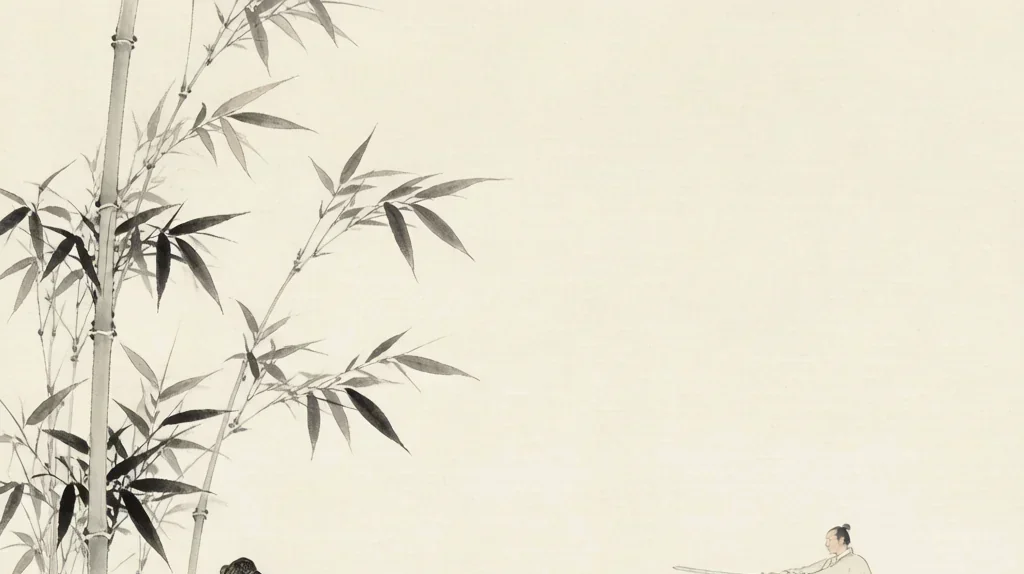
In the pantheon of Chinese weapons, the Jian (剑) — the straight, double-edged sword — occupies a unique position. It is called the "Gentleman of Weapons" (君子之器), a tool not merely of violence but of cultivation, refinement, and moral character. For over 2,500 years, the Jian has been carried by emperors and scholars, wielded by legendary swordsmiths and martial artists, and immortalized in poetry and legend. It is simultaneously a deadly weapon and a symbol of the highest human virtues — a paradox that lies at the heart of Chinese sword culture.
From Bronze to Steel: The Evolution of the Jian
The earliest Chinese swords date back to the Spring and Autumn Period (770–476 BC), when bronze casting technology reached extraordinary heights. These early bronze Jian were relatively short — typically 50 to 60 centimeters — limited by the structural properties of bronze, which becomes brittle at longer lengths. Yet within these constraints, ancient swordsmiths achieved remarkable sophistication. The famous Sword of Goujian, discovered in 1965 in a tomb in Hubei Province, was over 2,400 years old yet emerged from its scabbard untarnished, its blade still sharp enough to cut through a stack of paper. The sword's surface was treated with a chemical compound that prevented corrosion — a technology that modern metallurgists still study with admiration.
The transition from bronze to iron and then steel during the Han Dynasty (206 BC–220 AD) revolutionized sword-making. Steel could be forged into longer, stronger, and more flexible blades. The Han Dynasty Jian grew to 80 to 100 centimeters, with a refined balance between rigidity for thrusting and flexibility for cutting. Swordsmiths developed sophisticated techniques of differential heat treatment, creating blades with a hard, sharp edge and a softer, more flexible spine — the same principle that would later be applied to the Japanese katana.
The Gentleman's Weapon: Philosophy Embodied in Steel
What truly distinguishes the Jian from other weapons is its cultural and philosophical significance. Confucian scholars carried the Jian not primarily for combat but as a symbol of their refinement and moral cultivation. The sword's straightness represented moral rectitude. Its double edge represented the balance of wisdom and courage. Drawing the sword was an act of last resort, undertaken only when all other means of resolution had failed.
The association between the sword and the scholar-gentleman created a rich culture of sword appreciation. A fine Jian was judged not only by its combat effectiveness but by its aesthetic qualities: the grain pattern of the folded steel, the carving of the guard, the wrapping of the grip, the craftsmanship of the scabbard. Sword connoisseurship became a form of art appreciation, and famous swords were treasured as cultural artifacts. The phrase "wearing a sword while reciting poetry" (佩剑吟诗) captured the ideal of the cultivated warrior-scholar.
Gan Jiang and Mo Ye: The Swordsmiths' Legend
No discussion of Chinese swords is complete without the legend of Gan Jiang (干将) and Mo Ye (莫邪), the most famous swordsmiths in Chinese history. According to the ancient text "Spring and Autumn Annals of Wu and Yue," the King of Wu commissioned Gan Jiang to forge a pair of swords. Gan Jiang and his wife Mo Ye labored for three months, but the iron would not melt properly in the furnace. Mo Ye, understanding that the furnace required a human sacrifice to reach the necessary temperature, cut off her hair and nails and threw them into the flames — or in some versions, threw herself in entirely. The furnace blazed, and two magnificent swords were born. Gan Jiang named them after himself and his wife, keeping the male sword (Gan Jiang) hidden while presenting only the female sword (Mo Ye) to the king.
When the king discovered the deception, he ordered Gan Jiang's execution. Their son, grown to manhood and carrying the hidden Gan Jiang sword, eventually avenged his father. The twin swords passed into legend, their names becoming synonymous with supreme craftsmanship and the intimate bond between creator and creation. Even today, "Gan Jiang Mo Ye" is a phrase used to describe something of unparalleled quality.
The Jian in Martial Arts: Tai Chi and Wudang
The Jian found its ultimate expression in the internal martial arts, particularly Tai Chi (太极拳). Tai Chi sword practice transforms the weapon into an extension of the body and mind. Movements are fluid and continuous, the blade tracing circles and spirals through the air. The practitioner seeks to embody the sword's qualities: straightness in intention, flexibility in response, sharpness in perception, and the restraint to keep the blade sheathed.
Tai Chi sword forms are among the most beautiful martial practices to watch. The practitioner moves with apparent effortlessness, the sword an extension of intention rather than muscle. Techniques include thrusts (刺), slices (劈), upward cuts (撩), and circular deflections (挂). The emphasis is not on brute force but on precision, timing, and the cultivation of internal energy (气). Advanced practitioners seek to "let the sword wield itself" — a state where conscious intention dissolves and the sword moves with spontaneous appropriateness to each situation.
Wudang Mountain, the traditional center of Taoist martial arts, is particularly associated with Jian practice. Wudang sword techniques are characterized by soft, flowing movements that conceal deadly precision, embodying the Taoist principle of overcoming hardness with softness. The Wudang sword practitioner moves like water — adaptable, penetrating, and ultimately unstoppable.
The Jian Today: Living Tradition
In contemporary China, the Jian has been transformed from a weapon into a cultural practice. Millions of people, particularly older adults, practice Tai Chi sword in parks every morning, the slow, graceful movements serving as exercise, meditation, and social activity. The swords they use are typically unsharpened — tools for health and art rather than combat. Yet the tradition remains alive in other forms. Wushu (competitive martial arts) includes sword routines of breathtaking speed and precision. Historical fencing enthusiasts study and reconstruct ancient sword techniques. Master swordsmiths continue to forge traditional Jian using centuries-old methods.
The Jian's journey from battlefield weapon to cultural treasure mirrors China's own transformation. Yet the sword retains its symbolic power. It represents the ideal of the cultivated person — capable of decisive action, yet governed by wisdom and restraint. In a world of increasingly abstract conflicts, the physical symbol of the Gentleman of Weapons reminds us that true strength lies not in aggression but in the discipline to know when to keep the blade sheathed.
The Sword in Poetry and Legend
The jian runs through Chinese literature as a token of honor and longing. Poets from the Tang dynasty wrote of drinking with a sword at the table or laying it aside to recite verse, and the image of 'wearing a sword while chanting poetry' captured the cultivated man who could act as well as reflect. Legends added flying swords wielded by Taoist immortals and magical blades that hummed before battle. These stories did not merely decorate the weapon; they fixed it in the language as a symbol of the person who is both gentle and ready, a meaning no bare description of steel could carry.
Reading a Blade: The Art of Connoisseurship
To admire a jian is to read it like a text. Connoisseurs look at the grain of the folded steel, the shape of the guard, the wrapping of the grip, and the carving of the scabbard, judging whether the maker balanced a hard edge with a flexible spine. A good blade is tapped to hear a clear ring and weighed to feel the balance near the guard, signs that the smith understood his craft. Famous swords were treasured as cultural objects, not just weapons, and the language of sword appreciation became a small branch of art criticism in its own right.
Swords as Gifts and Tokens of Honor
Because the jian stood for virtue, it was often given rather than merely owned. A teacher might present a sword to a worthy student, a ruler might bestow one on a loyal minister, and friends exchanged blades as pledges of trust. To receive such a gift was to be told one was upright and capable, so the sword carried a social message as clear as any written word. This gift custom helps explain why fine jian were preserved, copied, and sung about across centuries: they were keepsakes of relationship as much as instruments of war.
❓ Frequently Asked Questions
📝 Chinese Vocabulary
- 剑 (Jiàn) — The straight, double-edged Chinese sword, known as the "Gentleman of Weapons."
- 君子之器 (Jūnzǐ zhī Qì) — "Gentleman of Weapons," the traditional epithet for the Jian, emphasizing its association with moral cultivation.
- 干将莫邪 (Gān Jiāng Mò Yé) — The legendary husband-and-wife swordsmiths whose names became synonymous with supreme craftsmanship.
- 剑术 (Jiànshù) — Sword technique or swordsmanship, the art of wielding the Jian.
🎉 Fun Facts
- The Sword of Goujian, a 2,400-year-old bronze Jian, was found untarnished and still sharp enough to cut paper when excavated in 1965.
- In traditional Chinese culture, scholars were expected to master four arts: the qin (zither), qi (chess), shu (calligraphy), and hua (painting) — but the sword was often considered an unofficial fifth art.
- The Jian's double-edged blade symbolizes the Confucian virtues of wisdom (智) and courage (勇), balanced in equal measure.
- Collectors judge a jian by tapping the blade to hear its ring and by feeling the balance point near the guard, signs of good folded steel.
- Taoist tales speak of immortals whose swords flew to their call, making the flying sword a symbol of a freed and powerful spirit.
- Today's wushu performers often train with lightweight blades built for speed, carrying the look of the jian into competitive sport.