← Back to Cultural Details
Cultural Details
Dragon and Phoenix Culture (龙凤文化): The Yin-Yang of Chinese Symbolism
✍️ by xiaoyu luo
🗓️ Updated Jul 29, 2026
Last updated: June 2024 · Reading time: 7 min
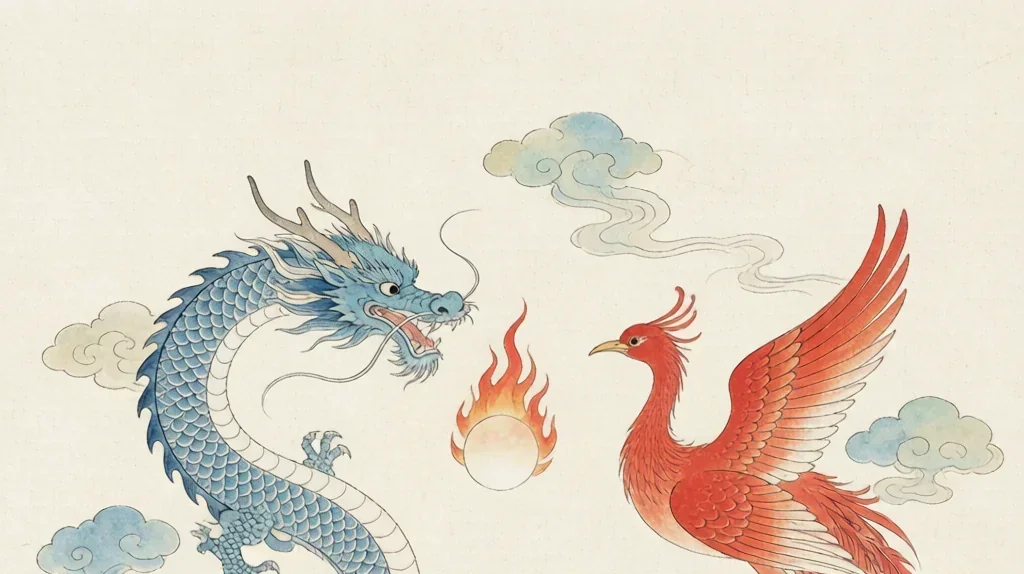
In the symbolic vocabulary of Chinese culture, no pairing is more fundamental, more ubiquitous, or more resonant than the dragon (龙, lóng) and the phoenix (凤, fèng). Together, these two mythical creatures form a complementary dyad that represents the fundamental duality of Chinese cosmology: yang and yin, heaven and earth, masculine and feminine, power and grace, emperor and empress. The phrase dragon and phoenix presenting auspiciousness (龙凤呈祥) is one of the most common expressions of good fortune in the Chinese language, appearing on everything from wedding decorations to corporate logos. The pairing is so deeply embedded in Chinese culture that the Chinese themselves are often referred to as descendants of the dragon (龙的传人), and a woman of exceptional talent or beauty is praised as a phoenix among people (人中龙凤). Understanding the dragon-phoenix dyad is essential to understanding Chinese aesthetics, social structure, and the deeply relational worldview that sees harmony not in uniformity but in the dynamic balance of complementary opposites.
The Chinese Dragon: Origins, Evolution, and Imperial Symbolism
The Chinese dragon is fundamentally different from its Western counterpart. While the European dragon is typically a malevolent, fire-breathing monster to be slain by heroic knights, the Chinese dragon is a benevolent, life-giving deity associated with water, rain, and the fertilizing power of nature. The Chinese dragon's origins lie in the Neolithic period: a jade pig-dragon from the Hongshan culture (circa 4700-2900 BCE) represents one of the earliest dragon-like forms in Chinese art. The dragon's composite form — it combines features of nine different animals: the horns of a deer, the head of a camel, the eyes of a demon, the neck of a snake, the belly of a clam, the scales of a carp, the claws of an eagle, the paws of a tiger, and the ears of an ox — reflects its nature as a creature that transcends ordinary biological categories. During the Han Dynasty, the dragon became firmly associated with the emperor. By the Ming Dynasty, the five-clawed dragon was reserved exclusively for the emperor, while four-clawed dragons could be used by princes and high officials. The emperor's throne was the Dragon Throne, his face was the Dragon Face, his robes were Dragon Robes.
The Chinese Phoenix: The Empress of Birds and Symbol of Virtue
The Chinese phoenix, known as fenghuang (凤凰), is a composite creature quite distinct from the Western phoenix of Greek mythology. The fenghuang combines features of multiple birds: the head of a golden pheasant, the body of a mandarin duck, the tail of a peacock, the legs of a crane, the beak of a parrot, and the wings of a swallow. Oracle bone inscriptions from the Shang Dynasty (circa 1600-1046 BCE) contain characters interpreted as references to a wind bird (凤) associated with the divine. In the classical text Shanhaijing, compiled between the Warring States and Han periods, the fenghuang is described as a bird whose appearance heralds a reign of peace and virtue: It resembles a chicken, has five-colored feathers, and its name is fenghuang. When it appears, the world is at peace. The fenghuang became associated with the empress as the dragon's feminine counterpart. Its five-colored plumage — red, green, yellow, white, and black — corresponds to the five cardinal virtues of Confucianism: benevolence, righteousness, propriety, wisdom, and trustworthiness.
The Dragon-Phoenix Dyad: Cosmic Complementarity in Art and Ritual
The pairing of dragon and phoenix appears across the entire spectrum of Chinese visual culture, from the most exalted imperial art to the most humble folk crafts. In imperial art, the dragon and phoenix together symbolized the perfect harmony of the imperial couple. The most famous example is the Nine-Dragon Wall in the Forbidden City, a glazed tile screen built in 1773 during the Qianlong reign. In wedding ceremonies, the dragon and phoenix are ubiquitous symbols: the bride's wedding dress traditionally features phoenix embroidery, while the groom's features dragons; the bridal sedan chair is called the phoenix palanquin; and the wedding candles are dragon and phoenix candles, lit together to symbolize the union of the couple. The motif has permeated the Chinese language: an exceptional person is a dragon among men, a phoenix among men; a harmonious marriage is dragon and phoenix in harmony; a couple blessed with both a son and a daughter is said to have a dragon and a phoenix.
The Dragon and Phoenix in Modern China and Global Culture
The dragon and phoenix continue to evolve as living symbols in contemporary Chinese and global culture. In the People's Republic of China, the dragon has been embraced as a national symbol — the phrase descendants of the dragon was popularized by the Taiwanese singer Hou Dejian in his 1978 song of the same name, which became an unofficial anthem of Chinese nationalism. The phoenix has been adopted as a symbol of feminine empowerment in contemporary Chinese culture. The phrase phoenix nirvana, a modern coinage based on the Western phoenix myth, is used to describe women who have overcome adversity and achieved success. The dragon-phoenix motif has been incorporated into global fashion: designers from Guo Pei (whose phoenix dress was worn by Rihanna at the 2015 Met Gala) to Laurence Xu (who dressed Fan Bingbing in a dragon robe for the 2010 Cannes Film Festival) have drawn on dragon and phoenix imagery. In architecture, the Dragon and Phoenix Towers in Wuhan, a pair of skyscrapers completed in 2021, incorporate dragon and phoenix motifs in their facades.
❓ Frequently Asked Questions
Q: What do the dragon and phoenix symbolize in Chinese culture?
A: The dragon (龙, lóng) represents power, strength, and yang (male) energy. The phoenix (凤, fèng) represents beauty, grace, and yin (female) energy. Together, they are the ultimate symbol of marital harmony, prosperity, and the union of complementary forces.
Q: How are dragons and phoenixes used in Chinese weddings?
A: The dragon and phoenix motif (龙凤呈祥, lóng fèng chéng xiáng) is ubiquitous at Chinese weddings. The bride's wedding dress (longfenggua) features dragon and phoenix embroidery. Invitations, decorations, and jewelry also incorporate the pair, symbolizing a harmonious marriage.
Q: How does the Chinese dragon differ from the Western dragon?
A: Unlike Western dragons, which are often portrayed as fire-breathing, malevolent beasts, Chinese dragons are benevolent creatures associated with water, rain, and abundance. They are symbols of imperial authority and good fortune, and are celebrated in festivals like the Dragon Boat Festival.
Q: What is the legend of the Dragon and Phoenix?
A: According to legend, the dragon and phoenix were originally enemies, but their rivalry transformed into a cosmic partnership. Their union created the natural world — the dragon controls the weather, and the phoenix brings harmony. This story underpins their symbolism in Chinese art, literature, and marriage.
Q: What does it mean to be a descendant of the dragon?
A: It is a popular way Chinese people refer to themselves, rooted in the dragon as a national and cultural emblem rather than a literal ancestor. The idea spread widely after the 1978 song of that name and expresses shared identity and pride more than a claim of bloodline.
Q: Are there female dragons in Chinese stories?
A: Although the dragon is usually a yang symbol, dragon kings had daughters, and the dragon girl, or longnu, appears in Buddhist and folk tales as a devoted attendant who attains enlightenment. The phoenix remains the chief female cosmic partner, but women dragons do appear when the story calls for them.
Key Terms
龙凤
lóng fèng
龙 (lóng)the dragon, the benevolent yang creature of water, rain, and imperial power.
凤凰 (fèng huáng)the fenghuang or Chinese phoenix, the yin bird of grace and good omen.
龙凤呈祥 (lóng fèng chéng xiáng)the phrase 'dragon and phoenix present auspiciousness,' a standard wedding blessing.
人中龙凤 (rén zhōng lóng fèng)a 'dragon-phoenix among people,' praise for one of exceptional talent or beauty.
真龙天子 (zhēn lóng tiān zǐ)the 'true dragon son of heaven,' a title for the emperor.
九龙壁 (jiǔ lóng bì)the Nine-Dragon Wall, a glazed screen displaying imperial dragons.
五色 (wǔ sè)the five colors of the phoenix's plumage, linked to the five Confucian virtues.
Fun Facts
- The Chinese character for dragon (龙) appears on oracle bones from the Shang Dynasty (circa 1600-1046 BCE), making it one of the oldest continuously used symbols in human civilization, predating written Chinese literature by over a millennium.
- The Forbidden City contains an estimated 12,654 dragon images — carved in stone, painted on beams, embroidered on textiles, and cast in bronze — while phoenix images number approximately 4,800.
- In 2012, Chinese archaeologists at the Erlitou site in Henan Province discovered a turquoise-inlaid dragon mosaic dating to approximately 1700 BCE, measuring 64.5 centimeters in length and composed of over 2,000 individual turquoise pieces — the oldest known dragon image in Chinese art.
- The dragon is a sign of the Chinese zodiac, and dragon-year babies are still welcomed as especially fortunate.
- A favorite motif shows two dragons chasing a flaming pearl, the pearl read as wisdom or the moon and the chase as a quest for knowledge.
- So expected is the dragon-phoenix pairing at weddings that the embroidery is treated as the very sign of a proper, auspicious union.
The Dragon in the Zodiac and Folk Life
Beyond the throne, the dragon lives in everyday Chinese life through the zodiac. People born in a dragon year are said to be confident and lucky, and many families once hoped for a dragon-year child. The creature also fills idioms and folk sayings, from 'hoping one's child becomes a dragon' to descriptions of a capable person as a 'dragon among men.' Dragon dances at New Year and temple fairs keep the beast moving through the streets, so the symbol is not locked in palaces but woven into seasonal celebration and ordinary wishes for success.
The Phoenix in Literature and the Ideal Woman
The fenghuang has long stood for the virtuous and gifted woman. Poets compared a talented wife or daughter to a phoenix, and the bird's five-colored plumage was read as the five Confucian virtues made visible. In legend the phoenix appeared only in times of peace, so its image also carried a hope for good governance and harmony. This made the phoenix more than a pretty motif; it was a standard against which feminine excellence was measured, appearing in praise, in portrait poetry, and in the language of courtship.
Dragon and Phoenix in Architecture
The pair is carved, painted, and tiled across Chinese buildings. Imperial roofs, throne rooms, and palace ceilings show dragons for the emperor and phoenixes for the empress, while the Nine-Dragon Wall turns the beast into pure ornament on a grand scale. In homes, the motif appears on beams, screens, and bridal chambers as a wish for harmony. Because architecture is the most public art, the dragon-phoenix dyad became a kind of national signature, visible to anyone who looked up, and it still decorates restaurants, gates, and wedding halls today.
Sayings Born of Dragon and Phoenix
The dyad has generated a small dictionary of phrases. 'Dragon and phoenix present auspiciousness' opens wedding wishes; 'a dragon and a phoenix among people' praises the outstanding; 'dragon and phoenix in harmony' describes a happy marriage; and a family with both a son and a daughter is blessed with 'a dragon and a phoenix.' These sayings let speakers pack a whole cosmology of balance into a few words, which is why the pair survives not only in art but in the daily rhythm of the Chinese language.