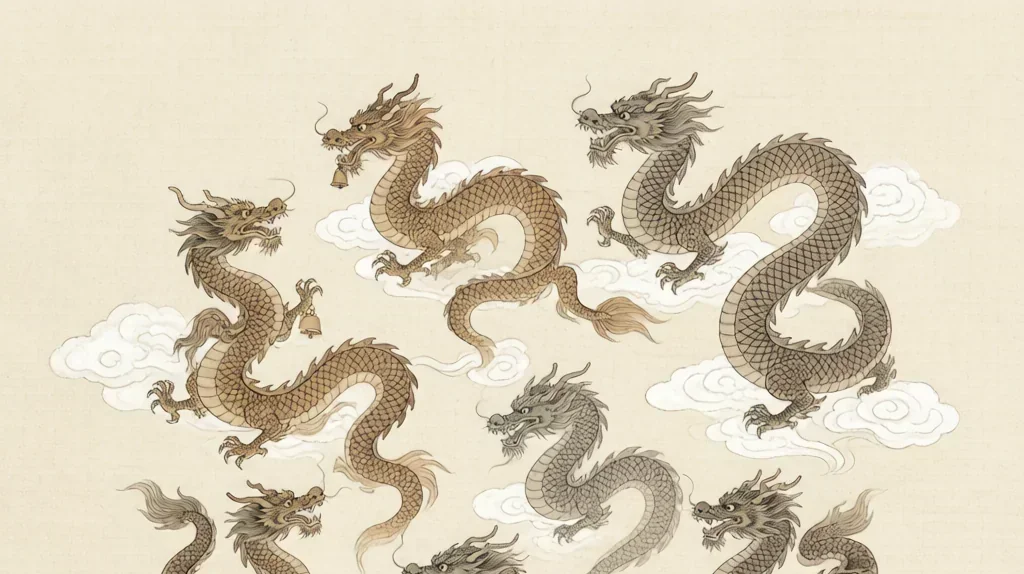
There is a well-known Chinese saying: "The dragon has nine sons, and each is different" (龙生九子,各有所好). The Chinese dragon — that magnificent, serpentine creature of clouds and rain — did not, according to legend, father more dragons. Instead, each of his nine sons was a hybrid creature with its own distinct appearance, personality, and purpose. These nine dragon sons appear throughout Chinese art and architecture, carved into roof ridges, guarding doorways, holding up stone tablets, and adorning musical instruments. Learning to recognize them is like learning to read a hidden language embedded in the visual fabric of traditional Chinese culture.
The Origins: Why Nine Sons?
The "Nine Sons of the Dragon" legend crystallized during the Ming Dynasty (1368–1644), though its roots stretch back much further. The number nine is significant in Chinese numerology — it is the largest single digit, the number of the emperor, and a homophone for "long-lasting" (久). But the phrase "dragon has nine sons" may also simply mean "many sons," as nine was often used in classical Chinese to indicate multiplicity rather than a precise count. Different texts list slightly different nine sons, and regional variations exist. The most widely accepted list comes from the Ming Dynasty scholar Lu Rong's writings and the architectural traditions of the Forbidden City.
Each dragon son represents a particular quality or function, and their images were placed in specific architectural and artistic contexts where their attributes would be most beneficial. Together, they form a comprehensive system of symbolic protection and blessing — a dragon-derived bestiary that watches over every corner of traditional Chinese buildings.
Qiuniu (囚牛): The Musician
Qiuniu is the eldest son, a yellow dragon with a gentle disposition and an extraordinary love of music. He is most often depicted curled around the head of stringed instruments, particularly the huqin (胡琴), a family of two-stringed fiddles. Qiuniu's image on an instrument was believed to enhance its sound and bring inspiration to the musician. Unlike his more martial brothers, Qiuniu represents the refined, cultured aspect of dragon nature — the dragon as patron of the arts. In some traditions, he is depicted with a qin (zither) or pipa (lute), his serpentine body gracefully wrapping around the instrument as if listening.
Yazi (睚眦): The Warrior
If Qiuniu is the artist among the dragon's sons, Yazi is the warrior. His name literally means "the corner of the eye" — a reference to his fierce, glaring expression. Yazi was born with a wolf-like body and a dragon's head, and he possessed a temperament that was quick to anger and eager for battle. The idiom "睚眦必报" (yázì bì bào) means "to seek revenge for even a sideways glance" — describing someone who avenges the slightest grievance.
Yazi's aggressive nature made him the perfect guardian for weapons. His image was carved onto sword hilts, dagger guards, and the handles of battle axes. Warriors believed that Yazi's spirit would lend ferocity to their blows and intimidate their enemies. He represents the martial aspect of dragon power — the righteous anger that defends against evil and injustice.
Chaofeng (嘲风): The Adventurer
Chaofeng is the dragon son who loves adventure and heights. He has the body of a beast and the head of a dragon, and his greatest joy is perching on high places and gazing out over vast distances. This love of elevation made him the natural guardian of roof ridges. In traditional Chinese architecture, Chaofeng is carved at the corners of roof ridges, looking out in all four directions, his image believed to ward off evil spirits and protect the building from fire and disaster.
Chaofeng's adventurous spirit also carries symbolic meaning: he represents the courage to explore, to climb to new heights, and to survey the world from an elevated perspective. His presence on a building suggests that its inhabitants share these qualities of boldness and vision.
Pulao (蒲牢): The Roaring One
Pulao is the dragon son who loves to roar. He resembles a small dragon and lives by the sea, but despite his fearsome voice, he is terrified of whales. Whenever a whale approaches, Pulao roars in terror — and this roaring made him the guardian of bells. His image is cast onto the top of large bronze bells, and the striking hammer is often shaped like a whale, so that when the bell is rung, the "whale" strikes Pulao and produces a loud, resonant sound.
The association between Pulao and bells is found in temples and palaces throughout China. The great bells of Buddhist monasteries, Confucian temples, and imperial courts all bear his image. His roar, carried by the bell's resonance, was believed to reach the heavens and the underworld, communicating prayers and announcements to the spirit world.
Suanni (狻猊): The Fire Lover
Suanni is the dragon son who loves fire and smoke. He has a lion-like body — indeed, his name is sometimes used interchangeably with the Chinese word for lion — and he is drawn to flames. This affinity made him the guardian of incense burners and Buddhist thrones. In temples, Suanni is carved sitting regally at the base of incense burners, breathing in the fragrant smoke of offerings. On Buddhist altars, his image supports the lotus throne of the Buddha.
Suanni's association with fire and incense connects him to spiritual practices. The rising smoke of incense carries prayers to heaven, and Suanni, guardian of the flames, ensures that the communication reaches its destination. His calm, seated posture contrasts with the more active dragon sons, suggesting meditation, stillness, and spiritual contemplation.
Bixi (赑屃): The Strong One
Bixi is perhaps the most frequently encountered of the dragon sons. He has the body of a giant tortoise and the head of a dragon, and he possesses immense physical strength. His great joy is carrying heavy objects on his back. This made him the natural bearer of stone stelae — the tall stone tablets inscribed with important texts that stand in temples, palaces, and tombs throughout China.
Bixi's image supporting a stele represents endurance, stability, and the weight of history. The texts he carries are often imperial edicts, Confucian classics, or memorial inscriptions — the most important written records of Chinese civilization. By placing these texts on Bixi's back, the builders symbolically ensured that they would be supported by dragon strength for eternity. Some of the largest Bixi statues weigh over 100 tons, bearing stelae that rise 8 meters or more.
Bi'an (狴犴): The Judge
Bi'an is the dragon son with a tiger-like body and a deep sense of justice. He is drawn to litigation and debate, and his image was placed at the gates of prisons and above the entrance to courtrooms. Bi'an represents the impartial application of law — fierce enough to deter wrongdoers, wise enough to discern truth from falsehood.
In traditional Chinese yamen (government offices), Bi'an's image served as a reminder that justice, like the dragon, sees all and cannot be deceived. Prisoners passing beneath his carved gaze were meant to reflect on their crimes. Judges sitting in his presence were reminded of their duty to be fair. Bi'an embodies the Confucian ideal that law should be enforced not through cruelty but through moral authority.
Baxia (霸下): The Water Master
Baxia, sometimes confused with Bixi due to their similar names, is the dragon son who loves water. He has the body of a dragon but a preference for aquatic environments. His image was placed on bridges, canal locks, and the stone railings of waterfront structures. Baxia was believed to control floods, calm rough waters, and protect travelers crossing rivers and streams.
The distinction between Bixi and Baxia is subtle but important: Bixi carries weight (stone stelae), while Baxia controls water. In some traditions, they are considered the same being in different contexts; in others, they are distinct sons. The ambiguity reflects the organic nature of Chinese mythology, where boundaries between figures are often fluid.
Chiwen (螭吻): The Devourer
Chiwen, also called Chiwei (螭尾), is the dragon son with a fish-like tail and a dragon's head, who loves to swallow things. His image crowns the ridges of imperial roofs, where he appears to be devouring the roof beam. But Chiwen is also associated with water, and his presence on rooftops was believed to protect buildings from fire — the greatest threat to wooden Chinese architecture.
Chiwen's dual nature — devouring yet protective, fire-associated yet water-bringing — makes him a complex figure. On the roofs of the Forbidden City, Chiwen figures hold the ridge beam in their mouths, their tails curling upward toward the sky. A sword is often thrust through their bodies, pinning them to the roof and preventing them from flying away. This image of the dragon son, pierced by a sword yet still guarding the building, is one of the most distinctive sights in Chinese architectural ornament.
The Living Legacy
Today, the nine dragon sons remain everywhere in Chinese visual culture — if you know where to look. Tourists at the Forbidden City walk past Bixi bearing stelae, beneath Chiwen on the rooflines, past Bi'an at the gates. Musicians play instruments adorned with Qiuniu. Temple bells ring with Pulao's roar. The dragon's nine sons are not forgotten deities but living presences in the built environment, their images continuing to protect, inspire, and remind.
The saying "the dragon has nine sons, each different" has also become a metaphor for diversity and individuality. It reminds us that even within a single family, each child is unique — with their own talents, temperaments, and paths. The dragon, mightiest of all creatures, did not demand that his sons be like him. He let each become what they were meant to be. In that, perhaps, lies the deepest wisdom of the legend.
❓ Frequently Asked Questions
📝 Chinese Vocabulary
- 龙生九子 (Lóng Shēng Jiǔ Zǐ) — "The dragon has nine sons," the proverb about diversity and the origin of these mythical beings.
- 赑屃 (Bìxì) — The tortoise-dragon who carries stone stelae, the most commonly seen dragon son at historical sites.
- 睚眦必报 (Yázì Bì Bào) — An idiom meaning to seek revenge for even the smallest grievance, named after the warrior dragon son.
- 螭吻 (Chīwěn) — The fish-tailed dragon son who guards roof ridges and protects buildings from fire.
🎉 Fun Facts
- Different historical texts list different dragon sons — the Ming Dynasty's "Shuyuan Zaji" lists one set, while the "Huailu Tangji" lists another, with some overlap.
- The largest Bixi statue in China, at the Ming Xiaoling Mausoleum in Nanjing, weighs over 100 tons and supports a stele nearly 9 meters tall.
- In the Forbidden City, Chiwen figures on the roof ridges weigh up to 4 tons each and are secured with iron chains to prevent them from being dislodged by earthquakes.
- Qiuniu, the eldest son, loved music so dearly that his curled figure still ornaments the heads of two-stringed fiddles such as the erhu.
- Chaofeng craved heights and wide views, which is why his statue braces the corners of roof ridges, gazing outward over the land.
- Suanni adored fire and smoke, so his lion-like form sits at the base of temple incense burners, breathing the offerings upward.