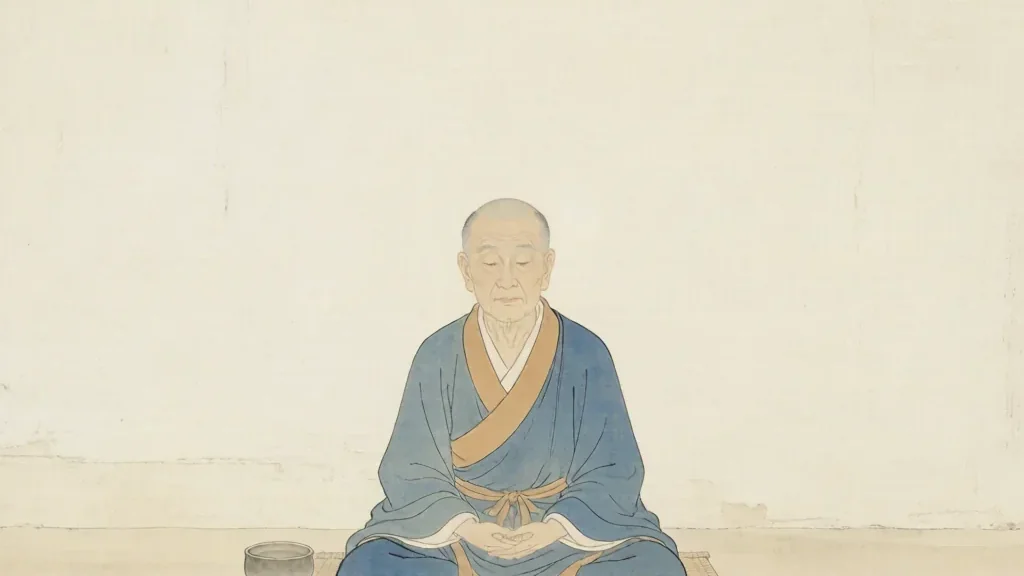
Imagine sitting in silence for nine years, facing a blank wall, saying nothing at all. This was the method of Bodhidharma, the legendary Indian monk who brought a revolutionary form of Buddhism to China. His teaching would evolve into Chan — the School of Meditation — a tradition so distinctively Chinese that it is often called the most original product of the Chinese Buddhist mind.
The Blue-Eyed Barbarian
Bodhidharma (菩提达摩, Pútídámó) arrived in China around 520 CE, during the turbulent Southern and Northern Dynasties period. Legends describe him as a fierce, bearded monk with piercing blue eyes — a "blue-eyed barbarian" whose uncompromising style shocked the Chinese Buddhist establishment.
The most famous story about Bodhidharma concerns his meeting with Emperor Wu of Liang, a devout Buddhist who had built countless temples and supported thousands of monks. "What merit have I earned?" the emperor asked. "No merit at all," Bodhidharma replied. The emperor, bewildered, asked about the highest truth of Buddhism. "Vast emptiness," said Bodhidharma, "nothing holy." When the emperor demanded to know who stood before him, the monk answered simply: "I don't know."
This exchange, recorded in Chan literature, encapsulates the tradition's radical approach. Merit-making, scripture study, and ritual piety — all were brushed aside. What mattered was direct, personal realization. Finding no receptive audience at court, Bodhidharma crossed the Yangtze River on a single reed (so the legend says) and retreated to the Shaolin Monastery, where he sat facing a wall for nine years in deep meditation.
Bodhidharma is traditionally credited with introducing two revolutionary ideas to Chinese Buddhism: first, that enlightenment is a direct transmission from mind to mind, outside the scriptures; and second, that one's own mind is itself the Buddha. He is also said to have taught the monks of Shaolin physical exercises to strengthen their bodies for long meditation sessions — the legendary origin of Shaolin martial arts.
The Sixth Patriarch's Poetry Contest
If Bodhidharma planted the seed, it was Huineng (慧能, 638–713 CE) who made it flower. His story, recorded in the Platform Sutra, is one of the most dramatic in Buddhist literature.
Huineng was an illiterate woodcutter from the southern frontier, a region Chinese elites considered barbaric. One day, while delivering firewood, he heard someone recite the Diamond Sutra and experienced a flash of awakening. He traveled to the monastery of the Fifth Patriarch, Hongren, who assigned him to menial labor in the kitchen.
When Hongren prepared to name his successor, he asked the monks to compose a verse demonstrating their understanding. The head monk, Shenxiu, wrote on the wall:
"The body is the bodhi tree,
The mind is like a bright mirror's stand.
At all times we must strive to polish it,
And must not let dust collect."
The verse reflected the gradual approach: enlightenment required constant effort to purify the mind. Huineng, who could not read, had someone read the verse to him. He then dictated his own response:
"Bodhi originally has no tree,
The bright mirror also has no stand.
Fundamentally there is not a single thing —
Where could dust alight?"
Huineng's verse expressed the doctrine of sudden enlightenment (顿悟, dùnwù): the Buddha-nature is already perfect within us. There is nothing to polish, nothing to attain — only to realize. Hongren recognized Huineng's superior understanding and secretly transmitted the robe and bowl of the patriarchate to him at midnight. Fearing jealousy from the other monks, Huineng fled south and eventually established what became known as the Southern School of Chan.
The split between Shenxiu's "gradual" Northern School and Huineng's "sudden" Southern School defined Chan's early history. The Southern School eventually prevailed, and all surviving Chan lineages trace themselves back to Huineng. The Platform Sutra, the only Chinese Buddhist text accorded the status of "sutra" (a word usually reserved for the Buddha's own words), remains one of the tradition's foundational texts.
Koans and the Art of Perplexity
Perhaps no aspect of Chan is more famous — or more misunderstood — than the koan (公案, gōng'àn), literally "public case." Koans are paradoxical stories, questions, or statements used to short-circuit the rational mind and provoke a direct experience of enlightenment.
The most famous koan is attributed to Master Zhaozhou: a monk asked, "Does a dog have Buddha-nature?" Zhaozhou answered, "Wu" (无) — meaning "no" or "not." But this was not a philosophical answer. The word "wu" functions as a tool for meditation; the student sits with it until the distinction between yes and no, self and other, collapses entirely.
Other classic koans include "What is the sound of one hand clapping?" and "What was your original face before your parents were born?" These are not riddles with clever answers. They are devices for breaking through conceptual thinking. A student might work on a single koan for years, presenting their understanding to the master in private interviews (独参, dúcān). The master tests the student's insight not through logical explanation but through spontaneous interaction — a gesture, a shout, or a sudden blow with a stick.
During the Song Dynasty, masters compiled koan collections like the Blue Cliff Record (碧岩录) and the Gateless Gate (无门关), which remain central texts in Chan and Zen practice. These collections include not only the koans themselves but also commentaries and poems that illuminate their meaning — though ultimately, Chan insists, the meaning can only be grasped through direct experience.
The Cultural Flowering of Chan
Chan's influence extended far beyond the meditation hall. During the Tang and Song dynasties, Chan aesthetics permeated Chinese culture. The ideal of spontaneous, effortless creativity — captured in the phrase "the mind like a mirror, reflecting things as they are" — transformed poetry, painting, and calligraphy.
The great Tang poet Wang Wei was a devout Chan practitioner whose nature poems capture the stillness and clarity of meditative awareness. The monochrome ink-wash landscapes of the Southern Song, with their vast empty spaces and solitary figures, express the Chan vision of the self dissolving into the totality of nature.
Chan also shaped the Chinese tea ceremony (茶道, chádào). The saying "Chan and tea share the same flavor" (禅茶一味, chán chá yīwèi) reflects the shared emphasis on mindfulness, simplicity, and present-moment awareness. The Japanese tea ceremony, with its elaborate ritual of precise, meditative movements, is a direct descendant of Chan-inspired tea practices brought from China by the monk Eisai in the twelfth century.
And then there is Shaolin kung fu. While the historical connection between Bodhidharma and martial arts is debated, the Shaolin Monastery became synonymous with martial arts training, which was understood as a form of moving meditation. The discipline, focus, and mind-body integration required by martial arts aligned perfectly with Chan principles.
The Living Tradition
Chan's influence today extends worldwide through its Japanese descendant, Zen. But in China itself, Chan remains a living tradition. Monasteries like Shaolin continue to train monks and attract pilgrims. The practice of seated meditation (坐禅, zuòchán) and koan study continues in temples and lay communities. And the radical message of Chan — that enlightenment is not something to achieve but something to realize, right here, right now — continues to inspire seekers around the world.
In the end, Chan's greatest teaching may be its simplest: the ordinary mind is the Way. Enlightenment is not a distant goal but the very ground beneath your feet.
The Linji and Caodong Schools
After Huineng, Chan divided into several lineages, of which the Linji and Caodong schools became the most influential. The Linji lineage, founded by the Tang master Linji Yixuan, favored abrupt methods: a shouted question, a blow with a stick, or a sudden gesture meant to shatter a student's fixed ideas. Its teaching aids included the famous three barriers, set phrases that forced the mind into a corner. The Caodong school, by contrast, emphasized silent illumination, a calm, sustained sitting in which distinctions gently dissolve without dramatic shock. Both aimed at the same awakening but offered different temperaments a path. These schools spread through monasteries across China and later into Japan as Rinzai and Soto Zen, carrying Chan's two great teaching styles to the wider world.
Chan Meditation in Daily Life
Chan is often associated with long hours on a cushion, yet its teachers insist the practice extends into ordinary action. Washing a bowl, drinking tea, or sweeping the courtyard can become meditation when done with full attention and without grasping at results. The saying Chan and tea share one flavor captures this fusion of mindfulness and routine, where the ceremonial preparation of tea becomes a moving form of stillness. Lay practitioners today join weekend retreats, sit in silence before work, or recite a phrase to steady the mind in busy moments. The point is not to escape life but to meet it directly, moment by moment, without the fog of constant commentary. In this everyday mode Chan's radical claim becomes practical: the awakened mind is not a distant prize but the ordinary awareness already present beneath habit.
Chan's Spread to Japan and the West
Chan left China through travel and translation, taking root most famously in Japan as Zen. Monks such as Eisai and Dogen carried Linji and Caodong methods across the sea in the twelfth and thirteenth centuries, where they became Rinzai and Soto Zen and shaped Japanese tea, archery, and garden design. Later, in the twentieth century, teachers brought Chan and Zen to Europe and the Americas, where meditation centers and universities introduced its practice to new audiences. The encounter with the West produced new hybrids, from mindfulness programs to ink-painting workshops, while Chinese and Taiwanese temples kept the older liturgical forms alive. Today the school founded by a blue-eyed barbarian at Shaolin is a global tradition, proof that a distinctly Chinese insight into the mind can travel far beyond its native soil.
菩提达摩 — : Bodhidharma, the Indian monk traditionally honored as the first patriarch of Chan in China.
慧能 — : Huineng, the illiterate woodcutter recognized as the Sixth Patriarch and founder of the Southern School of sudden enlightenment.
六祖 — : The Sixth Patriarch, the title of Huineng, from whom all surviving Chan lineages trace their descent.
临济宗 — : The Linji school, the most influential Chan lineage, known for abrupt teaching methods.
棒喝 — : The stick and the shout, Chan teaching devices used to jolt a student out of conceptual thought.
禅茶一味 — : Chan and tea share one flavor, the saying linking meditation with the mindful tea ceremony.
南宗 — : The Southern School of Chan, which taught sudden enlightenment and eventually prevailed over the Northern School.
默照 — : Silent illumination, a calm, wordless meditation style associated with the Caodong school.
❓ Frequently Asked Questions
🎉 Fun Facts
- The word "Zen" is simply the Japanese pronunciation of the Chinese character 禅 (chán), which itself comes from the Sanskrit word dhyāna (meditation).
- According to legend, Bodhidharma was so frustrated with himself for falling asleep during meditation that he cut off his own eyelids. Where they fell, the first tea plants grew — explaining tea's association with alertness during meditation.
- The Platform Sutra is the only Chinese Buddhist text to be called a "sutra" — a title normally reserved for texts believed to be the direct words of the Buddha.
- Chan teachers developed the ox-herding pictures, a series of ten images tracing the mind from a lost ox to perfect enlightenment, still used as a meditation map.
- The Linji school taught through three barriers, puzzling phrases a student had to penetrate, showing how structured even wordless Chan could be.
- Bodhidharma's nine years of wall-gazing became the model of sheer endurance in seated meditation, inspiring generations of monks to sit through long, silent retreats.
- Chan teachers developed the ox-herding pictures, a series of ten images tracing the mind from a lost ox to perfect enlightenment, still used as a meditation map.
- The Linji school taught through three barriers, puzzling phrases a student had to penetrate, showing how structured even wordless Chan could be.
- Bodhidharma's nine years of wall-gazing became the model of sheer endurance in seated meditation, inspiring generations of monks to sit through long, silent retreats.