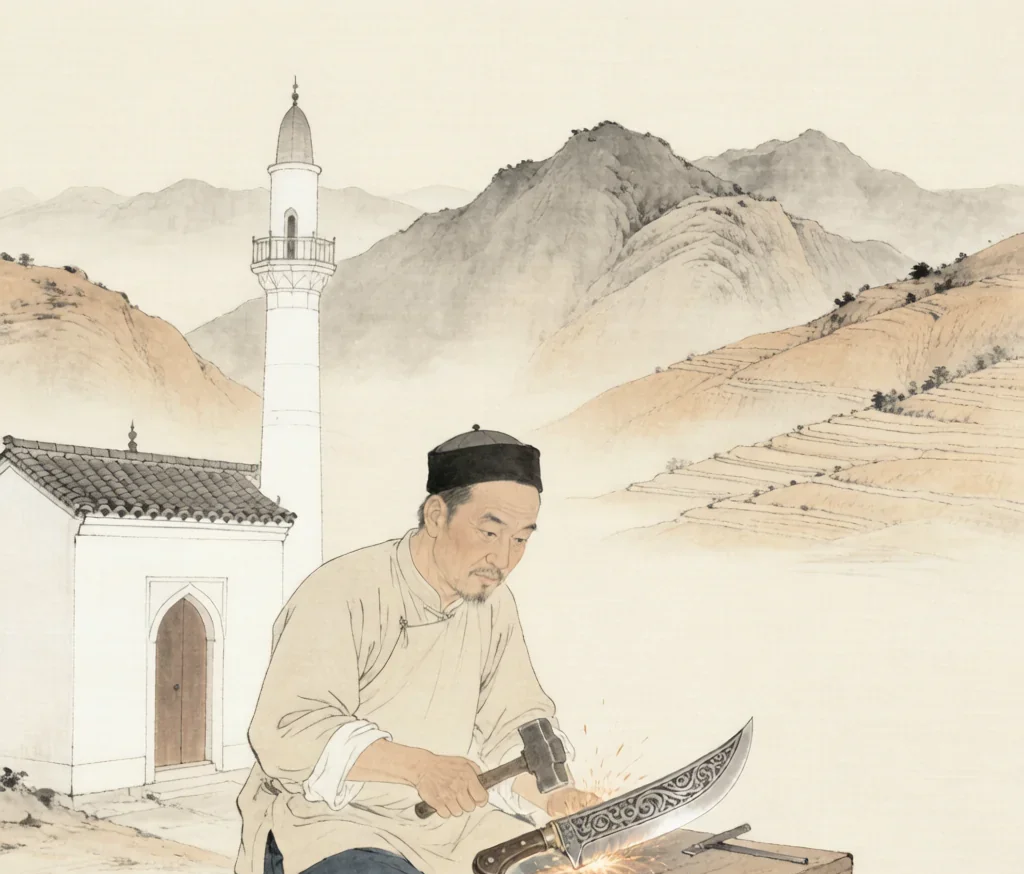
In the arid mountains of the Jishishan Bonan, Dongxiang and Salar Autonomous County in Gansu, the Bonan people (保安族, Bǎo ān zú) are one of China's smallest Muslim minorities, with approximately 24,000 people. They are renowned for their extraordinary craftsmanship: the Bonan waist knife.
The Bonan Waist Knife
The Bonan waist knife (保安腰刀, bǎo ān yāo dāo) is the community's most celebrated cultural achievement, recognized as a National Intangible Cultural Heritage. These knives are renowned for exceptional sharpness, durability, and beauty. Production involves sophisticated metalworking — the blade is forged from high-quality steel, and the handle and scabbard are crafted from copper, silver, bone, and horn, often decorated with intricate engravings and inlays. The most famous type is the "Ten Brocade Knife" (什样锦, shí yàng jǐn), featuring elaborate decorative work. Bonan knives are prized throughout northwestern China and beyond, and the craft supports many Bonan families.
Islamic Faith and Culture
The Bonan are Sunni Muslims, and Islam defines their cultural identity. Their ancestors were Mongol and Central Asian Muslim soldiers who settled in the region during the Yuan Dynasty. Bonan communities are organized around mosques, and religious life follows the Islamic calendar with Ramadan fasting and Eid celebrations. The Bonan language belongs to the Mongolic family, related to Dongxiang and Mongolian, but is endangered, with most Bonan now speaking Mandarin Chinese.
Agriculture and Daily Life
The Bonan homeland is arid and mountainous, requiring adaptive agriculture — wheat, potatoes, and dryland crops on terraced hillsides, supplemented by sheep herding. Bonan cuisine follows halal dietary laws, featuring lamb, hand-pulled noodles, and distinctive baked breads. Despite their small population, the Bonan maintain strong cultural identity through their knife-making tradition, Islamic faith, and community solidarity.
More About This Ethnic Group
The ethnic minority groups of China represent an extraordinary tapestry of cultural diversity, stretching across the vast landscapes of this ancient land. With 55 officially recognized minority nationalities alongside the Han majority, each group contributes unique traditions, languages, and customs that have been carefully preserved and passed down through countless generations. These communities are primarily concentrated in the autonomous regions of Tibet, Xinjiang, Inner Mongolia, Ningxia, and Guangxi, as well as in the culturally rich provinces of Yunnan, Guizhou, Sichuan, and Qinghai, where some of the most diverse concentrations of ethnic cultures in the world can be found.
China's ethnic minority policies provide important protections for minority languages, cultural practices, and regional autonomy. Many minority communities have autonomous prefectures or counties where their languages are used in local government, education, and media. Traditional festivals, such as the Dai Water-Splashing Festival, the Yi Torch Festival, and the Mongolian Naadam, are celebrated with government support and draw visitors from around the world. These celebrations are not merely tourist attractions but living expressions of cultural identity that reinforce community bonds and transmit cultural knowledge to younger generations.
The cultural heritage of these communities extends to every aspect of daily life — from distinctive architectural styles adapted to local environments, to colorful traditional costumes that encode social information through their patterns and designs, to unique musical instruments and dance forms that express the community's relationship with nature and the cosmos. Embroidery, silverwork, textile weaving, paper-cutting, and countless other handicrafts continue to thrive in minority regions, with many recognized as national or even UNESCO Intangible Cultural Heritage. These crafts are not frozen museum pieces but living traditions that evolve while maintaining their essential character.
In recent decades, concerted efforts to document and preserve minority languages and oral traditions have intensified across China. Scholars and cultural workers collaborate with community elders to record epic poems, folk songs, creation myths, and traditional ecological knowledge before they fade from living memory. Many minority languages that once had no written form now have standardized writing systems, and bilingual education programs help ensure that children can learn both their mother tongue and Mandarin Chinese. Museums, cultural centers, and digital archives have been established to safeguard this heritage for future generations.
Tourism has also played a significant role in the revitalization of minority cultures, offering economic opportunities while raising awareness of the importance of cultural preservation. Ethnic tourism allows visitors to experience traditional architecture, sample distinctive cuisines, purchase handmade crafts directly from artisans, and participate in local festivals. When managed responsibly, this engagement provides income that supports the continuation of traditional practices and gives communities a stake in preserving their cultural heritage. For travelers and culture enthusiasts, visiting minority villages and participating in local festivals offers an authentic window into China's remarkable cultural mosaic and the enduring vitality of its ethnic traditions.
China's Ethnic Diversity
China is home to 56 officially recognized ethnic groups, including the Han majority and 55 minority nationalities. These minority communities are primarily concentrated in autonomous regions and provinces such as Yunnan, Guizhou, Sichuan, Guangxi, Xinjiang, Tibet, and Inner Mongolia. Each ethnic group has its own distinct language, customs, traditional costumes, and festivals, contributing to the rich cultural mosaic of the nation.
In recent decades, significant efforts have been made to document and preserve the languages, oral traditions, and cultural practices of China's ethnic minorities. Many traditional crafts, festivals, and art forms have been recognized as National Intangible Cultural Heritage, ensuring their protection and transmission to future generations. Through cultural tourism, academic research, and government support, these unique traditions continue to thrive and gain appreciation both within China and internationally.
Bonan Weddings and Family Life
Bonan marriage customs weave Islamic practice together with local Gansu tradition. Matches are often arranged with the involvement of both families, and a bride-price is customary before the wedding. Ceremonies include a procession, a shared feast, and blessings offered according to Muslim rite, with the community gathering to celebrate across several days.
Bonan Cuisine and Halal Traditions
Bonan food follows halal dietary law, built around lamb, wheat-based noodles, and hearty baked breads suited to the cold, arid highlands. Hand-pulled noodles and mutton soups are everyday staples, while festive occasions add richer dishes. The shared culinary vocabulary with neighboring Hui, Dongxiang, and Salar Muslims reflects the close cultural ties of the region.