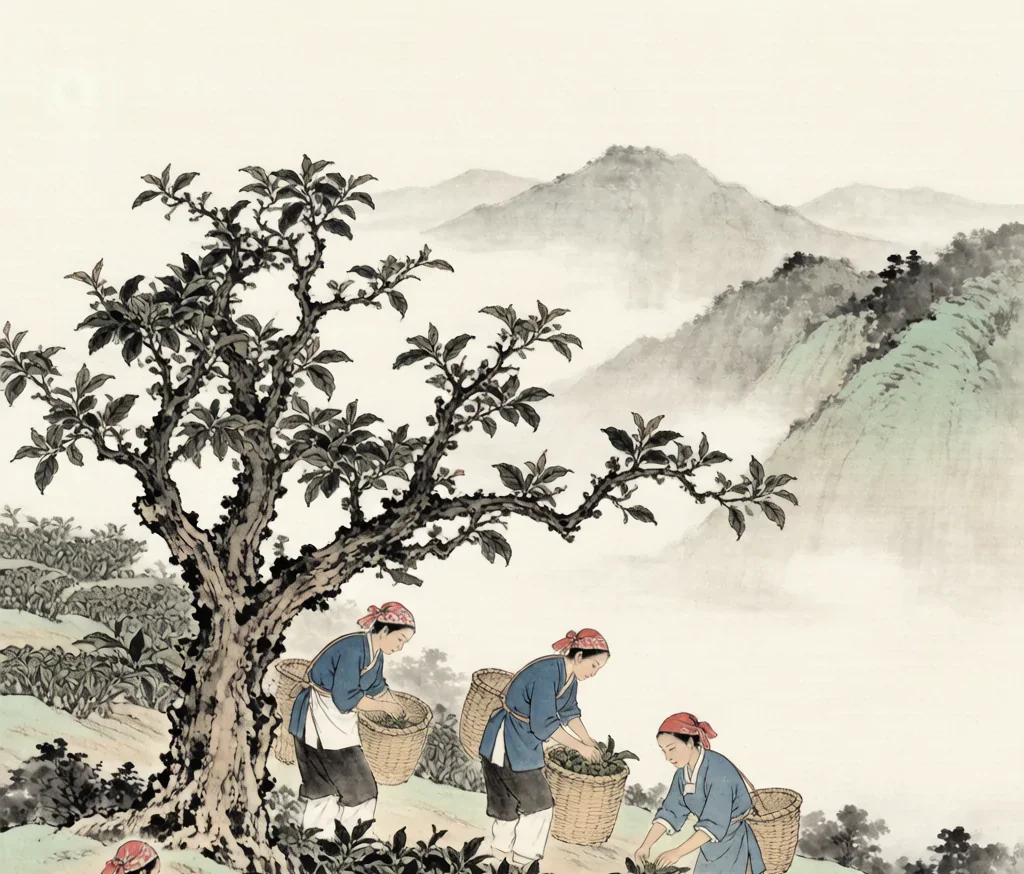
In the subtropical mountains of southern Yunnan, the Blang people (布朗族, Bù lǎng zú) have cultivated tea for over a thousand years. With a population of approximately 127,000, the Blang are among the world's earliest tea-cultivating peoples, and their ancient tea gardens contain trees over a millennium old.
The Ancient Tea Culture
According to Blang oral tradition, their legendary ancestor Pa Aileng (帕哎冷) discovered tea and taught its cultivation. He is revered as the "Tea Ancestor" (茶祖, chá zǔ), with shrines where offerings are made. Blang tea cultivation integrates tea trees under forest canopy — a multi-layered agroforestry system maintaining biodiversity while producing high-quality leaves. Pu'er tea (普洱茶, pǔ ěr chá), one of China's most famous teas, originates from these ancient tea forests. Some trees have been producing leaves for over 1,000 years, since the Tang Dynasty, and aged Pu'er from Blang gardens can sell for thousands of dollars per kilogram.
Festivals and Religion
The Blang celebrate the New Year coinciding with the Dai Water-Splashing Festival in mid-April, with water splashing, temple ceremonies, and feasting. The "Closing the Door" and "Opening the Door" festivals (关门节/开门节) mark the Buddhist rainy season retreat. The Blang practice Theravada Buddhism alongside older animist beliefs, venerating nature spirits, ancestral spirits, and the spirit of the tea mountains.
Blang Society
Blang villages are autonomous communities governed by customary law, Buddhist principles, and modern administration. Courtship is relatively free, with young people choosing partners and weddings involving elaborate ceremonies and gift exchanges. Newly married couples typically live with the bride's family initially before establishing independent households.
More About This Ethnic Group
The ethnic minority groups of China represent an extraordinary tapestry of cultural diversity, stretching across the vast landscapes of this ancient land. With 55 officially recognized minority nationalities alongside the Han majority, each group contributes unique traditions, languages, and customs that have been carefully preserved and passed down through countless generations. These communities are primarily concentrated in the autonomous regions of Tibet, Xinjiang, Inner Mongolia, Ningxia, and Guangxi, as well as in the culturally rich provinces of Yunnan, Guizhou, Sichuan, and Qinghai, where some of the most diverse concentrations of ethnic cultures in the world can be found.
China's ethnic minority policies provide important protections for minority languages, cultural practices, and regional autonomy. Many minority communities have autonomous prefectures or counties where their languages are used in local government, education, and media. Traditional festivals, such as the Dai Water-Splashing Festival, the Yi Torch Festival, and the Mongolian Naadam, are celebrated with government support and draw visitors from around the world. These celebrations are not merely tourist attractions but living expressions of cultural identity that reinforce community bonds and transmit cultural knowledge to younger generations.
The cultural heritage of these communities extends to every aspect of daily life — from distinctive architectural styles adapted to local environments, to colorful traditional costumes that encode social information through their patterns and designs, to unique musical instruments and dance forms that express the community's relationship with nature and the cosmos. Embroidery, silverwork, textile weaving, paper-cutting, and countless other handicrafts continue to thrive in minority regions, with many recognized as national or even UNESCO Intangible Cultural Heritage. These crafts are not frozen museum pieces but living traditions that evolve while maintaining their essential character.
In recent decades, concerted efforts to document and preserve minority languages and oral traditions have intensified across China. Scholars and cultural workers collaborate with community elders to record epic poems, folk songs, creation myths, and traditional ecological knowledge before they fade from living memory. Many minority languages that once had no written form now have standardized writing systems, and bilingual education programs help ensure that children can learn both their mother tongue and Mandarin Chinese. Museums, cultural centers, and digital archives have been established to safeguard this heritage for future generations.
Tourism has also played a significant role in the revitalization of minority cultures, offering economic opportunities while raising awareness of the importance of cultural preservation. Ethnic tourism allows visitors to experience traditional architecture, sample distinctive cuisines, purchase handmade crafts directly from artisans, and participate in local festivals. When managed responsibly, this engagement provides income that supports the continuation of traditional practices and gives communities a stake in preserving their cultural heritage. For travelers and culture enthusiasts, visiting minority villages and participating in local festivals offers an authentic window into China's remarkable cultural mosaic and the enduring vitality of its ethnic traditions.
China's Ethnic Diversity
China is home to 56 officially recognized ethnic groups, including the Han majority and 55 minority nationalities. These minority communities are primarily concentrated in autonomous regions and provinces such as Yunnan, Guizhou, Sichuan, Guangxi, Xinjiang, Tibet, and Inner Mongolia. Each ethnic group has its own distinct language, customs, traditional costumes, and festivals, contributing to the rich cultural mosaic of the nation.
In recent decades, significant efforts have been made to document and preserve the languages, oral traditions, and cultural practices of China's ethnic minorities. Many traditional crafts, festivals, and art forms have been recognized as National Intangible Cultural Heritage, ensuring their protection and transmission to future generations. Through cultural tourism, academic research, and government support, these unique traditions continue to thrive and gain appreciation both within China and internationally.
Blang Cuisine and Betel Nut
Blang food centers on rice, supplemented by vegetables, chili, and foraged plants from the forest garden. Tea is consumed constantly, both as a daily drink and as a medicine, while betel nut (areca) chewing is a long-standing social habit shared with neighboring Southeast Asian peoples. Meals tend to be sour, spicy, and light, suited to the humid subtropical climate.
Blang Dress and Textiles
Traditional Blang clothing uses handwoven cotton dyed in dark, somber tones, with women's jackets often trimmed in contrasting bands and adorned with silver ornaments. Everyday dress has largely given way to modern clothing, but festive and ceremonial costumes are still worn at New Year and temple events, preserving a visual link to Blang identity.