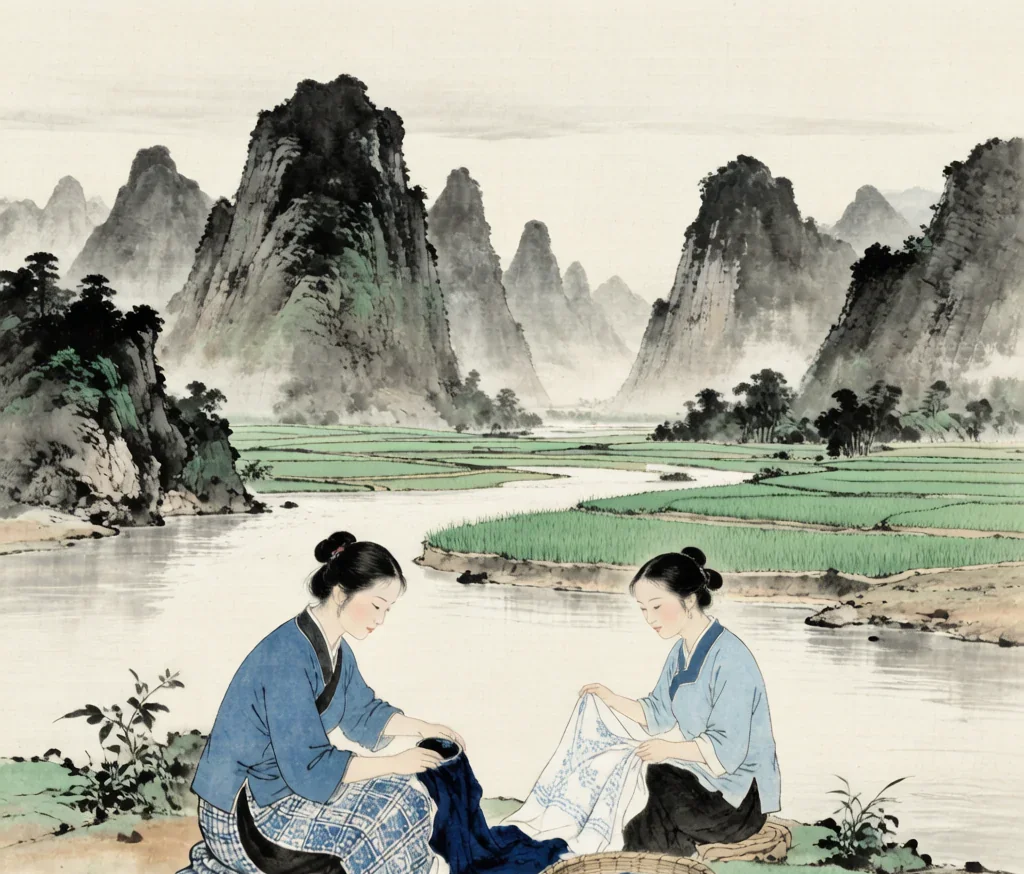
In the karst landscapes of southern Guizhou, where limestone peaks rise dramatically from emerald rice paddies and rivers carve their way through ancient stone, the Buyi people (布依族, Bù yī zú) have developed one of China's most refined textile traditions. With a population of approximately 3.6 million, the Buyi are concentrated primarily in Guizhou province, with smaller communities in Yunnan and Sichuan. Their name, meaning "cloth people" or "cotton people," hints at their most celebrated cultural achievement: the art of batik. The Buyi are one of the most ancient ethnic groups in southwestern China, with a history in the region that predates the arrival of Han Chinese settlers by centuries.
The Art of Batik
Batik (蜡染, là rǎn) is the signature art form of the Buyi people, a wax-resist dyeing technique that produces textiles of extraordinary beauty and complexity. The process is painstaking: hot liquid wax is applied to white cotton cloth using a copper knife-like tool called a canting, tracing intricate patterns by hand. When the wax cools and hardens, the cloth is dipped in indigo dye. The areas covered by wax resist the dye, remaining white, while the exposed fabric turns deep blue. The wax is then removed by boiling, revealing the white pattern against the blue background. This process may be repeated multiple times to create layered patterns with different shades of blue.
The designs of Buyi batik draw from the natural world and Buyi mythology. Common motifs include flowers, butterflies, fish, birds, and geometric patterns representing mountains, rivers, and the cycles of nature. The butterfly is especially significant — in Buyi mythology, the butterfly mother is a creator figure who gave birth to all living things. Each pattern carries meaning, and the ability to compose and execute complex batik designs is a mark of a woman's skill, creativity, and cultural knowledge. Traditionally, a Buyi girl began learning batik from her mother at a young age, and her mastery of the art was an important factor in her marriage prospects.
Rice Culture and Water Festivals
The Buyi are primarily rice farmers, and their agricultural calendar structures their social and spiritual life. The terraced rice paddies of southern Guizhou represent centuries of accumulated knowledge about water management, soil conservation, and the cultivation of dozens of rice varieties adapted to different microclimates. The most important Buyi festival is the "June Sixth" (六月六, liù yuè liù), celebrated on the sixth day of the sixth lunar month, marking the midpoint of the agricultural year. It is a time for worshipping ancestors, praying for good harvests, and celebrating community bonds.
Another distinctive Buyi celebration is the "Third Month Third" (三月三, sān yuè sān), which involves ritual bathing, water games, and the making of special five-color glutinous rice (五色糯米饭, wǔ sè nuò mǐ fàn). The rice is dyed with natural plant extracts — black, red, yellow, purple, and white — each color representing different blessings and aspects of Buyi cosmology. This festival, celebrated at the height of spring, is also a time for young people to court, with singing competitions and social gatherings providing opportunities for romance.
Language and Oral Literature
The Buyi language belongs to the Tai-Kadai language family, related to Zhuang, Dai, and Thai. Like many minority languages in China, it faces challenges from the dominance of Mandarin, but efforts to preserve and revitalize the language continue through cultural programs, broadcasting, and education. The Buyi have a rich oral literature, including creation myths, historical epics, love songs, and ritual chants. The Buyi epic "The Ancient Song" (古歌, gǔ gē) recounts the creation of the world, the origins of the Buyi people, and the great migrations that brought them to their present homeland. Buyi folk songs are classified into mountain songs (山歌, shān gē) sung outdoors during work and travel, wine songs (酒歌, jiǔ gē) performed at banquets, and ritual songs used in weddings, funerals, and religious ceremonies.
Stone Architecture and Village Life
In the rocky karst terrain of southern Guizhou, the Buyi have developed a distinctive stone architecture. Traditional Buyi houses are built of stone — stone walls, stone floors, and even stone roof tiles — creating villages that seem to grow organically from the limestone landscape. The thick stone walls provide excellent insulation against both summer heat and winter cold. Buyi villages are typically located near water — rivers, streams, or springs — reflecting the importance of water in Buyi life and cosmology. The Buyi are known for their hospitality, and guests are welcomed with rice wine and elaborate meals featuring local specialties: sour fish soup (酸汤鱼, suān tāng yú), glutinous rice cakes (糍粑, cí bā), and various pickled vegetables that provide flavor and nutrition throughout the year.
China's Ethnic Diversity
China is home to 56 officially recognized ethnic groups, including the Han majority and 55 minority nationalities. These minority communities are primarily concentrated in autonomous regions and provinces such as Yunnan, Guizhou, Sichuan, Guangxi, Xinjiang, Tibet, and Inner Mongolia. Each ethnic group has its own distinct language, customs, traditional costumes, and festivals, contributing to the rich cultural mosaic of the nation.
In recent decades, significant efforts have been made to document and preserve the languages, oral traditions, and cultural practices of China's ethnic minorities. Many traditional crafts, festivals, and art forms have been recognized as National Intangible Cultural Heritage, ensuring their protection and transmission to future generations. Through cultural tourism, academic research, and government support, these unique traditions continue to thrive and gain appreciation both within China and internationally.