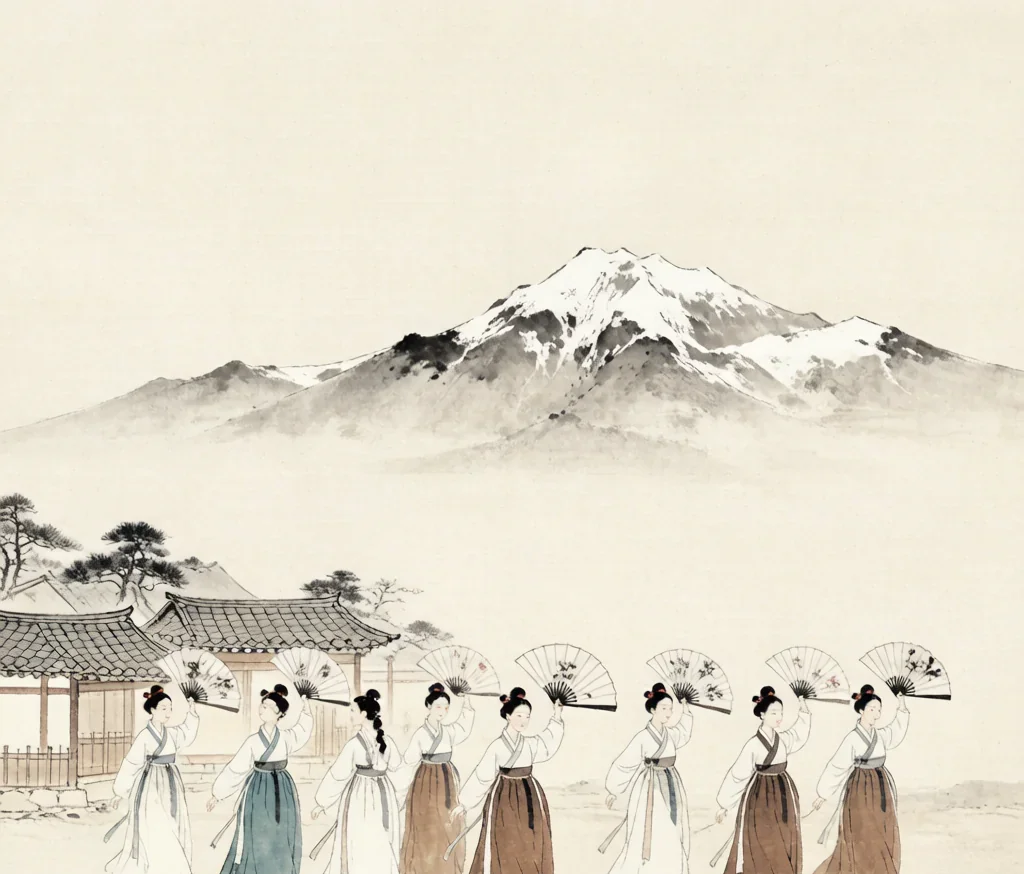
In the Yanbian Korean Autonomous Prefecture of northeastern Jilin province, where the Tumen River marks the border with North Korea and the Changbai Mountains rise snow-capped against the winter sky, the Korean Chinese (朝鲜族, Cháo xiǎn zú) have maintained a vibrant ethnic culture that bridges the Korean peninsula and the Chinese mainland. With a population of approximately 1.7 million, the Korean Chinese are one of China's most distinctive ethnic minorities — a community whose language, cuisine, and traditions have enriched Chinese culture while maintaining deep connections to their Korean heritage.
History and Migration
The Korean presence in what is now northeastern China dates back centuries, but the modern Korean Chinese community was largely formed during the late nineteenth and early twentieth centuries, when economic hardship and Japanese colonial rule drove large numbers of Koreans across the Tumen and Yalu rivers into Manchuria. These immigrants brought with them their language, their agricultural skills — particularly wet-rice cultivation in a region where it had not been widely practiced — and their rich cultural traditions. During the anti-Japanese resistance of the 1930s and 1940s, Korean guerrillas fought alongside Chinese communists, forging strong bonds between the two communities. Today, Yanbian is the heartland of Korean Chinese culture, where Korean is an official language alongside Mandarin, street signs are bilingual, and Korean-language media, schools, and cultural institutions thrive.
Kimchi and Korean Cuisine
Korean Chinese cuisine is one of the community's most beloved contributions to Chinese food culture. At its heart is kimchi (泡菜, pào cài) — fermented vegetables, most commonly napa cabbage, seasoned with chili pepper, garlic, ginger, and fish sauce. The preparation of kimchi, known as gimjang, is a major annual event in Korean Chinese households. In late autumn, families gather to make enough kimchi to last through the long northeastern winter, burying the finished product in special earthenware jars to ferment. Beyond kimchi, Korean Chinese cuisine features Korean barbecue (烤肉, kǎo ròu) with sizzling table grills and arrays of side dishes (banchan), cold noodles (冷面, lěng miàn) — chewy buckwheat noodles in an icy broth — and rice cakes (年糕, nián gāo) featured in holiday celebrations.
The Nongak — Farmers' Music and Dance
The Nongak (农乐舞, nóng lè wǔ), or Farmers' Music and Dance, is the most vibrant expression of Korean Chinese performing arts. Originating in the agricultural rituals of the Korean countryside, Nongak combines drumming, dancing, singing, and acrobatics into a high-energy performance. The most spectacular element is the sangmo (象帽) — the "hat dance" in which performers wear hats with long ribbons attached to the top. By rotating their heads in precise, rapid movements, the dancers send the ribbons spinning through the air in mesmerizing patterns, with the longest ribbons extending over 20 meters. In 2009, the Korean Chinese Nongak was recognized by UNESCO as an Intangible Cultural Heritage of Humanity.
Festivals and Life Cycle Rituals
The Korean Chinese celebrate both traditional Korean holidays and Chinese national holidays. The Lunar New Year (Seollal) is the most important family holiday, marked by ancestor worship (jesa), the wearing of hanbok, and eating tteokguk (rice cake soup). The Harvest Moon Festival (Chuseok) in autumn is a time for giving thanks for the harvest and visiting ancestral graves. The first birthday celebration (dol) is a major event where the child picks an object that predicts their future. The sixtieth birthday (hwangap) marks the completion of the traditional sixty-year zodiac cycle. The Korean Chinese community has placed extraordinary emphasis on education, earning a reputation as one of China's best-educated ethnic minorities, with Korean-language schools producing generations of bilingual graduates who have contributed significantly to Chinese society.
More About This Ethnic Group
The ethnic minority groups of China represent an extraordinary tapestry of cultural diversity, stretching across the vast landscapes of this ancient land. With 55 officially recognized minority nationalities alongside the Han majority, each group contributes unique traditions, languages, and customs that have been carefully preserved and passed down through countless generations. These communities are primarily concentrated in the autonomous regions of Tibet, Xinjiang, Inner Mongolia, Ningxia, and Guangxi, as well as in the culturally rich provinces of Yunnan, Guizhou, Sichuan, and Qinghai, where some of the most diverse concentrations of ethnic cultures in the world can be found.
China's ethnic minority policies provide important protections for minority languages, cultural practices, and regional autonomy. Many minority communities have autonomous prefectures or counties where their languages are used in local government, education, and media. Traditional festivals, such as the Dai Water-Splashing Festival, the Yi Torch Festival, and the Mongolian Naadam, are celebrated with government support and draw visitors from around the world. These celebrations are not merely tourist attractions but living expressions of cultural identity that reinforce community bonds and transmit cultural knowledge to younger generations.
The cultural heritage of these communities extends to every aspect of daily life — from distinctive architectural styles adapted to local environments, to colorful traditional costumes that encode social information through their patterns and designs, to unique musical instruments and dance forms that express the community's relationship with nature and the cosmos. Embroidery, silverwork, textile weaving, paper-cutting, and countless other handicrafts continue to thrive in minority regions, with many recognized as national or even UNESCO Intangible Cultural Heritage. These crafts are not frozen museum pieces but living traditions that evolve while maintaining their essential character.
In recent decades, concerted efforts to document and preserve minority languages and oral traditions have intensified across China. Scholars and cultural workers collaborate with community elders to record epic poems, folk songs, creation myths, and traditional ecological knowledge before they fade from living memory. Many minority languages that once had no written form now have standardized writing systems, and bilingual education programs help ensure that children can learn both their mother tongue and Mandarin Chinese. Museums, cultural centers, and digital archives have been established to safeguard this heritage for future generations.
Tourism has also played a significant role in the revitalization of minority cultures, offering economic opportunities while raising awareness of the importance of cultural preservation. Ethnic tourism allows visitors to experience traditional architecture, sample distinctive cuisines, purchase handmade crafts directly from artisans, and participate in local festivals. When managed responsibly, this engagement provides income that supports the continuation of traditional practices and gives communities a stake in preserving their cultural heritage. For travelers and culture enthusiasts, visiting minority villages and participating in local festivals offers an authentic window into China's remarkable cultural mosaic and the enduring vitality of its ethnic traditions.
Korean Chinese Clothing and Hanbok
The hanbok (韩服) is the signature dress of the Korean Chinese, with women's ensembles of a short jacket and a high-waisted, flowing skirt, and men's robes worn over loose trousers. White is the classic ceremonial color, though festival versions use vivid hues. Hanbok is worn at New Year, weddings, and birthdays, and its making is valued as a craft in its own right.
Traditional Sports and Games
Korean Chinese communal life includes vigorous traditional pastimes. The see-saw (跳板, tiào bǎn) and swinging (秋千, qiū qiān) are especially associated with women, while men practice traditional archery and wresting (ssireum). These games come to the fore at holiday gatherings, combining competition with music and dress.
Education and Community Life
The Korean Chinese place extraordinary value on education, and Yanbian has long run Korean-language schools from kindergarten through university. This bilingual emphasis has produced generations of graduates fluent in Korean and Chinese, sustaining newspapers, broadcasting, and cultural institutions that keep the community's heritage vivid.