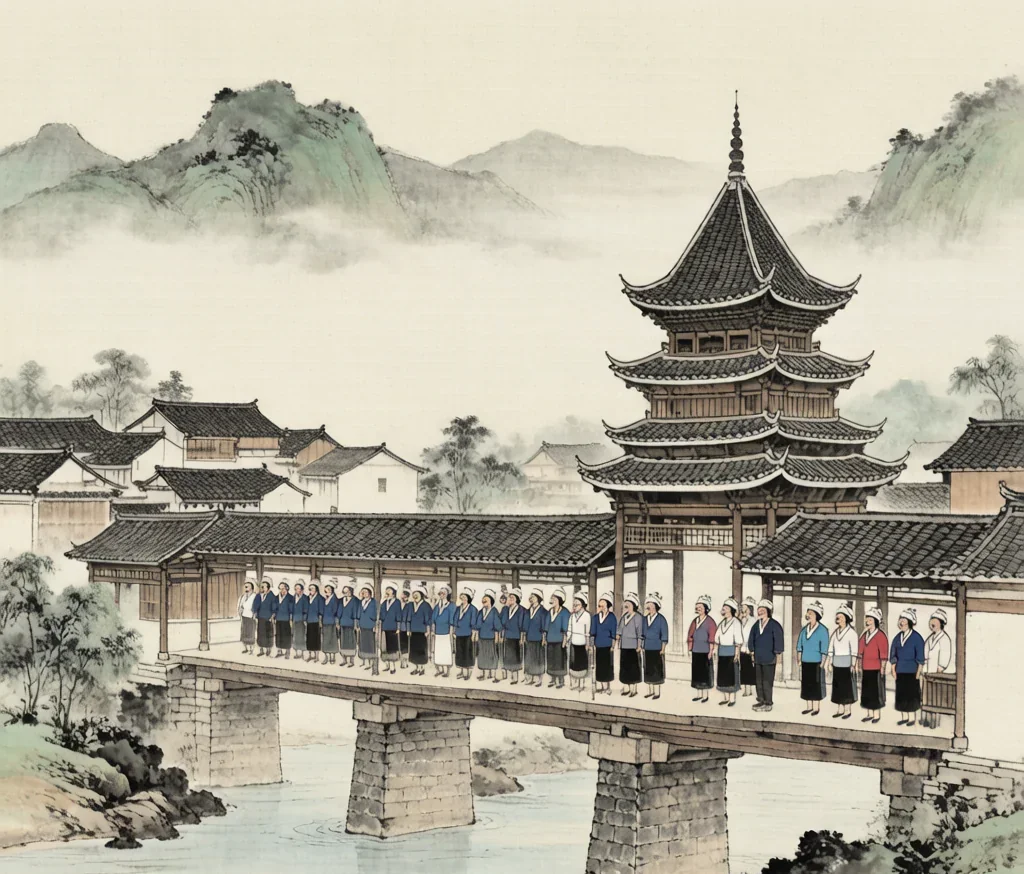
In the misty valleys where Guizhou, Hunan, and Guangxi provinces meet, the Dong people (侗族, Dòng zú) have built a civilization that sings. With a population of approximately 3.5 million, the Dong are renowned throughout China for three extraordinary cultural achievements: their drum towers that pierce the sky, their wind-and-rain bridges that span the rivers, and their polyphonic grand songs that have earned recognition from UNESCO as a Masterpiece of the Oral and Intangible Heritage of Humanity. The Dong say that "rice nourishes the body, but song nourishes the soul" (饭养身,歌养心, fàn yǎng shēn, gē yǎng xīn), and in Dong society, music is not merely entertainment — it is the very fabric of social life.
The Drum Tower — Heart of the Village
Every traditional Dong village is centered around a drum tower (鼓楼, gǔ lóu), a magnificent multi-story wooden structure that rises like a pagoda from the village center. The drum tower is the architectural masterpiece of Dong civilization — built entirely without nails, using intricate mortise-and-tenon joinery, it can reach heights of over 20 meters with multiple layers of sweeping eaves. The tower serves as the village's communal heart: the place where elders gather to discuss village affairs, where young people meet to court, where visitors are received, and where festivals are celebrated. The number of eaves is always odd, reflecting Dong beliefs about auspicious numbers, and the top is decorated with carved figures of dragons, phoenixes, and other mythical creatures.
The Wind-and-Rain Bridge
If the drum tower is the heart of the Dong village, the wind-and-rain bridge (风雨桥, fēng yǔ qiáo) is its gateway and its shelter. These covered bridges, built entirely of wood with stone foundations, feature corridors with benches where travelers can rest, sheltered from wind and rain — hence their poetic name. The most famous example, the Chengyang Wind-and-Rain Bridge (程阳风雨桥) in Guangxi's Sanjiang Dong Autonomous County, stretches over 64 meters with five pavilions and has been called one of the world's most beautiful bridges. Built in 1912, it contains no nails — its entire structure is held together by precisely fitted mortise-and-tenon joints — and it has survived over a century of floods and storms. The bridge serves multiple functions: practical crossing, social gathering space, and spiritual protector, with many bridges containing small shrines to local deities.
The Grand Song — Polyphonic Harmony
The Dong Grand Song (侗族大歌, Dòng zú dà gē) is a form of polyphonic choral singing unlike anything else in Chinese traditional music. Performed by large groups — sometimes dozens or even hundreds of singers — without instrumental accompaniment or a conductor, the Grand Song features multiple interweaving vocal lines that create harmonies of extraordinary complexity and beauty. The songs often imitate the sounds of nature: birds singing, water flowing, wind through bamboo. This is music that emerges from the Dong people's deep connection to their forested, river-crossed homeland. The Grand Song tradition is transmitted orally, passed from generation to generation through informal teaching and community singing. Dong children begin learning songs as soon as they can speak, and by adulthood, a Dong person typically knows hundreds of songs by heart. In 2009, UNESCO inscribed the Dong Grand Song on its Representative List of the Intangible Cultural Heritage of Humanity.
Festivals and Celebrations
The Dong calendar is rich with festivals. The most important is the Spring Festival (春节, chūn jié), celebrated with distinctive Dong customs including traditional bullfighting — water buffalo locking horns in tests of strength. The Dong also celebrate the New Rice Festival (吃新节, chī xīn jié) in autumn, when the first rice of the harvest is offered to ancestors before the community shares a feast. Dong weddings are elaborate affairs that can involve days of ritual, feasting, and — of course — singing. A distinctive Dong courtship custom is "singing in the moonlight" (行歌坐月, xíng gē zuò yuè), in which young men visit young women's homes in the evening to sing love songs, engaging in antiphonal exchanges that can last for hours. Through these musical conversations, couples get to know each other and romantic relationships develop within a socially sanctioned framework.
Cuisine and Daily Life
Dong cuisine reflects the agricultural abundance of their homeland. Sticky rice (糯米, nuò mǐ) is the staple food, preferred over non-glutinous rice varieties. The Dong are famous for their pickled foods — vegetables, fish, and meat preserved through fermentation — which provide flavor and nutrition throughout the year. The Dong practice of "blocking the road with wine" (拦路酒, lán lù jiǔ) — in which visitors are stopped at the village entrance and must drink a cup of rice wine before being allowed to enter — is a famous expression of Dong hospitality. The Dong people, with their drum towers reaching toward heaven and their grand songs filling the valleys, represent a civilization where architecture and music are not separate arts but expressions of the same cultural genius — the ability to create complex, harmonious structures that bring people together and connect them to their community, their ancestors, and their land.