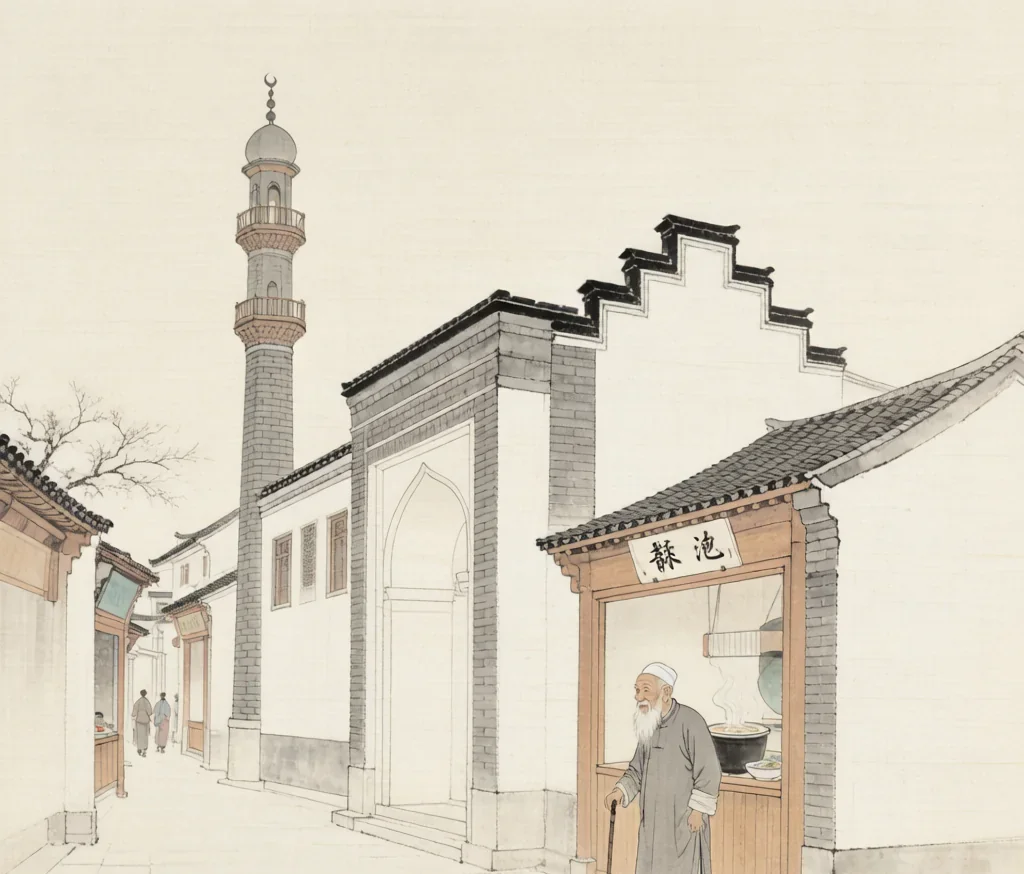
The Hui people (回族, Huí zú) represent one of the most widely distributed ethnic minorities in China, with a population of approximately 11.4 million found in virtually every province and major city across the country. Unlike many other Chinese ethnic minorities who are concentrated in specific autonomous regions, the Hui are distinguished by their remarkable geographic dispersion — from the Ningxia Hui Autonomous Region in the northwest to the bustling Muslim quarters of Beijing, Xi'an, and Kunming. What unites this diverse and far-flung community is not a shared homeland or language, but a shared faith: Islam. The Hui are unique among China's 55 officially recognized ethnic minorities in having no single geographic homeland — they are found in 98% of China's counties, making them the most widely distributed minority group in the country.
Origins and History
The Hui trace their origins to the Silk Road, that ancient network of trade routes that connected China to Central Asia, the Middle East, and beyond. Beginning in the Tang Dynasty (618-907 CE), Arab and Persian merchants arrived in Chinese port cities like Guangzhou and Quanzhou, as well as overland trading posts like Chang'an (modern Xi'an). These Muslim traders married local Han Chinese women, and their descendants formed the nucleus of what would become the Hui community. During the Yuan Dynasty (1271-1368 CE), the Mongol rulers brought large numbers of Central Asian Muslims — soldiers, administrators, craftsmen, and scholars — to China, further enriching the Hui gene pool and cultural heritage.
Throughout Chinese history, the Hui have played significant roles as merchants, scholars, military commanders, and government officials. The famous Ming Dynasty admiral Zheng He (郑和, Zhèng Hé), who led seven epic maritime expeditions across the Indian Ocean between 1405 and 1433, was of Hui descent. His voyages reached as far as East Africa, decades before Columbus crossed the Atlantic, and they remain one of the great achievements of Chinese — and Hui — history. The Hui community has produced generations of Islamic scholars who have worked to reconcile Islamic teachings with Chinese Confucian philosophy, creating a distinctive Sino-Islamic intellectual tradition known as the Han Kitab — literally "Chinese books" about Islam written in classical Chinese by Hui scholars.
Islamic Faith and Practice
Islam is the defining characteristic of Hui identity. The Hui follow Sunni Islam of the Hanafi school, and their religious practice centers on the Five Pillars: the declaration of faith (shahada), daily prayers (salat), fasting during Ramadan, charitable giving (zakat), and the pilgrimage to Mecca (hajj) for those who are able. Hui communities are organized around mosques (清真寺, qīng zhēn sì), which serve not only as places of worship but as community centers where religious education, social gatherings, and charitable activities take place. The call to prayer echoes from minarets across Hui neighborhoods, and the rhythm of daily life is structured around the five prayer times.
The Hui practice of Islam has developed distinctive Chinese characteristics over the centuries. Mosque architecture blends Islamic and Chinese architectural traditions, with prayer halls that feature Chinese-style curved roofs, courtyards, and pagoda-like minarets rather than the domes and pointed arches of Middle Eastern mosques. Islamic calligraphy in China often uses Chinese characters alongside Arabic script, and some Hui scholars have written extensively in classical Chinese about Islamic theology. During Ramadan, Hui communities come alive with night markets selling special foods for breaking the fast, and the celebration of Eid al-Fitr (开斋节, Kāi zhāi jié) and Eid al-Adha (古尔邦节, Gǔ ěr bāng jié) are major events in the Hui calendar that bring entire communities together for prayer, feasting, and celebration.
Cuisine and Halal Culture
Hui cuisine is one of the most visible and beloved contributions of the Hui people to Chinese food culture. The Hui adhere to halal dietary laws, which prohibit the consumption of pork, alcohol, and improperly slaughtered meat. Within these constraints, Hui chefs have developed a rich culinary tradition that combines Chinese cooking techniques with Central Asian and Middle Eastern influences. Lanzhou beef noodle soup (兰州拉面, Lán zhōu lā miàn) is perhaps the most famous Hui dish — hand-pulled noodles served in a clear, aromatic beef broth, found in Muslim restaurants across China and increasingly around the world. The art of pulling noodles by hand, transforming a lump of dough into hundreds of uniform strands through a series of rhythmic stretches and folds, is a culinary performance that has become iconic of Hui food culture.
Other iconic Hui dishes include yangrou paomo (羊肉泡馍), a hearty mutton soup with crumbled flatbread from Xi'an that has been called the "number one dish of the ancient capital"; shouzhua yangrou (手抓羊肉), boiled mutton eaten with the hands and seasoned simply with salt and cumin; and various grilled lamb skewers (羊肉串, yáng ròu chuàn) seasoned with cumin and chili that have become popular street food throughout China. Hui pastries and snacks, such as sanzi (馓子, fried dough twists) and various nut-filled cakes, are especially popular during festivals. The Hui have also contributed to Chinese tea culture, with the "eight-treasure tea" (八宝茶, bā bǎo chá) — a blend of tea leaves, dried fruits, nuts, and rock sugar — being a Hui specialty served to guests as a gesture of hospitality.
Community and Identity
Hui communities in Chinese cities are often organized around a central mosque and are easily identifiable by the presence of halal restaurants, butcher shops, and businesses displaying Arabic calligraphy. The Hui speak Mandarin Chinese as their native language, but their speech is often peppered with Arabic and Persian loanwords related to religious practice. Hui names typically combine a Chinese surname with a Muslim given name — for example, Ma (马), one of the most common Hui surnames, derived from the Chinese transliteration of "Muhammad." Other common Hui surnames include Ha (哈), Sha (沙), and Na (纳), all reflecting the community's Central Asian and Middle Eastern heritage.
Hui identity exists at an interesting intersection of Chinese and Islamic civilization. Unlike the Uyghurs and other Turkic Muslim groups in Xinjiang, the Hui are culturally Chinese in language, dress, and many customs, while maintaining a distinct religious identity. This dual heritage has allowed the Hui to serve as cultural bridges between China and the Islamic world, facilitating trade, diplomacy, and cultural exchange. Today, the Hui continue to navigate the balance between their Chinese nationality and Islamic faith, contributing to China's multicultural society while maintaining the traditions that have defined their community for over a thousand years. From the Great Mosque of Xi'an — one of China's oldest and most architecturally significant mosques — to the bustling Muslim Quarter of Beijing's Niujie district, Hui culture remains a vibrant and essential thread in the fabric of Chinese civilization.