Nestled in the rugged Wuling Mountains that span the borders of Hunan, Hubei, Guizhou, and Chongqing, the Tujia people (土家族, Tǔ jiā zú) have created a culture as dramatic and vibrant as their mountain homeland. With a population of approximately 9.6 million, the Tujia are one of China's larger ethnic minorities, yet their culture remains relatively unknown outside China compared to more famous groups like the Miao or Tibetan. The Tujia name means "local family" or "native people," reflecting their status as one of the indigenous peoples of central China, with a history in the region stretching back over two thousand years.
The Baishou Dance — Dancing with Hands
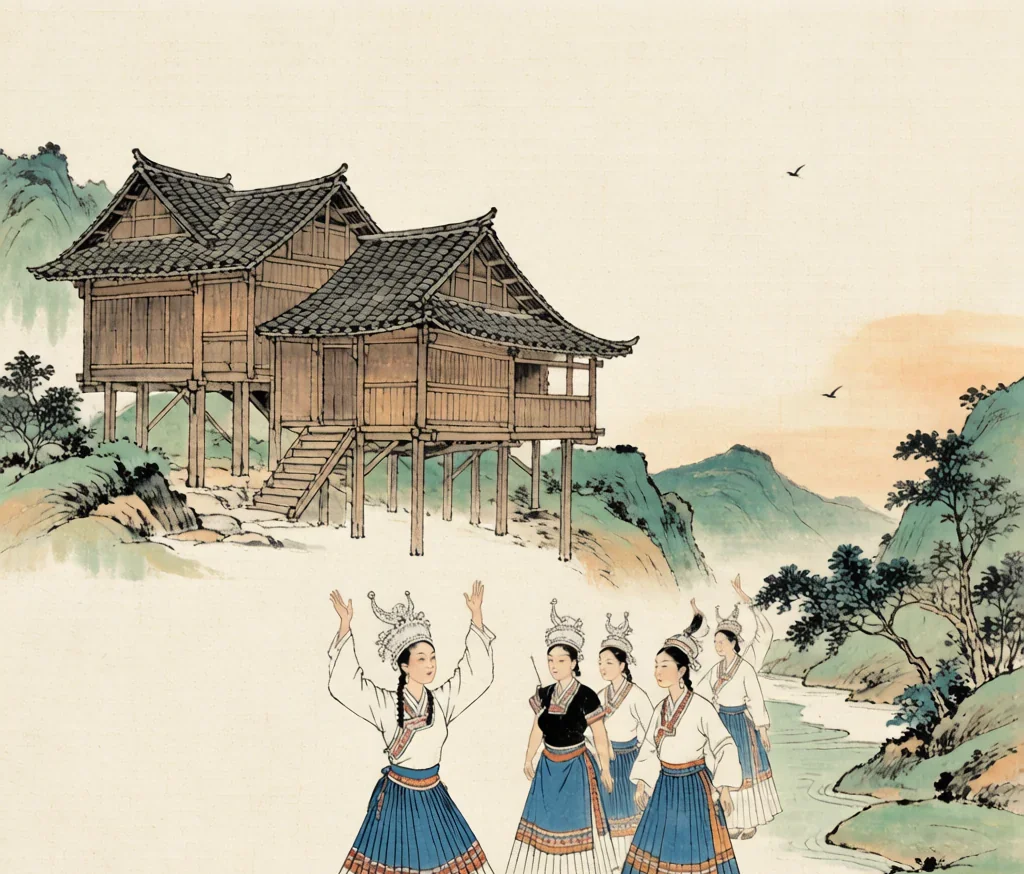
If there is one cultural treasure that defines the Tujia people, it is the Baishou Dance (摆手舞, bǎi shǒu wǔ), literally the "hand-waving dance." This ancient performance tradition is both a dance and a living history book, with over 120 distinct movements that tell the story of Tujia life across the ages. The dance is performed collectively by entire villages during major festivals, with participants forming large circles or lines and moving in synchronized patterns that depict hunting, farming, weaving, warfare, and daily domestic activities. Each movement has a name and a meaning, passed down through generations of Tujia dance masters who serve as the living custodians of this embodied cultural encyclopedia.
The Baishou Dance is divided into two categories: the "Great Baishou" (大摆手, dà bǎi shǒu), performed once every three to five years as a massive ritual involving thousands of participants from multiple villages, and the "Small Baishou" (小摆手, xiǎo bǎi shǒu), performed annually during the lunar New Year and other festivals. The Great Baishou can last for seven days and nights, with dancers telling the complete epic of Tujia history — from the creation of the world and the migration of the Tujia ancestors through the Wuling Mountains, to the battles they fought and the heroes they produced. The dance is accompanied by drumming and the singing of ancient Tujia songs in the Tujia language, creating a multi-sensory experience that immerses participants in their cultural heritage. The Baishou Dance has been described as a "living fossil" of ancient Chinese dance, with some movements believed to date back over 2,000 years to the Warring States period.
The Weeping Marriage Tradition
Among the most distinctive Tujia customs is the tradition of "weeping marriage" (哭嫁, kū jià), a ritual in which a bride weeps and sings laments for days — sometimes up to a month — before her wedding. Far from being a sign of unhappiness, the weeping marriage is a formalized expression of gratitude to parents, sorrow at leaving one's natal family, and good wishes for the future. The bride's laments follow set patterns, addressing each family member in turn — parents, siblings, aunts, uncles — with personalized verses that recall shared memories and express love and gratitude. The bride's skill at weeping and composing verses is judged by the community, and a bride who weeps beautifully earns great respect and admiration.
The Stilted Houses of the Mountains
Tujia architecture is perfectly adapted to the steep, forested terrain of the Wuling Mountains. The traditional Tujia dwelling is the Diaojiaolou (吊脚楼, diào jiǎo lóu), a stilted wooden house built on mountain slopes. The front of the house rests on solid ground while the rear extends over the slope, supported by long wooden pillars. This ingenious design maximizes usable living space on terrain where flat land is scarce. Remarkably, these houses are built entirely from local timber without nails, using traditional mortise-and-tenon joinery techniques passed down through generations of Tujia carpenters. The intricate carved details on beams and window frames often feature motifs from Tujia mythology — dragons, phoenixes, and the sacred white tiger.
The White Tiger Totem and Tujia Religion
At the core of traditional Tujia spirituality is the worship of the white tiger (白虎, bái hǔ). According to Tujia mythology, the Tujia people are descended from a great chieftain named Lin Jun (廪君) who, after his death, transformed into a white tiger and ascended to heaven. The white tiger thus became the totem and guardian spirit of the Tujia people, symbolizing courage, strength, and protection. Traditional Tujia religion involves the worship of ancestors and nature spirits, with shamans (梯玛, tī mǎ) serving as intermediaries between the human and spirit worlds, performing healing rituals, divination, and ceremonies in the ancient Tujia language.
Festivals and the Lunar New Year
The Tujia celebrate the lunar New Year one day earlier than the Han Chinese — a tradition known as "Guo Gannian" (过赶年, guò gǎn nián), or "hurrying the New Year." According to legend, Tujia ancestors were once called to battle during the New Year period, and the community moved the celebration forward by one day so the soldiers could celebrate before departing. The soldiers went on to win a great victory, and the tradition of celebrating a day early has been maintained ever since. The Tujia New Year features special foods, particularly a dish called "he cai" (合菜) — a stir-fry of multiple vegetables and meats that symbolizes unity and togetherness. The Tujia also celebrate the "Ox King Festival" (牛王节) honoring the ox that is essential to their agricultural life, and the "June Sixth" festival with singing, dancing, and the wearing of traditional Tujia clothing.