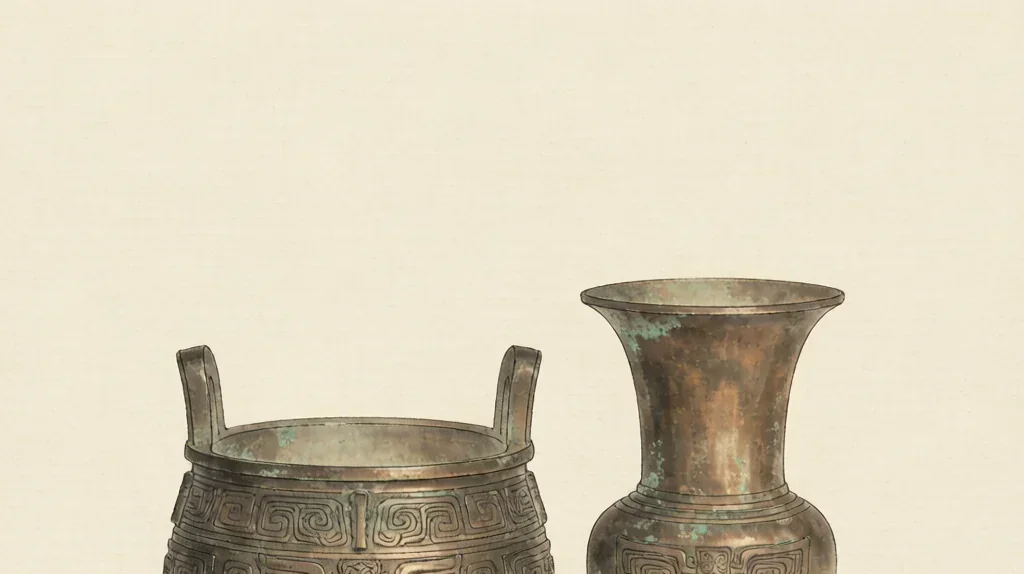
Imagine a vessel so important that owning it meant you could speak to heaven. Imagine a cauldron so powerful that possessing it legitimized an entire dynasty. This was the world of Chinese bronze — a world where metal was not merely material but medium between human and divine. For over a thousand years, from roughly 1700 BCE to 256 BCE, the rulers of China expressed their authority, communicated with their ancestors, and recorded their history through objects cast in bronze.
The Chinese Bronze Age produced objects of such technical sophistication and artistic power that they remain among the greatest achievements of human craft. A Shang dynasty ritual vessel, with its taut silhouette, precisely placed decorative bands, and staring taotie monster faces, can still make a museum visitor's heart race three thousand years after it was cast. These are not passive artifacts; they are objects that command attention and radiate power.
The Technology: Piece-Mold Casting
Unlike most ancient civilizations, which cast bronze using the lost-wax method (creating a wax model, encasing it in clay, melting out the wax, and pouring metal into the cavity), Chinese bronze workers developed a fundamentally different technique: piece-mold casting. This method was so distinctive that its presence in archaeological sites across Asia is considered evidence of Chinese cultural influence.
The process was extraordinarily demanding. Artisans first created a clay model of the desired vessel, then built clay mold sections around it in precise segments. These mold pieces were removed, fired, and reassembled around a clay core that was slightly smaller than the original model — the gap between mold and core defining the thickness of the final bronze. Molten bronze (an alloy of copper, tin, and lead) was poured into this gap. After cooling, the mold pieces were broken away, and the core was chiseled out, revealing the finished vessel.
The sophistication of this technique is staggering. The famous Houmuwu Ding (后母戊鼎, formerly called Simuwu Ding), the largest bronze ever discovered from the ancient world, weighs 832.84 kilograms and stands 133 centimeters tall. Casting such an enormous object required coordinating multiple furnaces and pouring hundreds of kilograms of molten metal in a single continuous operation — a logistical feat that speaks volumes about Shang dynasty organizational capabilities.
The Vessel Types: A Language in Metal
Chinese ritual bronzes are not random forms; they constitute a precise vocabulary of vessel types, each with its specific ritual function. The most important is the ding (鼎), a tripod or quadruped cauldron used for cooking sacrificial meat offerings. The number of ding a noble could own was strictly regulated by rank: the Zhou king was entitled to nine ding, feudal lords to seven, senior ministers to five, and lesser officials to three or one. This system was so fundamental that the Chinese idiom "to inquire about the ding" (问鼎) means to challenge someone's authority — to ask about their ding was to question their right to rule.
The gui (簋) was a handled bowl for holding cooked grain offerings, often paired with ding in sets. The zun (尊) was a tall wine vessel, often shaped like animals — owls, elephants, rams — in some of the most imaginative creations of the Bronze Age. The jue (爵) was a tripod wine cup with an elegant spout and tail, used for heating and pouring ritual wine. The hu (壶) was a jar for storing wine, often decorated with intricate geometric patterns.
Each vessel type had its place in the elaborate ritual banquets that structured Shang and Zhou political life. These were not casual dinner parties but sacred ceremonies in which the living ruler fed the spirits of his ancestors, who in return would bless the dynasty with prosperity and victory. The bronze vessels were the instruments through which this cosmic transaction took place.
Taotie: The Face That Watches
The most iconic decorative motif on Shang and early Zhou bronzes is the taotie (饕餮) — a staring, symmetrical animal face with bulging eyes, horns, and a gaping mouth, but no lower jaw. The name comes from a much later text describing a gluttonous monster that devoured everything, even its own body. But what the taotie meant to the Shang people who created it remains one of Chinese archaeology's great mysteries.
Some scholars interpret the taotie as a shamanic mask, representing the ability to see into the spirit world. Others see it as a composite animal — perhaps a tiger, ox, or dragon — symbolizing the power of the ancestors. Still others argue that it was deliberately designed to be ambiguous, a visual paradox that kept the viewer unsettled and aware of the supernatural forces at work in the ritual. Whatever its meaning, the taotie's hypnotic stare across three millennia remains one of the most powerful images in world art.
Inscriptions: The First Chinese History Books
Zhou dynasty bronzes carry another treasure: inscriptions (jinwen, 金文) cast into the metal itself. Unlike Shang oracle bones, which were used for divination and then buried, Zhou bronze inscriptions were meant to be permanent public records. They record military victories, land grants, legal judgments, and genealogies. The longest known inscription, on the Mao Gong Ding (毛公鼎), contains 497 characters — a substantial historical document preserved in bronze.
These inscriptions are priceless historical sources. They confirm, correct, and supplement the transmitted textual tradition, giving us direct access to the political and social world of early China. A typical inscription might read: "The King said: 'You have served me well in battle. I award you this bronze, that your descendants may treasure it forever.'" And treasure it they did — many inscribed bronzes were passed down through families for centuries, discovered in hoards buried during times of crisis.
Sanxingdui: A Lost Civilization in Bronze
In 1986, construction workers near the town of Sanxingdui in Sichuan province made a discovery that would rewrite Chinese history. Two sacrificial pits yielded hundreds of bronze objects utterly unlike anything found elsewhere in China: towering masks with protruding eyes and elephantine ears, a standing figure over 2.6 meters tall, and bronze trees hung with birds, dragons, and coins. The largest mask is 1.32 meters wide, its eyes extending outward on stalks for 16 centimeters.
The Sanxingdui culture (c. 1600–1046 BCE) was contemporaneous with the Shang but culturally distinct. Its bronze workers used the piece-mold technique with equal mastery, but their artistic vision was entirely different. Where Shang bronzes are controlled, symmetrical, and hieratic, Sanxingdui bronzes are exuberant, exaggerated, and seemingly fantastical. The masks' bulging eyes have been interpreted as representing zongmu (纵目) — "vertical eyes" — a physical trait of the legendary ancestor Cancong, who according to ancient texts had protruding eyes.
Even more mysterious is why these magnificent objects were deliberately broken and buried. The pits show evidence of ritual destruction: bronzes smashed, burned, and deposited in layers with elephant tusks and jade. Was this a ceremonial abandonment of a sacred site? A response to political upheaval? We may never know, but the discovery at Sanxingdui reminds us how much of China's ancient past remains to be uncovered.
The Bronze Age Legacy
The Chinese Bronze Age ended not with a bang but a transformation. As iron replaced bronze for weapons and tools during the Warring States period (475–221 BCE), the ritual significance of bronze vessels faded. Confucius himself lamented that the old rites were no longer properly observed. Yet bronze never lost its prestige. Throughout Chinese history, the discovery of ancient bronze vessels was seen as an auspicious omen, and emperors from Song dynasty antiquarians to Qianlong collected them avidly.
Today, Chinese ritual bronzes are among the most sought-after objects in the world. The Xuande dragon-handled censer, the Tianlongshan bodhisattvas, the Ming dynasty gilt bronzes — these names command millions at auction. But the true value of Chinese bronzes lies not in their market price but in what they tell us about a civilization that learned to speak to heaven through metal.
📝 Chinese Vocabulary
- 青铜器 (qīngtóngqì) — Bronze vessels or implements; the defining artifacts of China's Bronze Age
- 鼎 (dǐng) — Ritual cauldron, the most prestigious bronze vessel type
- 饕餮 (tāotiè) — The iconic animal-mask motif on Shang and Zhou bronzes
- 金文 (jīnwén) — Bronze inscriptions; literally "metal writing"
- 三星堆 (Sānxīngduī) — Sanxingdui, an archaeological site revealing a previously unknown Bronze Age civilization
Ritual Bells and the Music of Bronze
Bronze in early China was not only visual but audible. Court and temple ensembles used sets of bells called bianzhong, hung in wooden racks and struck with wooden mallets to perform ceremonial music. Each bell was cast to a precise pitch, and the musician could draw two different tones from one bell by striking its center or its edge. The surviving set of Marquis Yi of Zeng, buried around 433 BCE with sixty-five bells, preserves a fully tuned instrument that still rings after more than two millennia. Such bells show that bronze founders were also acoustic engineers, controlling wall thickness to fix pitch. Music joined with the vessel types and taotie masks to make bronze the complete language of ritual, where sound as much as form communicated with ancestors and the cosmos.
Bronzes as Records of State and Law
Beyond sacrifice, bronzes served as the hard media of politics and law. Zhou rulers cast inscriptions that recorded land grants, military victories, appointments, and binding covenants between states, expecting the metal to outlast any written bamboo slip. Some vessels carried exact copies of legal judgments or the text of oaths, so that bronze itself became a contract that witnesses and descendants could consult for centuries. When an alliance was sworn, a bronze might be cast to mark the moment, and copies were sometimes buried with each party. Because the inscriptions were permanent, they let later historians verify the transmitted texts and recover the names, dates, and offices of early China. In this sense the bronze age was also an age of written memory, with metal standing as the impartial witness to power and promise.
❓ Frequently Asked Questions
🎉 Fun Facts
- The Houmuwu Ding, the largest ancient bronze ever found, was so heavy that when villagers discovered it in 1939, the Japanese army occupying the area tried to haul it away — but gave up because they couldn't move it.
- Chinese bronze workers added lead to their alloy to improve fluidity during casting. Modern analysis shows lead content as high as 20% in some vessels — a level that would have been dangerous to the metalworkers who handled it daily.
- In 2021, archaeologists discovered six more sacrificial pits at Sanxingdui, yielding a gold mask, more bronze heads, and fragments of silk — proving that this mysterious civilization still has secrets to reveal.
- The bronze bell set of Marquis Yi of Zeng, with 65 bells from about 433 BCE, could play a nearly full chromatic scale and still sounds today.
- Bronze was so valued that Warring States money took the form of miniature knife and spade shapes cast in the metal.
- Many Zhou bronzes were buried in deliberate caches when a state fell, which is why so many inscribed vessels survive in hoards rather than tombs.