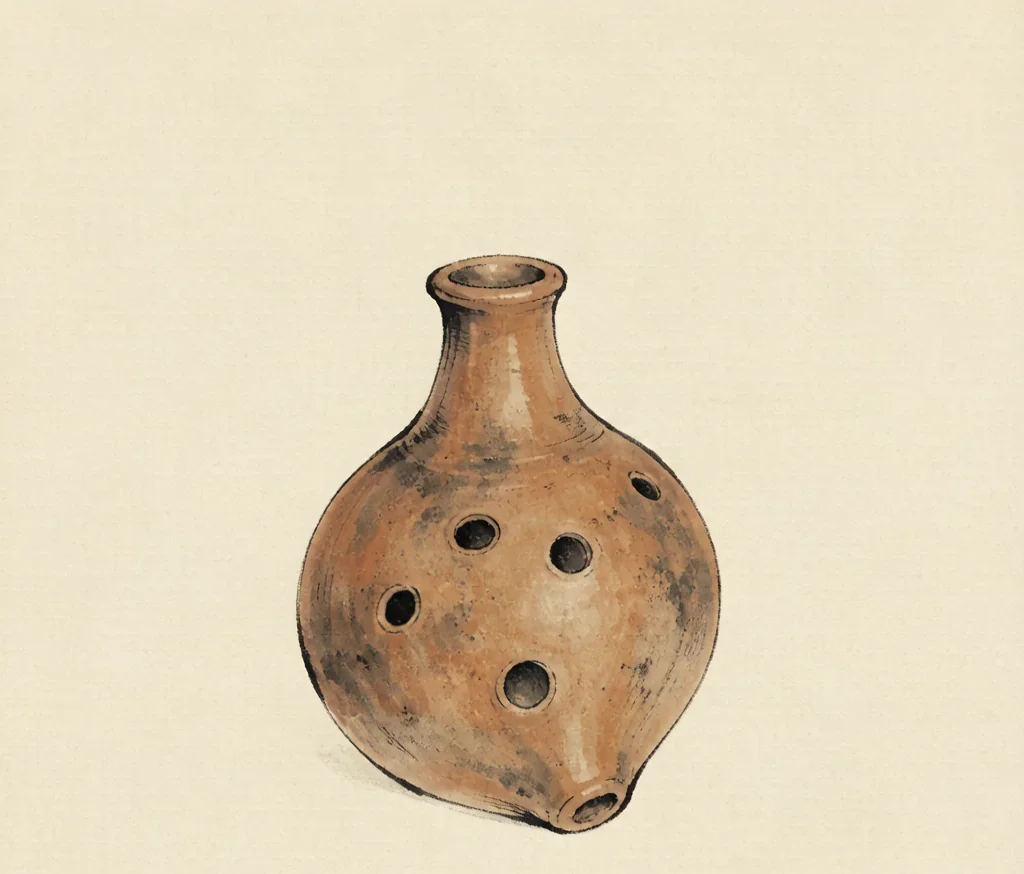
The xun (埙, xūn) is one of the oldest musical instruments in China — and indeed in the world — a vessel flute made of baked clay or ceramic, typically egg-shaped or globular, with a blow hole at the top and finger holes along the body. Its haunting, ethereal tone — hollow, breathy, and somehow both ancient and timeless — has echoed across Chinese civilization for over 7,000 years. Archaeological excavations have uncovered xun dating to the Neolithic Yangshao culture (c. 5000–3000 BCE), including a remarkable one-hole xun from the Banpo site near Xi'an that could produce two distinct pitches. By the Shang Dynasty (c. 1600–1046 BCE), the xun had evolved into a five-hole instrument capable of playing a complete pentatonic scale, and it was used alongside stone chimes, bronze bells, and drums in the elaborate ritual orchestras of the Shang and Zhou courts. The xun's unique timbre — a hollow, resonant sound that seems to emerge from the earth itself — has always been associated with the most profound human emotions: grief, longing, reverence, and the contemplation of nature's mysteries. In the hierarchy of ancient Chinese instruments, the xun was classified as an 'earth' instrument (土, tǔ) in the traditional 'bayin' (八音) system of eight material categories, and its deep, grounding tone was believed to connect the player and listener to the primordial energies of the earth.
Seven Thousand Years of Evolution
The xun's evolution from a simple hunting whistle to a sophisticated musical instrument mirrors the development of Chinese civilization itself. The earliest xun, dating to approximately 5000 BCE, were small, egg-shaped clay vessels with a single blow hole and no finger holes — essentially vessel flutes that produced a single note. Archaeologists believe these may have been used as hunting calls, imitating the cries of animals to lure prey, or as simple signaling devices. By 4000 BCE, xun with one or two finger holes had appeared, allowing two or three distinct pitches. The critical breakthrough came during the Shang Dynasty (c. 1600–1046 BCE), when xun makers developed the five-hole instrument that could produce a complete pentatonic scale plus one additional note — the foundation of Chinese music for millennia. Shang Dynasty xun have been excavated from royal tombs at Anyang, including exquisitely crafted specimens made for the royal court that feature intricate decorations and precise tuning. The Zhou Dynasty (1046–256 BCE) saw the xun reach its classical form: a flattened ovoid shape, typically 8-10 centimeters tall, with five finger holes on the front and one on the back, capable of producing a full heptatonic (seven-note) scale across a range of about one octave plus a fourth. The instrument was standardized and incorporated into the Confucian ritual music tradition, where it was played in the 'yayue' (雅乐, elegant music) orchestras that accompanied state ceremonies and ancestral rites. The classic text 'Rites of Zhou' (周礼) specifies the xun's role in these orchestras, and Confucius himself is said to have been moved to tears by the sound of the xun.
The Sound of Earth: Acoustics and Playing Technique
The xun's unique and instantly recognizable tone is a product of its simple acoustic design. Unlike most wind instruments, which use a reed, a sharp edge, or a vibrating air column to produce sound, the xun is a 'Helmholtz resonator' — the entire hollow body of the instrument vibrates as a single unit, with the pitch determined primarily by the total volume of the chamber and the total area of all open holes. This gives the xun its characteristic sound: a fundamental tone that is surprisingly rich in overtones, with a hollow, breathy quality that evokes the sound of wind across an open landscape. The instrument's clay or ceramic body contributes to its distinctive timbre — the porous, earthy material absorbs some of the higher frequencies while allowing the fundamental to resonate fully, creating a warm, grounded tone that is the antithesis of the bright, penetrating sound of metal or wooden instruments. Playing technique involves a delicate balance of breath control and finger placement: the embouchure must be precise and relaxed, with the player's lips forming a narrow aperture against the blow hole; breath pressure must be carefully modulated, as the xun's pitch is highly sensitive to changes in air speed; and the fingers must cover the holes completely, as even the slightest leak will alter the pitch. The instrument's relatively limited dynamic range — it cannot play very loudly without the pitch going sharp — contributes to its intimate, introspective character. Advanced players use techniques including vibrato (achieved through subtle breath pulses), pitch bending (by partially covering holes or varying breath pressure), and portamento (sliding between notes) to create the instrument's characteristic expressive effects.
The Xun in Ritual, Poetry, and Philosophy
In traditional Chinese culture, the xun was far more than a musical instrument — it was a vessel of philosophical meaning and emotional expression. The instrument's classification as an 'earth' (土) material in the bayin system was not merely technical but cosmological: the xun was believed to channel the qi (气, vital energy) of the earth, and its deep, resonant tone was thought to ground the spirit and connect the player to the primordial forces of nature. In the Confucian ritual tradition, the xun was paired with the chi (篪), a bamboo transverse flute classified as a 'bamboo' (竹) instrument. The xun and chi duet was considered the ideal musical expression of harmony between earth and heaven, yin and yang — the deep, feminine voice of the clay vessel balancing the bright, masculine voice of the bamboo tube. The 'Book of Poetry' (诗经, Shījīng), compiled around 600 BCE, contains several references to the xun, including the famous lines: 'The elder brother plays the xun, the younger brother plays the chi' — a metaphor for fraternal harmony that was quoted for centuries as the ideal of sibling relationships. The Tang Dynasty poet Bai Juyi (772–846) wrote of hearing a xun player on a cold autumn night, the instrument's mournful tone evoking the transience of beauty and the inevitability of parting. The Song Dynasty philosopher Zhu Xi (1130–1200) used the xun as a metaphor for the cultivated mind: just as the xun's simple clay body produces sounds of profound beauty, so the disciplined mind, though outwardly plain, gives rise to thoughts of wisdom and compassion.
Revival and Reinvention in Modern China
The xun suffered a long period of decline after the Song Dynasty (960–1279), as musical fashions shifted and the instrument's association with archaic court ritual made it seem increasingly irrelevant. By the early 20th century, the xun was virtually extinct as a living performance tradition, known only from archaeological artifacts and historical texts. Its revival began in the 1970s and 1980s, when Chinese musicologists and instrument makers, inspired by the growing interest in traditional culture, reconstructed the instrument based on archaeological specimens and historical descriptions. The modern xun is typically larger than its ancient predecessors (12-15 centimeters rather than 8-10), with eight or nine finger holes that extend its range to over two octaves. Some modern makers have experimented with double-chamber xun that can play chords, and with materials including porcelain and even jade for high-end instruments. The xun virtuoso Cao Zheng (曹正, 1920–1998) was instrumental in the instrument's revival, developing the modern fingering system and composing the first contemporary works for the instrument. Today, the xun has found a place in several musical niches: it is widely used in film and television soundtracks to evoke ancient China or the beauty of nature; it is a popular instrument among Chinese new-age and ambient musicians, who value its meditative, ethereal tone; and it has become a favorite among amateur musicians seeking an instrument that is portable, affordable, and easy to begin learning (though challenging to master). The instrument's haunting voice continues to connect modern listeners to the deepest layers of Chinese musical heritage — a sound that, across 7,000 years, has lost none of its power to move the human heart.