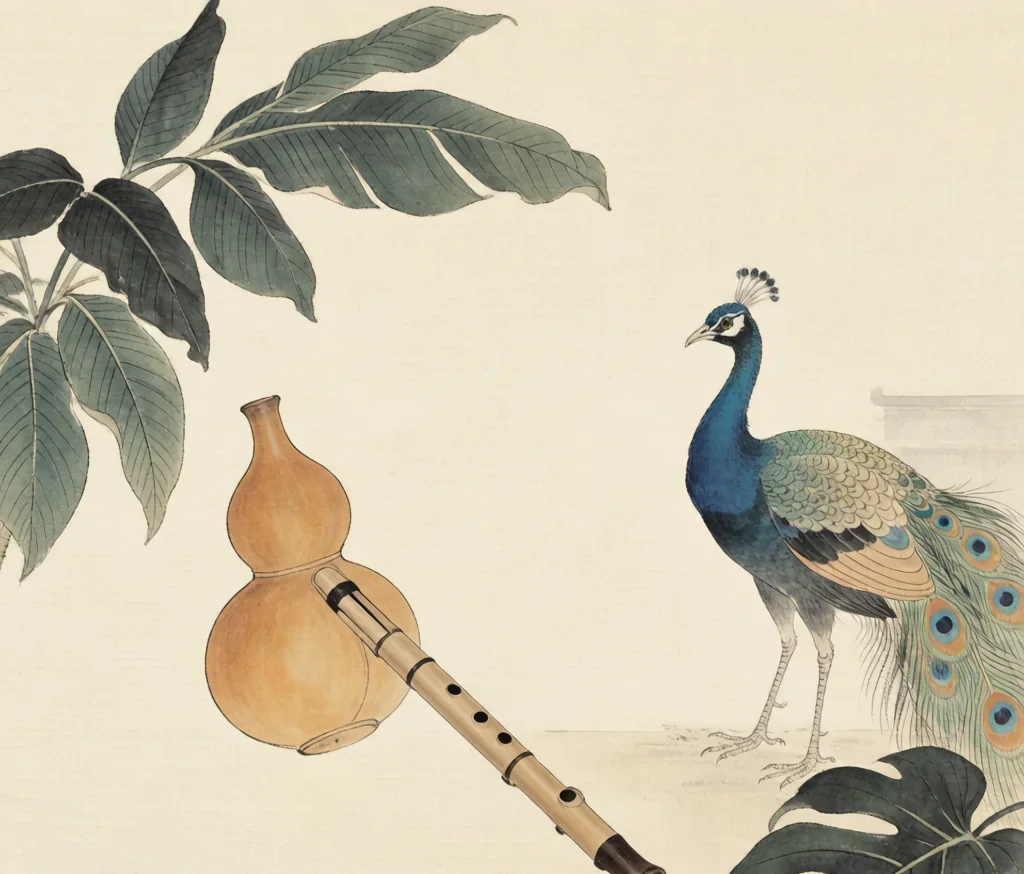
The hulusi (葫芦丝, húlusī), also known as the 'gourd flute' or 'calabash flute,' is one of the most distinctive and beloved traditional instruments of China's ethnic minorities, particularly associated with the Dai (傣族), Achang (阿昌族), and Wa (佤族) peoples of Yunnan Province in southwestern China. The instrument's name is descriptive: 'hulu' (葫芦) means 'gourd' and 'si' (丝) means 'silk,' referring to the gourd wind chamber and the silk-like quality of its sound. The hulusi produces a mellow, hauntingly beautiful tone that falls somewhere between a clarinet, a harmonica, and a bagpipe — a soft, reedy timbre with a distinctive vibrato that seems to capture the misty mountains, bamboo groves, and tranquil rivers of its Yunnan homeland. Unlike most Chinese wind instruments, the hulusi uses a free-beating metal reed (rather than a vibrating air column or double reed) enclosed within the gourd chamber, which gives it its uniquely warm, intimate sound. The instrument's history is difficult to trace precisely — it evolved from older gourd-based free-reed instruments that have existed in Southwest China and Southeast Asia for centuries — but its modern form crystallized among the Dai people of the Xishuangbanna region, where it has long been associated with courtship, storytelling, and the expression of romantic love.
Construction and Acoustics
The traditional hulusi consists of three main components: a gourd that serves as the wind chamber and resonator, a main melody pipe with finger holes, and one or two drone pipes that produce a continuous background note. The gourd — usually a bottle gourd (Lagenaria siceraria) grown specifically for instrument-making — is hollowed out and dried, then fitted with bamboo pipes that pass through its base. The player blows into the gourd's mouthpiece, and the air passes through the gourd chamber, vibrating the free-beating brass or copper reed mounted in the main melody pipe. The drone pipes are typically tuned to the fifth or octave of the main pipe's lowest note, creating a continuous harmonic background against which the melody unfolds — an effect that contributes significantly to the instrument's meditative, trance-like quality. The main pipe typically has seven finger holes on the front and one thumb hole on the back, allowing a range of about one and a half octaves. The traditional tuning system uses the pentatonic scale, and most hulusi are pitched in keys of C, D, or B-flat. The instrument's construction requires considerable skill: the gourd must be of the right size and shape to produce good resonance, the bamboo must be properly aged and treated, and the reed must be carefully cut and adjusted to achieve the desired tone quality and responsiveness. Traditional hulusi makers, particularly among the Dai people, are highly respected artisans whose skills are passed down through family lineages.
The Hulusi in Dai Culture: Instrument of Love
Among the Dai people of Xishuangbanna in southern Yunnan, the hulusi holds a special place as the quintessential 'instrument of love' — intimately associated with courtship, romance, and the expression of tender emotions. In traditional Dai society, young men would play the hulusi outside the bamboo houses of the young women they wished to court, the instrument's soft, carrying tone serving as a romantic serenade that would drift through the tropical night air. If a young woman was interested, she would respond by opening her window or stepping onto the balcony — if not, the bamboo shutters would remain firmly closed, and the young man would move on. This tradition, known as 'playing under the bamboo house' (竹楼下吹葫芦丝), was immortalized in the famous Dai folk song 'Moonlit Night on the Bamboo House' (月光下的凤尾竹, Yuèguāng Xià de Fèngwěi Zhú), one of the most beloved melodies in the hulusi repertoire. The song, composed in the 1970s by the Yunnan composer Shi Guangnan (施光南), evokes a moonlit night in a Dai village, with the gentle strains of a hulusi floating through the bamboo groves. It has become so iconic that it is now practically synonymous with the instrument itself, and every hulusi player learns it as part of their core repertoire. Beyond courtship, the hulusi was played during Dai festivals — particularly the Water-Splashing Festival (泼水节, Pōshuǐ Jié), the Dai New Year celebration — and at community gatherings, where its gentle tone provided the perfect accompaniment to the region's relaxed, tropical pace of life.
From Folk Instrument to National Stage
The hulusi's journey from a regional folk instrument of Yunnan's ethnic minorities to a nationally recognized and internationally performed instrument is a remarkable story of cultural transmission and artistic innovation. For centuries, the hulusi was virtually unknown outside the mountainous borderlands of Yunnan. The instrument began to gain wider attention in the 1950s and 1960s, when Chinese ethnomusicologists conducting fieldwork in Yunnan documented its construction, repertoire, and cultural significance. The 1970s composition 'Moonlit Night on the Bamboo House' introduced the hulusi's sound to national radio audiences, and the instrument's popularity surged in the 1980s and 1990s as Chinese tourism to Yunnan expanded and travelers returned home with hulusi souvenirs. The instrument's accessibility — it is relatively easy to produce a pleasant sound on the hulusi compared to many Chinese wind instruments — contributed to its spread as an amateur instrument. The hulusi virtuoso Li Chunhua (李春华, b. 1964), who studied the instrument in Yunnan before becoming a professor at the China Conservatory of Music, has been instrumental in developing the hulusi's technique and expanding its repertoire. He pioneered advanced techniques including circular breathing, multi-phonics (producing more than one note simultaneously from the melody pipe), and the use of chromatic notes through half-holing, and he has composed dozens of concert pieces that showcase the instrument's expressive range. The hulusi is now taught in music conservatories across China, and national hulusi competitions attract thousands of participants annually.
The Hulusi in Contemporary Music and Culture
The hulusi's mellow, evocative tone has made it a popular choice for film and television soundtracks, where it is frequently used to evoke the exotic beauty of Yunnan, the nostalgia of rural life, or the spirituality of Buddhist and Daoist meditation. The instrument has been featured in numerous Chinese films and television dramas, and its sound is instantly recognizable to Chinese audiences. Contemporary musicians are exploring new contexts for the hulusi: Chinese new-age and ambient music artists have incorporated it into meditative soundscapes, world music ensembles use it to add a distinctive Asian timbre to their arrangements, and experimental composers have explored extended techniques and electronic processing. The instrument has also found a place in music therapy and wellness practices, where its soothing tone is used for relaxation and meditation. In Yunnan itself, the hulusi has become a symbol of regional identity and cultural pride — it is featured prominently in the province's tourism promotion, taught in schools as part of cultural heritage education, and celebrated at annual festivals dedicated to the instrument. The Xishuangbanna Hulusi Festival, held annually in Jinghong, draws players from across China and Southeast Asia. The instrument's future seems secure: its accessibility makes it popular with amateur musicians, its expressive capabilities challenge and reward professionals, and its deep cultural roots connect it to the living traditions of the Dai, Achang, and Wa peoples, who continue to play, make, and teach the hulusi as their ancestors have done for generations.