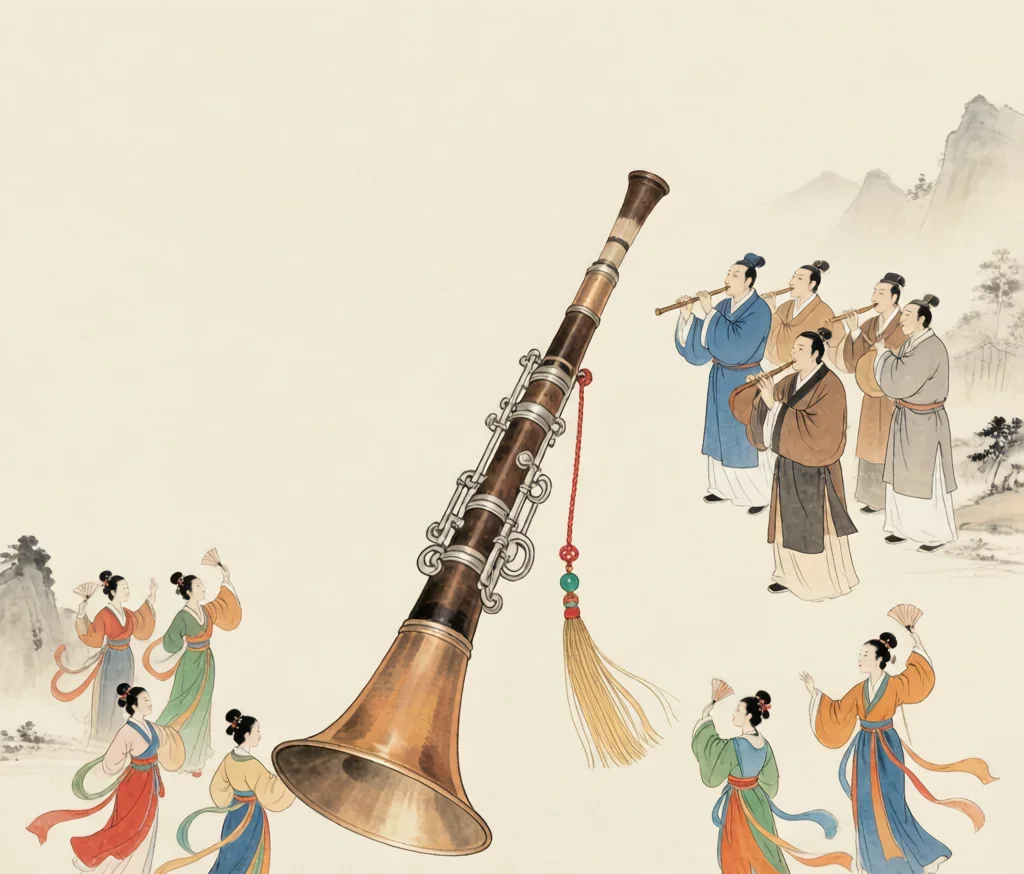
The suona (唢呐, suǒnà), a double-reed woodwind instrument with a flared metal bell, is one of the most distinctive and emotionally powerful instruments in Chinese music — its piercing, resonant tone can express the heights of wedding joy and the depths of funeral grief with equal intensity. Often described as the 'Chinese oboe' or 'Chinese trumpet' by Western observers, the suona is neither a direct relative of European double-reed instruments nor native to China proper: it entered China along the Silk Road from Central Asia or Persia during the 3rd to 5th centuries CE, likely originating from the Persian 'sorna' or 'zurna,' and was gradually absorbed into Chinese musical culture, where it evolved into a family of instruments in various sizes and tonal ranges. By the Ming Dynasty (1368–1644), the suona had become firmly established in Chinese folk music, and by the Qing Dynasty (1644–1912), it was a fixture of both rural celebrations and imperial court ceremonies. Today, the suona remains an indispensable voice in the musical life of northern China in particular, where its unmistakable sound signals to entire villages that a wedding, funeral, temple festival, or opera performance is underway.
Construction, Playing Technique, and the Suona Family
The traditional suona consists of five main components: a double reed made from a species of river reed (芦苇, lúwěi); a metal staple or 'bocal' that connects the reed to the body; a conical wooden body (typically made of rosewood, sandalwood, or ebony) with seven finger holes on the front and one thumb hole on the back; a metal 'bowl' or bell (usually brass or copper) that flares outward to amplify and project the sound; and a small metal disc or 'lip rest' that allows the player to maintain embouchure pressure without tiring. The suona's most distinctive acoustic characteristic is its extraordinary volume — a single suona can be heard over an entire percussion ensemble and across the distance of several village blocks, making it the ideal instrument for outdoor processions and open-air performances. The instrument's pitch range spans approximately two octaves plus a fifth, and skilled players can produce a remarkable variety of timbres, from the bright, nasal tone used for celebratory melodies to a softer, almost vocal quality achieved through subtle embouchure control. The suona exists in multiple sizes, each with its own tonal character and regional name: the 'big suona' (大唢呐, dà suǒnà), prevalent in Shandong and Henan provinces, produces a deep, sonorous tone; the 'small suona' (小唢呐, xiǎo suǒnà), common in southern China, is higher-pitched and more agile; and the 'zhongyin suona' (中音唢呐), a modern innovation, extends the instrument's range into the tenor register. The playing technique is notoriously demanding — mastering the suona requires years of dedicated practice to develop the embouchure strength and breath control necessary to sustain the instrument's powerful tone across long melodic phrases.
The Suona in Folk Rituals: Weddings, Funerals, and Festivals
In traditional Chinese society, the suona was primarily associated with the rituals of rural life, where its penetrating sound served to mark important transitions and to communicate across distances. At weddings, suona players would lead the bridal procession through village streets, their jubilant melodies — including the famous 'Hundred Birds Paying Homage to the Phoenix' (百鸟朝凤, Bǎi Niǎo Cháo Fèng) — announcing the celebration to the entire community. This virtuosic piece, which uses the suona to imitate the calls and songs of dozens of bird species, is considered the ultimate test of a player's skill and remains the most famous suona composition in the repertoire. At funerals, the suona takes on a completely different character: its wailing, keening tone gives voice to collective grief, and the 'Funeral Suona' repertoire includes melodies of heart-wrenching pathos that can reduce mourners to tears. The instrument's ability to shift so dramatically between emotional registers — from the most exuberant joy to the deepest sorrow — has made it the quintessential voice of the Chinese folk soul. During temple festivals and Lunar New Year celebrations, suona-led wind and percussion ensembles (鼓吹乐, gǔchuī yuè) perform for hours, driving lion dances, yangge (秧歌) folk dances, and stilt-walking performances with their propulsive rhythms and soaring melodies. In Shanxi, Shaanxi, and Hebei provinces, the suona remains an essential element of village identity, with each community taking pride in its local players and distinctive repertoire.
The Art of the Suona Master: Liu Ying and the Modern Tradition
The 20th century saw the suona transition from a purely folk instrument to one studied and performed in China's conservatories, a transformation largely credited to a few visionary masters. Liu Ying (刘英, 1935–2003), perhaps the most influential suona player of the modern era, was born into a family of folk musicians in Shandong Province and began learning the suona from his father at the age of seven. Liu's revolutionary contribution was to systematize the suona's playing technique — which had previously been transmitted orally from master to apprentice with little formal pedagogy — and to develop a repertoire of concert pieces that showcased the instrument's full expressive range. His performances of 'Hundred Birds Paying Homage to the Phoenix' became legendary, and his recordings introduced the suona to audiences across China and internationally. The 2016 film 'Song of the Phoenix' (百鸟朝凤), directed by Wu Tianming, tells the story of a young suona apprentice's relationship with his aging master, and the decline of traditional suona music in the face of modernization. The film, which was Wu's final work before his death, became a cultural phenomenon in China — it initially struggled to find distribution but gained widespread attention after its producer, Fang Li, made a dramatic public appeal by kneeling and pleading with theater owners to screen the film. The movie's success sparked a nationwide conversation about the preservation of traditional folk arts and introduced a new generation to the haunting beauty of the suona.
The Suona in Contemporary Music
In recent decades, the suona has found new life in contemporary musical contexts that extend far beyond its traditional folk roots. Chinese rock bands, including the pioneering 'Second Hand Rose' (二手玫瑰), have incorporated the suona into their sound, using its piercing tone to create a distinctively Chinese punk aesthetic. Jazz musicians in Shanghai and Beijing have explored suona improvisation, finding unexpected affinities between the instrument's expressive capabilities and the freedom of jazz soloing. Contemporary classical composers, including Tan Dun (谭盾) and Chen Yi (陈怡), have written concert works that place the suona at the center of the orchestra, exploring its dialogue with Western instruments. The instrument has also been featured in numerous film scores, where its distinctive timbre instantly evokes rural China, folk celebration, or historical settings. The suona's entry into the conservatory system has produced a new generation of technically brilliant players who are equally at home performing classical concertos, folk repertoire, and experimental collaborations. However, the instrument's future in its traditional context remains uncertain: as China's rural population continues to urbanize and traditional wedding and funeral practices evolve, the demand for suona players at village rituals has declined sharply. Efforts to preserve the tradition include government designation of suona music as a National Intangible Cultural Heritage and the establishment of transmission bases in Shandong, Henan, and Shanxi provinces where young apprentices can study with aging masters.