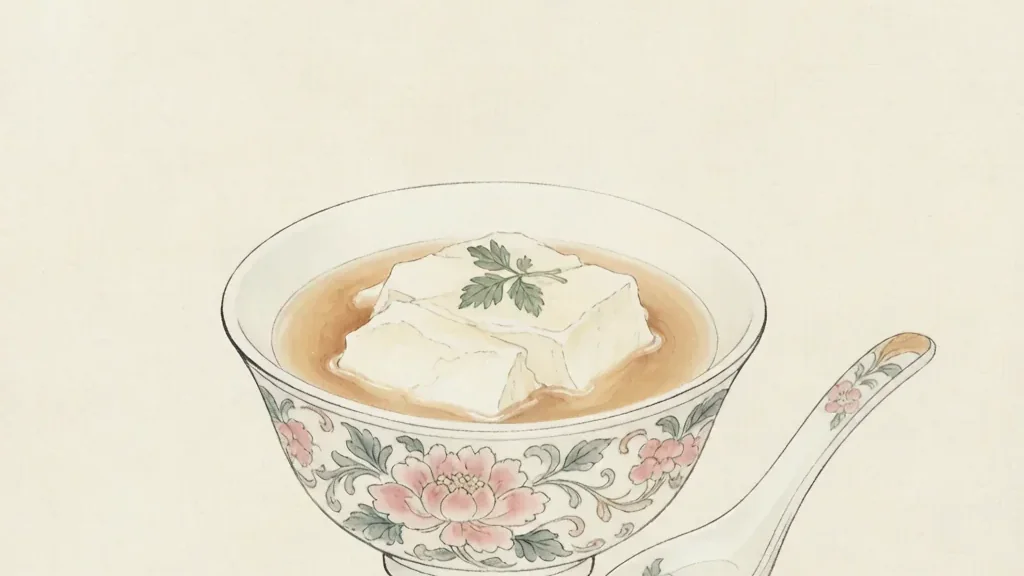
Tofu pudding (豆腐花 or 豆腐脑, dòufuhuā / dòufunǎo) is a soft, just-set custard of fresh soy milk, delicately spooned into a bowl and dressed according to regional taste—savory in the north, sweet in the south. Made by coagulating warm soy milk with a tiny amount of gypsum or lactone so it sets to a trembling, silken consistency softer than firm tofu, it is a breakfast and snack staple across China. The north crowns it with a hot, savory gravy of mushrooms, scallion, and sometimes meat or pickles; the south floats it in ginger-sugar syrup. Few dishes map China's sweet-savory divide as cleanly as this humble soybean curd.
From Soy Milk to Tender Curd
The base is simply fresh soy milk, heated and coagulated with a gentle agent—traditionally gypsum (calcium sulfate) or, in modern home and factory versions, glucono delta-lactone—so the proteins set into a barely-held custard. The skill lies in timing: too much coagulant and it turns rubbery; too little and it never holds. The result is softer and more fragile than the tofu sold in blocks, which is pressed and drained further.
Because it is essentially concentrated soy milk in custard form, tofu pudding carries the bean's mild sweetness and high protein. It is often made fresh each morning at breakfast shops, the curd kept warm in shallow trays until a customer orders, then scooped with a flat ladle that preserves the wobble.
The North-South Divide
The most famous feature of tofu pudding is its geography of taste. In northern China (and much of the interior) it is savory (咸): dressed with a warm, starchy gravy of scallion, mushroom, dried shrimp or meat, soy, and sometimes pickled vegetable, then topped with cilantro and chili oil. In the south—Guangdong, Fujian, Taiwan—it is sweet (甜): bathed in a clear ginger and rock-sugar syrup, sometimes with red beans or taro.
This split is a favorite teaching example of Chinese regional cuisine, since the same base becomes two opposite dishes by location alone. Travelers crossing the Yangtze quickly learn to specify "sweet" or "salty" (甜/咸) to avoid surprise, and debates over which is "correct" are good-natured but endless.
Savory Toppings (Northern Style)
The northern gravy is the star. A cook fries scallion, mushroom, and sometimes pork or dried shrimp, binds it with starch for a glossy pour, and ladles it over the curd so the white pudding sits under a savory glaze. Additions might include pickled mustard greens, sesame, or a fried egg. The contrast of cool-soft curd and hot, salty sauce is the appeal.
Because the curd itself is bland, the topping does all the talking, which is why northern shops compete on gravy. A great version makes the bean taste richer; a poor one buries it. The dish is thus a canvas for local seasoning philosophy as much as a soybean product.
Sweet Preparations (Southern Style)
In the south, the syrup is usually a light ginger-and-sugar brew, warm in winter and iced in summer, with the curd's smoothness carrying the gentle spice. Variations add red bean, lotus seed, or grass jelly for texture and color. Hong Kong and Cantonese dim-sum houses serve it chilled as a dessert, while street vendors sell it hot from insulated pails at dawn.
The sweetness highlights the soy's natural hint of sugar, making the south's version feel like a light confection rather than a meal. It is comfort food for the young and the old alike, easy to digest and soothing to the stomach.
Similar Dishes and Names
Names vary: dòufunǎo (豆腐脑, "tofu brain") is common in the north for the savory form, while dòufuhuā (豆腐花, "tofu flower") often denotes the southern sweet one, though usage overlaps. It differs from firmer dòufu and from soy milk (doujiang) by its set texture. In Malaysia and Singapore, "tau huay" is the sweet Hokkien cousin; in Japan, similar curds appear as part of desserts.
Confusion with doufuru (fermented tofu) and douzhi (fermented mung-bean drink) is understandable by name but the foods are unrelated in taste. Tofu pudding's family is the fresh-soy set: milk, curd, and the pressed cakes beyond.
Nutrition and Appeal
Tofu pudding is low in fat, high in plant protein, and easy to digest, which explains its role as breakfast, invalid food, and light dessert. It is naturally lactose-free, suiting those who avoid dairy. The warm savory version is filling; the sweet one is a gentle treat. Either way it delivers soy's nutrition in the gentlest possible form.
Its mildness is the point. In a cuisine of bold flavors, tofu pudding offers rest—a quiet, trembling spoonful that asks only to be dressed simply. That versatility, sweet or savory, is why it thrives from Beijing alley to Guangzhou market.
Modern Life
Today tofu pudding is both artisanal and industrial. Breakfast shops still make it fresh, while supermarkets sell sealed cups with separate syrup or gravy packets. Food halls in Chinese cities offer elaborate versions with toppings bar-style customization. Yet the essential experience—a spoon that quivers—has not changed in centuries.
As Chinese diets grow richer, tofu pudding's lightness keeps it relevant as a counterweight to heavier fare. Whether sweet or salty, it remains the soybean at its most tender, a small daily pleasure that connects regions through a single, shape-shifting curd.
Ordering the Right Style
Because the same curd is served two ways, it pays to state a preference clearly. In the north, ask for the savory version by name and expect a hot gravy; in the south, request it sweet (or "with syrup") to avoid a surprise savory bowl. Travelers crossing regions should simply announce "sweet" or "salty" when ordering, since shops assume the local default.
Toppings are customizable: northerners add chili oil or cilantro, southerners choose red bean or taro. The base price is low, and the portion light, so it pairs well with youtiao or a steamed bun for a fuller breakfast. Either style, eaten with a spoon, delivers the same trembling, soothing texture that defines the dish.
❓ Frequently Asked Questions
What is tofu pudding?
Fresh soy milk coagulated just enough to set into a soft, silken custard, served sweet or savory.
Is it the same as tofu?
No; it is much softer and unpressed, closer to set soy milk than the firm block sold as tofu.
Why sweet in the south, salty in the north?
Regional taste divides China; the same curd is syrupy in the south and gravy-topped in the north.
How is it made?
Warm soy milk is coagulated with a little gypsum or lactone, then left to set gently.
Is it healthy?
Yes; it is low-fat, high-protein, easy to digest, and naturally lactose-free.
What is it called in the north vs south?
Often "tofu brain" (doufunao) in the north and "tofu flower" (doufuhua) in the south.