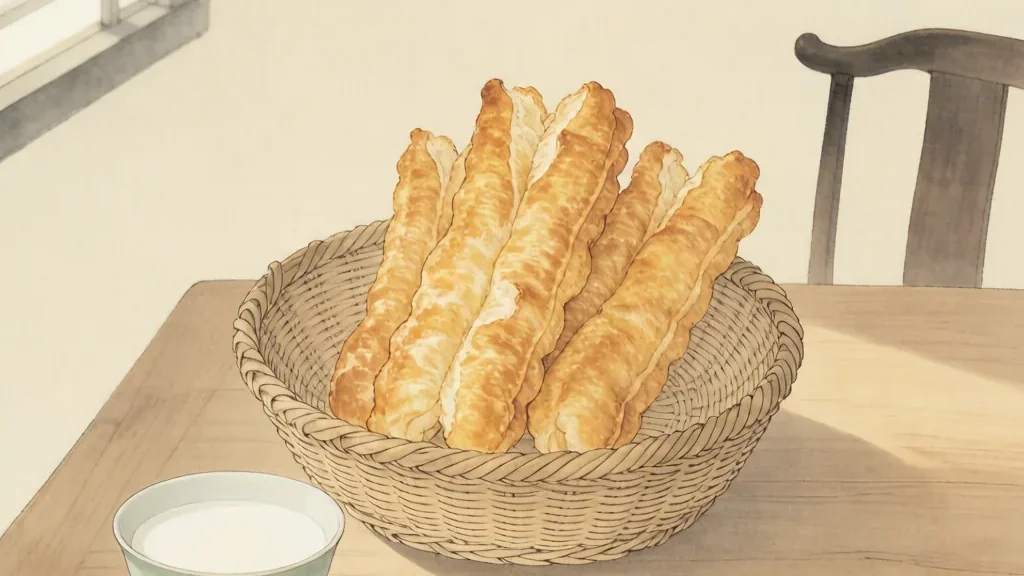
Golden, blistered, and faintly chewy inside with a crisp exterior, the 油条 () is China's beloved fried dough stick. Sold from dawn carts outside every subway entrance and breakfast shop, youtiao is the country's default morning carb: torn into a soy-milk bowl, wrapped in a thin pancake, or eaten plain while walking to work. Its name means simply "oil strip," and though it is unapologetically deep-fried, it holds a place in Chinese hearts comparable to the croissant in France or the donut in America — proof that the simplest fried dough, done right, becomes a national habit.
What Is a Youtiao?
A youtiao is made from a soft wheat dough enriched with a little salt, and traditionally a small amount of alum or baking ammonia and baking soda, which create the characteristic holes and lift. Two ropes of dough are pressed together lengthwise, then dropped into hot oil and fried, turning and stretching until puffed, golden, and crisp. The joined pair gives the stick its signature shape: long, with a hollow center running through it.
The ideal youtiao is crisp on the outside, airy and slightly salty within, and never greasy when fresh. Eaten within minutes of frying, it shatters then yields. Its neutral, bready flavor makes it endlessly versatile — it can be sweet with condensed milk, savory with congee, or a vehicle for soy milk. Few street foods are as adaptable to a meal or a snack.
A Long Fried History
Fried dough has existed in China for over a thousand years, but the youtiao as we know it is often tied to a grim legend from the Southern Song dynasty. The story says it represents the traitorous official Qin Hui and his wife, who conspired against the patriot general Yue Fei; vendors supposedly twisted two figures together and fried them in mock execution. Whether historical or not, the tale shows how food can carry memory and protest.
By the Ming and Qing dynasties, youtiao were a common breakfast item sold by itinerant fryers. The technique — a fermented, aerated dough fried in plenty of oil — was practical for feeding crowds quickly. Over centuries the recipe was refined for lightness and crispness, and the youtiao became a fixture of the urban morning, inseparable from the soy-milk stall beside it.
Youtiao and Soy Milk
The classic pairing is youtiao with 豆浆 (), fresh soy milk. Diners tear the hot stick into chunks and dunk them into a bowl of warm, unsweetened soy milk, where the dough soaks up the liquid and softens to a tender, savory-sweet bite. Sweetened soy milk with a crisp youtiao on the side is another favorite, especially in the south.
This combination is the Chinese breakfast archetype: cheap, fast, hot, and filling. In cities, the "youtiao and soy milk" shop is as common as the coffee stand elsewhere. The contrast of temperatures and textures — crisp against smooth, salty against mild — is what makes the pairing endure across generations and regions.
Regional Names and Forms
Across China the fried stick goes by many names. In Cantonese it is 油炸鬼 (), "fried ghost," echoing the Qin Hui legend. In Fujian and Taiwan it appears as 油條 in breakfast shops and is wrapped in thin 面饼 (mian bing) with egg and lettuce as a portable sandwich. Size varies from slim and brittle to thick and bready depending on local taste.
Similar fried doughs exist throughout Asia — the Malaysian cakoi, the Indonesian cakwe, the Korean twigim-ppang lineage — most tracing back to Chinese influence. Each culture tweaks the seasoning and serving, but the core idea of a long, airy fried dough strip remains recognizably the youtiao's descendant.
How Youtiao Is Made
At home or in a shop, the dough is mixed, rested to ferment slightly, then rolled into a sheet and cut into paired strips. The cook presses two strips together with a chopstick down the middle so they stay joined, then gently stretches the pair and slides it into hot oil. Constant turning ensures even puffing and color.
The timing is everything: too cool an oil and the dough absorbs grease; too hot and it browns before cooking through. A minute or two yields the perfect stick. Because the dough must rest and ferment, shops often prepare it the night before, so the first frying begins before dawn — the reason youtiao is so tied to early mornings.
Youtiao in Culture Today
Beyond breakfast, youtiao appears inside dishes: wrapped in 饭团 (, rice rolls) in Taiwan, stuffed into 煎饼 (jian bing) in the north, or chopped into congee. It is even used in some braised dishes for texture. Chefs have begun plating it creatively, but most Chinese still prefer it straight from the paper sleeve, hot and greasy-fingered.
Health concerns about frying and old frying oil have prompted lighter versions and air-fried copies, but purists insist the real thing requires the wok. The youtiao's survival through dynasties, wars, and food trends is a testament to its perfect fit with Chinese breakfast life: fast, cheap, and deeply comforting in its simplicity.
Youtiao as a Building Block
Beyond the soy-milk bowl, youtiao is a versatile ingredient in its own right. In Taiwan it is tucked inside fan tuan, a rice roll often wrapped with pickled vegetable, egg, and pork floss, where the crisp stick cuts the soft rice. In northern China it is folded into jian bing, the savory breakfast crepe, adding crunch beneath the egg and sauce. Chopped into congee, it softens into tender strands that flavor the porridge, and some braised dishes use it for texture. Cooks have even plated it with condensed milk or ice cream as a sweet contrast. Few fried breads weave through so many meals, which is part of youtiao's quiet genius: it is never just a snack but a component that makes other foods better.
Health, Oil, and Modern Alternatives
Deep-frying gives youtiao its character but also its critics. Concerns about old frying oil and excess fat have pushed shops toward fresher oil and smaller batches, while home cooks and brands offer air-fried and baked versions that mimic the crisp, airy bite with far less grease. Traditionalists argue the real thing needs the wok, and most people still prefer a fresh stick from a paper sleeve. Some makers use longer fermentation instead of alum to get the holes and lift, addressing older health worries. The debate reflects a wider tension in Chinese breakfast culture between convenience, tradition, and well-being. However it is cooked, youtiao's appeal, cheap, hot, and comforting, keeps it firmly on the morning menu.
❓ Frequently Asked Questions
📝 Chinese Vocabulary
油条 — : fried dough stick.
豆浆 — : soy milk.
油炸鬼 — : Cantonese "fried ghost" youtiao.
饭团 — : rice roll often containing youtiao.
煎饼 — : savory crepe that may wrap youtiao.
咸 — : Salty, describing youtiao's savory flavor profile.
面粉 — : Wheat flour, the base of the youtiao dough.
明矾 — : Alum, the traditional raising agent now often replaced.
🎉 Fun Facts
- Legend says youtiao represents a traitorous official and his wife, fried in mock punishment.
- The Cantonese name "fried ghost" (yau jaa gwai) echoes that same legend.
- Youtiao is the standard partner to soy milk, China's most common breakfast pairing.
- Similar fried dough sticks appear across Asia, from Malaysian cakoi to Indonesian cakwe.
- A fresh youtiao is best within minutes of frying; as it cools it loses its crispness, which is why stalls fry in small batches through the morning rush.
- In southern China, youtiao is sometimes dipped in sweetened condensed milk or sugar, showing how the same plain stick can swing sweet or savory.