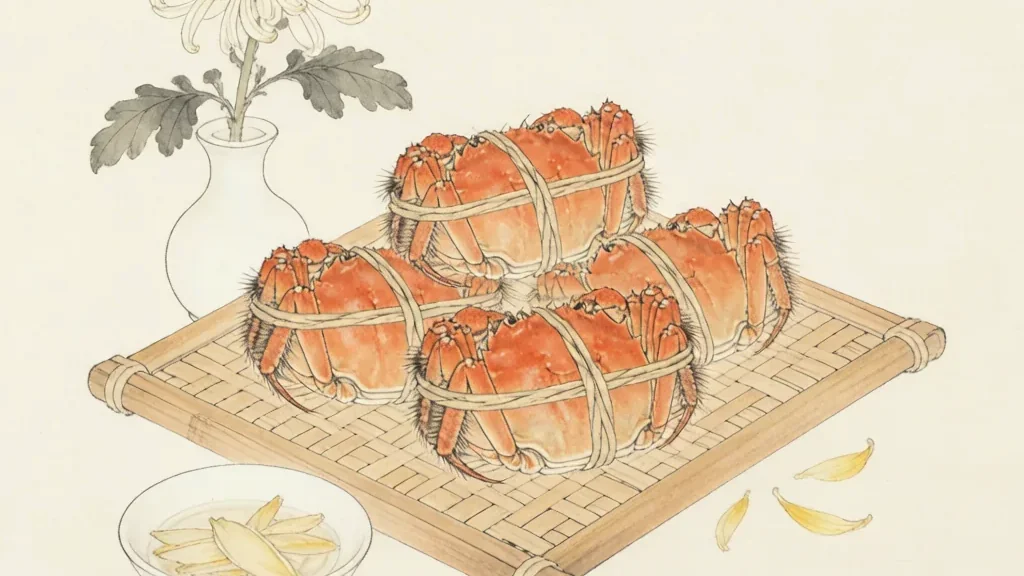
Every autumn, a quiet frenzy grips the lower Yangtze region: the harvest of dà zhá xiè (大闸蟹), the Chinese mitten crab, also called the "hairy crab" for the fuzz on its claws. From September to November, restaurants, gift boxes, and river towns devote themselves to this small, orange-fleshed crab whose roe and cream are considered among the finest flavors in Chinese cuisine. The name means "big sluice crab," a reference to the sluice gates (zhá) where the crabs were once trapped as they migrated. Eating dazhaixia is a seasonal ritual of anticipation — a delicacy so tied to time and place that its quality is measured by the exact month and the specific lake. It is the culinary calendar made flesh.
What Is the Hairy Crab?
The dà zhá xiè is the Chinese mitten crab (Eriocheir sinensis), a burrowing crab native to the estuaries of the Yangtze River, named for the dense hairs on its claws. Males (called "gōng" crabs) and females ("mǔ" crabs) are prized at slightly different times: tradition holds that females are best in the ninth lunar month and males in the tenth, when their roe and creamy "crab butter" are richest. The crabs are modest in size — usually 100 to 200 grams — but valued for the sweetness of their meat and the intensity of their reproductive organs.
The most famous are from Yangcheng Lake in Jiangsu province, whose clear, alkaline water yields crabs with exceptionally sweet meat and bright orange roe. Other lakes (Taihu, Gucheng) also produce sought-after crabs. What sets dazhaixia apart from ocean crabs is its delicate, almost fruity sweetness and the prized gelatinous roe and hepatopancreas ("crab cream"), which gourmets consider the best part. The crab is steamed plain to preserve that subtlety.
A Seasonal Delicacy
Dazhaixia is the ultimate seasonal food. Its availability is narrow — the autumn harvest, roughly September through November — and its quality peaks in a window of weeks, so demand spikes precisely when the crabs are fattest. In China, giving a box of live Yangcheng Lake crabs is a prestigious autumn gift, and restaurants run crab-themed menus. The brevity is the point: like sakura in Japan, the crab is treasured because it cannot be had year-round.
This seasonality shapes everything. Connoisseurs track the lunar calendar and the lake of origin; prices rise with scarcity and reputation. The crab's short glory also explains the rituals around it — a hasty, indulgent celebration before winter. For the Yangtze region, autumn without dazhaixia is unthinkable, and the dish anchors family dinners and business banquets alike during those few weeks.
How It Is Prepared and Eaten
The classic preparation is minimal: live crabs are cleaned, bound, and steamed whole, often with a few slices of ginger in the shell and a scatter of Shaoxing wine, just until the shells turn red. No heavy sauce, because the flavor should be pure. They are served with a dipping mixture of aged black vinegar, shredded ginger, and sometimes a little sugar, which complements the crab's sweetness and aids digestion.
Eating dazhaixia is a slow, hands-on affair. Diners crack the shell, pick the meat from the body and claws with tiny tools, and spoon out the roe and cream. Etiquette values patience and care; a dedicated crab set (hammer, pick, scissors) is common. The experience is as much about unhurried gathering as about taste. Because the crab is rich, it is often paired with warm Shaoxing rice wine and a light vegetable, the meal stretching pleasantly into the evening.
The Roe, the Cream, and the Connoisseur
To aficionados, the glory of dazhaixia is not the white meat but the reproductive and digestive organs. The female's roe (hóng gāo, "red paste") is a dense, sweet-orange mass; the male's "crab cream" (huáng, the hepatopancreas) is a soft, golden, custard-like substance. Both are richer and more aromatic than the meat and are the reason a small crab commands a high price. Connoisseurs judge a crab by the fullness and color of these parts.
This focus on offal-like richness reflects a broader Chinese appreciation for texture and umami in unexpected places — akin to the love of roe in other cuisines. The crab butter is sometimes used to enrich noodles (xiè fěn) or congee, extending the luxury. For the serious eater, a crab with sparse roe is a disappointment, while a fat, orange-laden female is the season's trophy, savored slowly and shared with admiration.
Culture, Gift, and Caution
Dazhaixia sits at the intersection of gastronomy and social custom. A live-crab gift box signals respect and prosperity in autumn; counterfeit "Yangcheng Lake" crabs are a known problem, prompting official protection marks. The crab also appears in poetry and art as a symbol of autumn abundance. Yet there are cautions: the crab is "cold" in traditional Chinese food theory, so it is eaten with warming ginger and wine, and those with certain health conditions are advised moderation.
For travelers to the Yangtze delta in autumn, a dazhaixia feast is a quintessential experience — best near the lakes themselves, where the crabs are freshest. Whether enjoyed as a humble home steam or a luxury banquet, the hairy crab distills a region's sense of season, place, and patience into a single, sweet, orange-flecked bite. It is Chinese seasonal eating at its most refined and its most anticipated.
Hairy Crab in Art and Poetry
The autumn crab has long been a muse for Chinese painters and poets, who valued it as a symbol of the season's abundance and a pretext for gathering. Song dynasty artists painted chrysanthemums and crabs together as a classic autumn subject, and scholars hosted crab feasts where wine flowed and poems were improvised. The historian and gourmet Yuan Mei wrote carefully about the crab in his eighteenth-century cookbook, treating its preparation as a serious art. These cultural traces matter because they show the crab was never just food; it was an occasion for leisure, friendship, and the performance of taste. Reading the old paintings and essays today still conveys the unhurried pleasure of an autumn evening spent picking a small crab apart with friends and a cup of warm wine.
Buying and Storing Live Crabs
Choosing a good hairy crab is itself a skill. Buyers look for lively movement, a heavy feel for the size, and a firm, intact shell, then check the belly and the depth of the apron to judge sex and fullness. Because the crabs are sold live, they are bound and kept cool, never frozen, and cooked within a day or two for the best meat. At home they are best steamed the same day, kept damp and cool if a short wait is unavoidable. Gift boxes from Yangcheng Lake and other famous lakes now ship nationwide with ice packs and certificates, which helps buyers avoid the counterfeit problem that surrounds prestigious origins. Knowing how to select and handle the live crab is the first step in the short, intense season that crab lovers await all year.
Crab in Noodles and Congee
Beyond the whole steamed crab, the roe and cream are prized as ingredients in their own right. Cooks scrape the rich material into crab roe noodles, where a small amount turns a plain bowl of wheat noodles into a luxurious treat, or stir it into congee for a silky, savory breakfast. The meat, too, is picked from the shell and used in stuffed vegetables or crab lion's-head meatballs, extending the value of a small crab across several dishes. This thriftful refinement reflects a broader Chinese habit of wasting nothing of a precious seasonal food. Whether eaten straight from the shell or dissolved into a noodle broth, the crab's sweetness carries the flavor of the Yangtze autumn, making even the simplest preparation feel like a celebration of the short harvest.
❓ Frequently Asked Questions
📝 Chinese Vocabulary
大闸蟹 — : Chinese mitten / hairy crab.
阳澄湖 — : Yangcheng Lake, the famed crab source.
蟹黄 — : crab roe / "crab butter."
公蟹 / 母蟹 — : male / female crab.
蒸 — : to steam.
蟹粉 — : a mixture of crab meat and roe used to enrich noodles and congee
黄酒 — : Chinese rice wine, often Shaoxing, paired with the crab
蟹八件 — : the eight-piece tool set for eating crab neatly
🎉 Fun Facts
- The "hairy" name comes from the fuzz on the crab's claws, not its body.
- Tradition says eat females in the ninth lunar month and males in the tenth, for the richest roe and cream.
- Counterfeit "Yangcheng Lake" crabs are common, so official protection labels exist.
- Dazhaixia is so seasonal that giving a box of live crabs is a prestigious autumn gift in China.
- Eating hairy crab is so tied to autumn that restaurants build entire seasonal menus around it, and the short harvest drives prices upward week by week.
- Because the crab is cooling in traditional food theory, it is traditionally paired with warming ginger and Shaoxing wine to protect digestion.