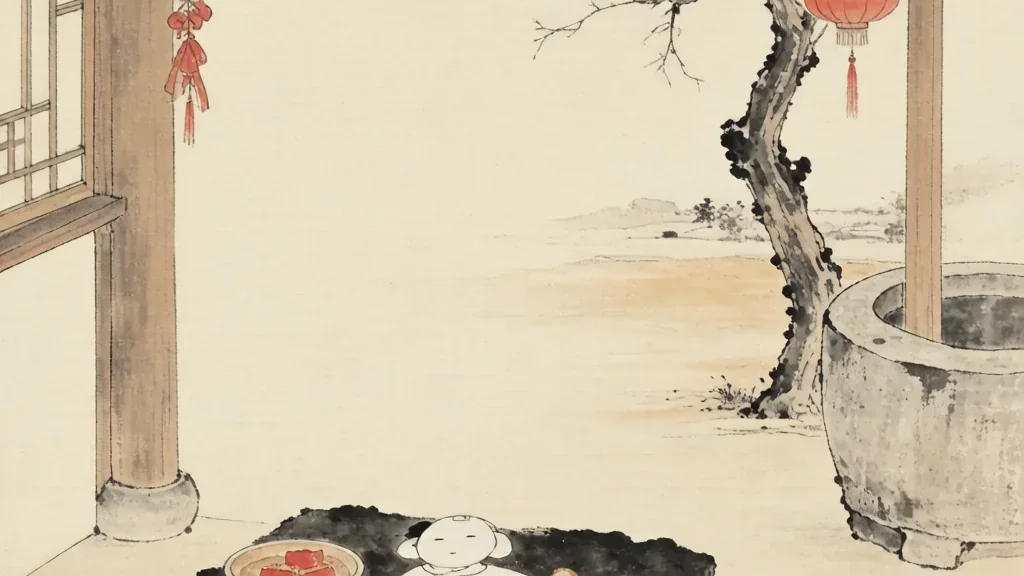
About a week before the great explosion of the Spring Festival, a quieter but equally important celebration takes place in Chinese homes: Xiaonian (小年, Xiǎonián), the "Little New Year." Falling on the 23rd or 24th of the twelfth lunar month, Xiaonian is the opening act of the New Year season — the moment when families begin the great cleaning, the great cooking, and the great settling of accounts that will prepare them for the fresh start of the Spring Festival. But at its heart, Xiaonian is the festival of a single, humble deity who watches over every household: the Kitchen God (灶神, Zào Shén).
The Kitchen God is one of the most beloved and most approachable figures in the Chinese pantheon. He does not dwell in a distant heaven. He lives in the kitchen — the warmest, most central room of the traditional Chinese home. His image, printed on a paper altar above the stove, watches over the family's daily meals, their conversations, their arguments, their joys, and their shortcomings. He sees everything. And once a year, on the night of Xiaonian, he leaves his post and ascends to Heaven to deliver his report to the Jade Emperor (玉皇大帝, Yù Huáng Dà Dì), the supreme ruler of the cosmos.
The Kitchen God's Origins: The Story of Zhang Sheng
Long ago, there was a poor young man named Zhang Sheng (张生) — or, in some versions, Zhang Dang or Zhang Dan. He married a virtuous and hardworking woman named Guo Dingxiang, who was gentle, frugal, and endlessly patient. Together they lived a modest but content life. But Zhang grew restless. He abandoned his wife to seek his fortune, wandering the land for years, growing poorer rather than richer, until he was reduced to begging.
One bitter winter day, half-starved and freezing, Zhang stumbled to the door of a wealthy household to beg for food. To his shock, the kind woman who opened the door was his former wife, Guo Dingxiang. After Zhang had left, she had been taken in by a generous family and had come to manage their household. Seeing her wretched former husband at her door, she did not turn him away. She brought him inside, prepared a hot meal, and let him warm himself by the kitchen fire.
As Zhang ate, the full weight of his shame crashed over him. He had abandoned a good and loving woman. He had squandered his life. And now she, whom he had wronged, was showing him more kindness than he deserved. He could not bear to face her. When she stepped out of the kitchen for a moment, Zhang crawled into the roaring stove, hiding himself among the burning firewood. Guo Dingxiang returned to find the kitchen ablaze. She tried to pull him out, but it was too late. Zhang had been consumed by the flames.
Grief-stricken, Guo Dingxiang built a small shrine to her lost husband beside the stove. She offered him food and incense, mourning the man who had, in his final moments, at least shown the decency to feel shame. When neighbors asked about the shrine, she told them she was worshiping the Zào Shén, the Kitchen God. The custom spread, and Zhang Sheng — the prodigal husband who repented too late — became, in popular belief, the Kitchen God who watches over every home.
The Report to the Jade Emperor
Whatever his human origins, the Kitchen God's divine duty is clear and solemn. Every day of the year, he sits above the stove and observes the family's conduct. He records every kind act and every cruel word, every generosity and every stinginess, every truth told and every lie spoken. And on the night of Xiaonian, he mounts a paper horse (or, in some versions, a horse made of straw and bamboo) and rides up to the Heavenly Court.
There, before the Jade Emperor, he delivers his annual report. The Jade Emperor, who oversees all of creation, relies on these reports to decide each family's fortune for the coming year. Will they enjoy health and prosperity? Will they suffer misfortune? Will their harvest be abundant, their business thrive, their children do well? Much depends on what the Kitchen God says.
This creates a wonderful tension in the tradition. The Kitchen God is, in effect, a divine auditor who has been living in your house all year, watching you burn the rice, snap at your children, and gossip about the neighbors. And now he is going to tell the Emperor of Heaven everything. What is a family to do?
Sweetening the Messenger's Mouth
The Chinese response to this dilemma is one of the most charming and cunning traditions in all of folklore: you feed the Kitchen God sweets. Specifically, you offer him Zào Táng (灶糖), also called "Kitchen Candy" or "Guandong Tang" — a sticky, chewy candy made from maltose or glutinous millet, shaped like long bars or twisted spirals. The candy is famously, almost absurdly sticky.
The logic is twofold, and both interpretations reveal the playfulness of folk religion. The first, more innocent reading: by offering the Kitchen God something sweet, you sweeten his mouth so that he will speak sweet words — that is, only good things — about your family when he reaches Heaven. The second, more mischievous reading: the candy is so sticky that it glues the Kitchen God's mouth shut, so that he cannot report any of the family's misdeeds at all. Either way, the Kitchen God leaves for Heaven with a mouthful of sweetness — or stuck shut entirely — and the family's secrets are safe for another year.
Before the offering, families remove the old paper image of the Kitchen God from above the stove. They smear his lips with honey or sugar, place a piece of Zao Tang before him, and burn his paper image so that the smoke carries his spirit up to Heaven. A new paper image is pasted up on New Year's Eve, welcoming him back to his post for another year of watching — and another year of being bribed with candy.
The Great Cleaning: Sweeping Away the Old Year
Xiaonian is also the day when families begin the great sǎo chén (扫尘), the "sweeping of the dust." This is no ordinary cleaning. It is a ritual purification of the entire home — walls are scrubbed, windows washed, curtains laundered, floors mopped, furniture moved and cleaned beneath, and every corner of the house made spotless. The word for "dust" (尘, chén) is a homophone for "old" or "stale" (陈, chén), so sweeping the dust symbolically means sweeping away the misfortunes, stale energies, and bad luck of the old year, making room for fresh fortune in the new.
In northern China, where Xiaonian falls on the 23rd, there is a saying: "On the 23rd, sweep the house clean" (二十三,扫房日). In the south, where it is often celebrated on the 24th, the cleaning is just as thorough. The cleaning also has a practical dimension: with the Kitchen God gone to Heaven and not yet returned, the family can clean freely without "disturbing" him. Some say the dust must be swept outward, toward the door, to drive bad luck out. Others say the broom should not be used on the first day of the New Year, lest you sweep the new good luck away.
Traditions North and South
Xiaonian falls on the 23rd in the north and the 24th in the south — a divergence that dates back to the Qing Dynasty. Traditionally, officials celebrated on the 23rd and commoners on the 24th, and the "officials first, commoners later" saying (官三民四) emerged. Over time, northerners adopted the 23rd and southerners kept the 24th. In some regions, boat-dwelling communities along the coast even celebrate on the 25th.
Beyond offering candy and cleaning, families also bathe and cut their hair on Xiaonian — a symbolic freshening-up. Some regions prepare special foods: in the north, families eat guandong tang (关东糖), a crunchy maltose candy; in the south, some make rice cakes or fried cakes. Paper cuttings of auspicious characters and animals are pasted on windows. New Year's couplets begin to be written and prepared. The whole house takes on an air of anticipation.
Xiaonian, in the end, is the hinge between the old year and the new. It is the day the Kitchen God packs his report and rides his paper horse to Heaven — and the day the family, alone for a brief moment without their divine observer, scrubs the house clean and prepares to welcome him back with a fresh altar and a hopeful heart. The candy on his lips is sweet, and so, the family prays, will be the year to come.
The Kitchen Goddess and the Household Shrine
The Kitchen God rarely travels alone in popular imagination. He is joined by the Kitchen Goddess, known affectionately as Zao Wang Nainai, who keeps her own record of the family's behavior beside his. Together the pair dwell above the stove on a paper image pasted to the wall, watching the daily life of the household. On Xiaonian the old image is taken down, honored with sweets, and burned so the couple can ascend. A fresh image is pasted up on New Year's Eve to resume the watch, making the shrine a small but constant presence at the warm heart of the Chinese home.
Foods of Xiaonian
Xiaonian is a day of small, meaningful eats. In the north families chew guan dong tang, a brittle maltose candy whose stickiness is meant to glue the Kitchen God's mouth shut or sweeten his words. Southern households favor rice cakes and fried cakes, while many prepare dumplings or sweet buns for the coming days. None of these dishes are lavish; their point is symbolic and preparatory, a tasting of the richer feasting still to come. Setting them out is also a way of feeding the departing deity, so that his report to heaven is delivered with a full stomach and a kind disposition.
Xiaonian in Modern Households
In today's cities the paper Kitchen God may be replaced by a sticker or omitted entirely, yet the spirit of Xiaonian survives. Families still use the week before the New Year to deep-clean apartments, buy new clothes, and stock the kitchen with treats and snacks for visiting relatives. Offices wind down, travel books fill up, and the familiar phrase 'the little new year' marks the mental shift from ordinary time into holiday time. The custom has loosened its rituals but kept its role as the gentle hinge between the old year and the new, a moment to tidy, to forgive, and to get ready for home.
❓ Frequently Asked Questions
📝 Chinese Vocabulary
小年 — : "Little New Year," celebrated on the 23rd or 24th of the 12th lunar month. It marks the beginning of New Year preparations and honors the Kitchen God.
灶神 — : The Kitchen God, a household deity who watches over the family from above the stove and reports their deeds to the Jade Emperor each year.
灶糖 — : "Kitchen Candy," a sticky maltose candy offered to the Kitchen God to sweeten his mouth — or glue it shut — before his heavenly report.
扫尘 — : "Sweeping the dust," the great pre-New Year house cleaning that symbolically removes the bad luck of the old year. The word for "dust" (尘) sounds like "stale/old" (陈).
玉皇大帝 — : The Jade Emperor, the supreme deity of the Chinese heavenly court who receives the Kitchen God's annual report.
灶王奶奶 — : The Kitchen Goddess, the wife who keeps her own record of the household alongside the Kitchen God.
关东糖 — : Guandong candy, a crunchy maltose sweet eaten in the north to honor and sweeten the Kitchen God.
纸马 — : The paper horse on which the Kitchen God is believed to ride up to heaven to deliver his report.
🎉 Fun Facts
- The Kitchen God is often depicted with his wife, the Kitchen Goddess (灶王奶奶), who keeps her own records of the household's behavior. Together they ride to Heaven on a paper horse.
- In some regions, families smear the Kitchen God's paper image with honey or malt sugar directly on the lips before burning it — ensuring that even his first words to the Jade Emperor will be sweet.
- The famous "灶王爷本姓张" (the Kitchen God's surname is Zhang) folk saying is a direct reference to the legend of Zhang Sheng, the prodigal husband who became the deity.
- Some families prepare a special "horse" made of straw and bamboo for the Kitchen God to ride to Heaven, along with a dish of beans and water for the horse to eat on its journey.
- The date split between the 23rd (north) and 24th (south) comes from the Qing Dynasty tradition where imperial officials celebrated first, followed by commoners — a custom that hardened into a regional difference over time.
- Because the Kitchen God is about to leave, many families also take the chance to scrub the hearth and repair cooking tools, not wanting the household deity to report a dirty or broken home.