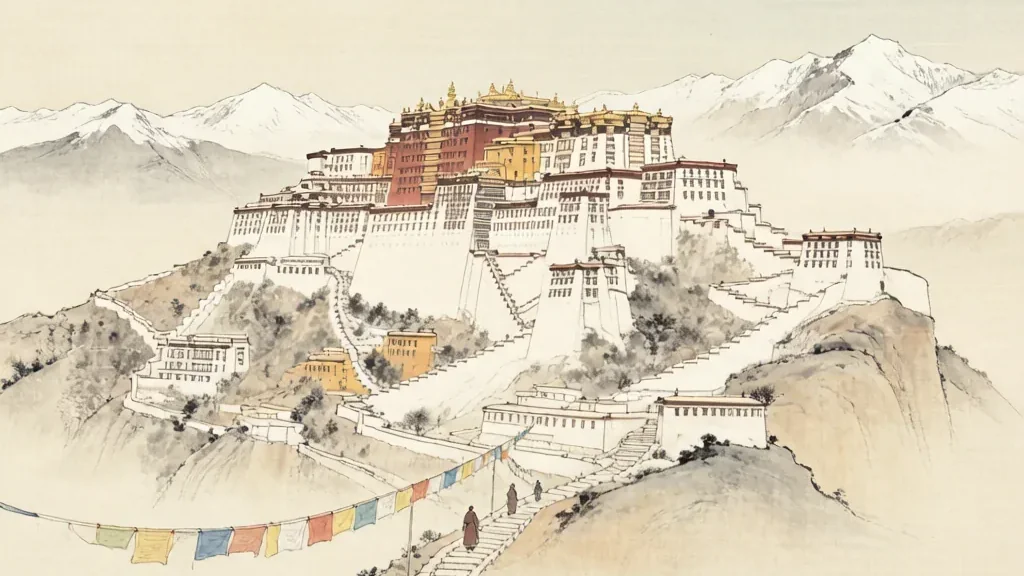
At 3,700 meters above sea level, where the air is thin and the sky is a shade of blue found nowhere else on Earth, a palace rises from a sacred hill like a vision from another world. The Potala Palace in Lhasa, Tibet, is the highest ancient palace on the planet — a 13-story, 1,000-room fortress-monastery-palace that dominates the skyline with its white and red walls, golden roofs, and an aura of spiritual power that has drawn pilgrims and travelers for centuries. It is, quite simply, one of the most extraordinary buildings ever constructed by human hands.
The Hill of the Goddess
Long before the Potala Palace existed, the hill on which it stands — Marpo Ri, or "Red Hill" — was a sacred site. According to Tibetan tradition, the hill was the dwelling place of the goddess Palden Lhamo, a fierce protector deity who rides a mule through a sea of blood. When the 33rd Tibetan king, Songtsen Gampo (c. 605–650 CE), moved his capital to Lhasa, he chose Red Hill as the site for his palace.
Songtsen Gampo was the king who first unified Tibet and introduced Buddhism to the Tibetan plateau. His marriages to Princess Wencheng of Tang China and Princess Bhrikuti of Nepal brought Buddhism, art, and scholarship from two of Asia's greatest civilizations. On Red Hill, he built a palace of 999 rooms — so the legend says — where he lived with his two queens. The original palace was destroyed by fire and warfare, but its memory persisted, and when the Fifth Dalai Lama decided to build a new palace in the 17th century, he chose the same sacred site.
The name "Potala" itself is significant. In Buddhist cosmology, Mount Potalaka is the mythical abode of Avalokiteshvara, the Bodhisattva of Compassion. The Dalai Lamas are believed to be incarnations of Avalokiteshvara. By naming his palace "Potala," the Fifth Dalai Lama was making a cosmic claim: this was not just a royal residence, but the earthly manifestation of a divine dwelling, the home of a living god.
The Great Fifth and the Building of the Palace
The Potala Palace as it stands today is largely the creation of the Fifth Dalai Lama, Ngawang Lobsang Gyatso (1617–1682), known to Tibetans as the "Great Fifth." In 1642, with the military support of the Mongol chieftain Gushri Khan, the Fifth Dalai Lama unified Tibet under the Gelug school of Tibetan Buddhism and established the Ganden Phodrang government, which would rule Tibet for the next three centuries.
Construction of the Potala began in 1645. Thousands of laborers — Tibetan serfs, Nepalese craftsmen, and Chinese artisans — worked for decades, carrying stone, timber, and gold up the steep slopes of Red Hill. The White Palace (Potrang Karpo), the secular administrative wing, was completed in 1648. The Red Palace (Potrang Marpo), the religious heart of the complex containing the stupa-tombs of the Dalai Lamas, was added after the Fifth Dalai Lama's death by his regent, Desi Sangye Gyatso, and completed in 1694.
The result was a building of staggering scale and beauty. The Potala rises 117 meters from the summit of Red Hill to the tips of its golden roofs, with walls up to 5 meters thick at the base, tapering to 2 meters at the top. The walls are not painted — the white sections are literally coated with a mixture of lime, milk, honey, and sugar, applied by hand and refreshed annually. The deep red of the Red Palace comes from walls made of bundled tamarisk branches, a traditional Tibetan technique that reduces weight while providing earthquake resistance.
The Red Palace: Tombs of the Living Buddhas
The Red Palace is the spiritual core of the Potala, and its most spectacular contents are the stupa-tombs of the Dalai Lamas. When a Dalai Lama died, his body was embalmed, coated in fragrant oils, wrapped in silk, and placed in a seated meditation posture within a magnificent chorten (stupa), a tiered monument encrusted with gold and precious stones.
The tomb of the Fifth Dalai Lama is the most magnificent. Standing 14.85 meters tall — five stories high — it is covered in nearly 4,000 kilograms of solid gold and studded with over 18,000 pearls, corals, turquoise, amber, and other gems. Beside it are the tombs of the Seventh through Thirteenth Dalai Lamas, each a masterpiece of Tibetan goldsmithing. The tomb of the Thirteenth Dalai Lama, who died in 1933, rises 14 meters and is covered in 590 kilograms of gold.
The Red Palace also houses some of Tibetan Buddhism's most sacred spaces. The Great West Hall, supported by massive wooden pillars draped in silk brocade, contains murals depicting the life of the Fifth Dalai Lama and the construction of the palace itself. The Saint's Chapel holds an ancient sandalwood statue of Avalokiteshvara said to have emerged miraculously from a tree trunk. The Dharma Cave, one of the oldest parts of the complex, is believed to be where Songtsen Gampo himself meditated, and contains statues of the king and his two Buddhist queens.
The White Palace: The Seat of Government
While the Red Palace is a realm of the dead — or rather, of the transcendently living — the White Palace was the realm of the living. It served as the winter residence of the Dalai Lamas and the seat of the Tibetan government. Its most important space is the Great East Hall, the throne room where the Dalai Lama received visitors, presided over ceremonies, and conducted the affairs of state.
The Dalai Lama's private apartments were on the upper floors, filled with sunlight and panoramic views of Lhasa and the surrounding mountains. The rooms are intimate in scale, decorated with thangka paintings, silk brocades, and intricate woodwork. The contrast with the Forbidden City in Beijing is instructive: where the Chinese emperor lived in sprawling horizontal grandeur, the Dalai Lama lived vertically, his private world stacked above the administrative halls and the tombs of his predecessors, reaching toward the sky.
The White Palace also housed the monastic offices, the treasury, the printing house (which produced Buddhist texts on hand-carved woodblocks), and the seminaries where young monks studied philosophy, debate, and ritual. The Potala was not just a palace or a temple; it was a self-contained city of faith and governance, the beating heart of Tibetan civilization.
Architecture That Defies Gravity
Building a 13-story palace at 3,700 meters above sea level, in an earthquake-prone region with extreme weather and limited oxygen, required extraordinary engineering. The Potala's builders employed several ingenious techniques.
The foundation is not a single platform but a series of terraces cut directly into the bedrock of Red Hill, so that the palace and the mountain are structurally one. The walls, built of stone and rammed earth, taper inward as they rise — wider at the base for stability, narrower at the top to reduce weight. This gives the palace its characteristic fortress-like silhouette. The flat roofs are constructed of a material called arga, a mixture of clay and crushed stone that is pounded into place and polished until it is hard, waterproof, and gleaming.
Perhaps most remarkably, the Potala contains no iron nails or structural steel. The entire building is held together by the weight of its own stones, by timber beams joined with mortise-and-tenon joints, and by the binding action of the tamarisk-branch walls. It is an organic architecture, rooted in the mountain, designed to flex rather than fracture when the earth shakes — and the earth has shaken many times. The Potala has survived earthquakes that have leveled newer buildings in Lhasa.
Pilgrimage, Power, and the Modern Era
For centuries, the Potala was the most important pilgrimage destination in Tibet. Devout Buddhists would prostrate themselves every few steps along the roads to Lhasa, some traveling for months or years to reach the palace. Circling the Potala — performing the kora, a clockwise circumambulation — was a sacred act, and still is. Even today, pilgrims with prayer wheels and mala beads circle the base of the palace, chanting mantras as they have for centuries.
The 20th century brought dramatic change. In 1959, during the Tibetan uprising, the 14th Dalai Lama fled to India. The Potala ceased to be a seat of government and became a museum. In 1994, UNESCO designated it a World Heritage Site, describing it as "a masterpiece of human creative genius." Today, the Potala is one of China's most visited tourist attractions, drawing millions of visitors annually.
The palace faces modern challenges. The sheer number of visitors strains the ancient structure. Climate change threatens the permafrost that underlies parts of the Tibetan plateau. Conservationists work to balance access with preservation, limiting daily visitor numbers and monitoring the building's structural health with sensors and satellite imaging.
Yet the Potala endures. At dawn, when the first light strikes its golden roofs and the prayer flags flutter in the thin mountain air, it is easy to understand why generations of Tibetans believed this was not just a building but a bridge between earth and heaven. The Potala Palace is the Roof of the World — and standing before it, you feel closer to the sky.
Sacred Art Within the Walls
Beyond its tombs and halls, the Potala is a treasury of Tibetan art. Its walls carry immense murals depicting the life of the Fifth Dalai Lama, the building of the palace, and scenes from Buddhist cosmology, painted in mineral pigments that have kept their glow for centuries. Thangka scrolls, silk brocades, and carved wooden pillars fill the chapels, while hand-carved woodblocks in the palace printing house once produced sacred texts by the thousand. The Dharma Cave, among the oldest parts of the complex, is said to be where King Songtsen Gampo meditated, linking the site to the very beginnings of Tibetan Buddhism. To walk the rooms is to move through a museum that is also a living place of worship.
Conservation in a Changing Climate
The Potala now faces threats its builders never imagined. Millions of visitors a year place strain on floors, beams, and foundations, and climate change is destabilizing the permafrost that underlies parts of the plateau. Conservators respond with strict daily visitor limits, structural sensors, and satellite monitoring that tracks the slightest movement in the walls. International expertise has been brought in to train local craftspeople in traditional repair methods, so that new work matches the old. The challenge is to keep the palace both accessible and intact, a task made harder by the very fame that makes it a symbol of Tibet. The Potala's next centuries will be decided as much by careful stewardship as by its remarkable engineering. Visitors today are asked to view the chapels quietly and in small numbers, a small price for keeping the mountain palace standing for the generations still to come.
❓ Frequently Asked Questions
📝 Chinese Vocabulary
- 布达拉宫 (Bùdálā Gōng) — The Potala Palace. The name is a Chinese transliteration of the Tibetan "Potala," referring to the mythical Mount Potalaka.
- 拉萨 (Lāsà) — Lhasa, the capital of Tibet, whose name means "Place of the Gods" in Tibetan.
- 达赖喇嘛 (Dálài Lǎma) — Dalai Lama, the spiritual leader of Tibetan Buddhism, believed to be the reincarnation of Avalokiteshvara.
- 红山 (Hóng Shān) — Red Hill (Marpo Ri), the sacred hill on which the Potala Palace is built.
- 转经 (Zhuǎnjīng) — Kora, the devotional practice of circumambulating a sacred site while chanting or spinning prayer wheels.
🎉 Fun Facts
- The Potala Palace contains over 1,000 rooms, but its exact room count has never been definitively established. Different surveys have produced different numbers, partly because some rooms are sealed and inaccessible.
- The golden roofs of the Potala are not merely decorative — they are covered in genuine gold leaf, and their design channels rainwater into a network of underground cisterns that supplied the palace with water for centuries.
- The white paint on the Potala's walls is a traditional mixture of lime, milk, honey, and sugar. Each year during the monsoon season, hundreds of volunteers scale the walls to apply fresh coats, a practice that has continued for over 300 years.
- The Potala's walls are as thick as five meters at the base and taper as they rise, giving the palace its unmistakable fortress-like silhouette.
- The tomb of the Fifth Dalai Lama is covered in nearly four thousand kilograms of solid gold and set with more than eighteen thousand pearls and other gems.
- The entire palace contains no iron nails; its stability comes from stone weight, mortise-and-tenon timber joints, and walls of bundled tamarisk branches.