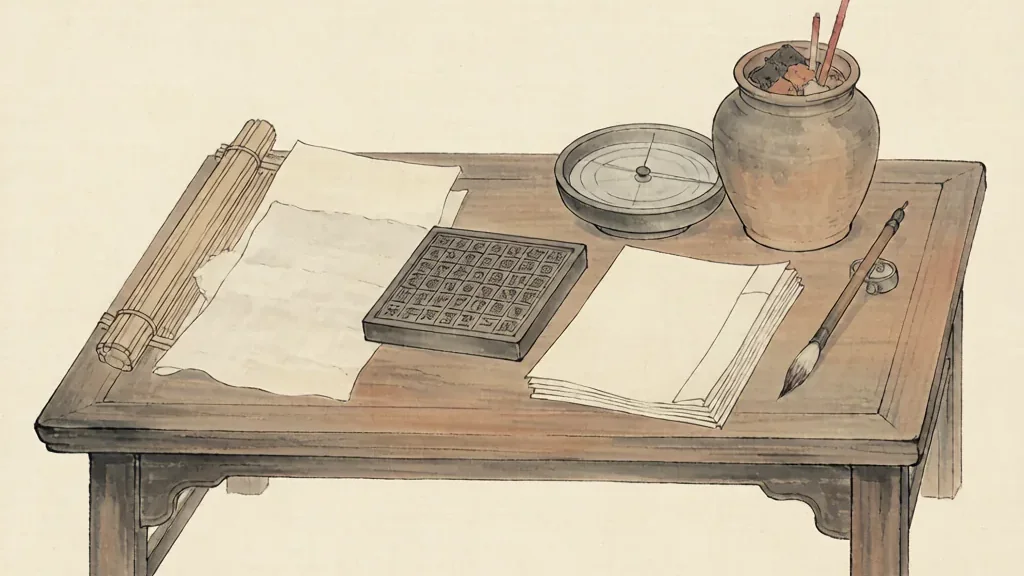
Imagine a world without paper. Without books. Without fireworks, firearms, or maps. Without the ability to navigate oceans, record history, or spread ideas. This was the world before China's Four Great Inventions — paper, printing, gunpowder, and the compass — transformed human civilization. The English philosopher Francis Bacon, writing in 1620, declared that these four inventions "have changed the whole face and state of things throughout the world." He was not exaggerating. Together, they enabled the Renaissance, the Age of Discovery, the Scientific Revolution, and the modern information age. And they all began in China.
Paper: The Foundation of Civilization
Before paper, humanity wrote on clay tablets, papyrus, parchment, bamboo strips, and silk. Each had limitations: clay was heavy, papyrus was fragile, parchment was expensive, bamboo was bulky, and silk was prohibitively costly. The world needed a writing surface that was light, cheap, and durable. It found one in China.
The invention of paper is traditionally credited to Cai Lun, a eunuch official in the Han Dynasty court, who presented his creation to Emperor He in 105 CE. Cai Lun's paper was made from mulberry bark, hemp, old rags, and fishing nets — materials that were readily available and could be produced at scale. The fibers were beaten into a pulp, suspended in water, and then lifted out on a screen, where the water drained away, leaving a thin sheet of interwoven fibers. The process was simple, elegant, and revolutionary.
In truth, archaeological evidence suggests that paper existed in China at least two centuries before Cai Lun. Fragments of hemp paper dating to the 2nd century BCE have been found in Gansu province. Cai Lun's contribution was not the invention of paper itself, but the refinement of the process — using a wider range of materials, improving quality, and standardizing production so that paper could be manufactured on an imperial scale.
Paper transformed Chinese civilization. It enabled the creation of a vast imperial bureaucracy, with records, census data, and legal documents that could be produced and stored efficiently. It democratized literature, making books affordable for scholars who could never have afforded silk or bamboo. And it provided the essential substrate for the next great Chinese invention: printing.
The secret of papermaking traveled slowly westward along the Silk Road. In 751 CE, at the Battle of Talas, Arab forces captured Chinese papermakers and brought the technology to Samarkand. From there it spread to Baghdad, Damascus, and Cairo. By the 12th century, paper mills were operating in Spain and Italy. By the 15th century, Johannes Gutenberg's printing press found in paper the perfect partner, and the European knowledge revolution was launched.
Printing: The Information Revolution
If paper gave humanity a surface to write on, printing gave it the power to reproduce writing at scale. China's printing revolution came in two stages: woodblock printing, invented during the Tang Dynasty (618–907), and movable type, developed during the Song Dynasty (960–1279).
Woodblock printing was brilliantly simple. Craftsmen carved text and images in reverse onto wooden blocks, applied ink to the raised surface, and pressed paper onto the block. A single skilled carver could produce thousands of impressions from one block. The world's oldest surviving printed book — the Diamond Sutra, dated 868 CE — was produced using this technique. Discovered in the Dunhuang caves in 1907, it is a masterpiece of the printer's art, with a beautiful frontispiece showing the Buddha preaching to his disciples.
But woodblock printing had a limitation: carving a new block for every page was labor-intensive and inflexible. The solution was movable type, invented by the artisan Bi Sheng around 1040 CE. Bi Sheng carved individual characters onto small blocks of fired clay, which could be arranged on an iron frame to form any page. After printing, the characters could be disassembled and reused. It was a concept of stunning elegance — and a practical nightmare, given that Chinese writing uses thousands of distinct characters rather than the 26 letters of the Latin alphabet.
Movable type was later improved with wooden and metal characters. By the 13th century, the technology had spread to Korea, where metal movable type was used to print Buddhist texts. In the 15th century, Gutenberg independently developed movable type in Europe — whether he was inspired by Asian precedents or reinvented the concept is still debated. What is certain is that Gutenberg's press, combined with the alphabetic simplicity of European languages, sparked a communications revolution that reshaped the world.
Gunpowder: The Alchemist's Fire
Gunpowder was discovered by accident — and, in a sense, by poetry. Chinese alchemists, seeking an elixir of immortality, experimented with various combinations of substances. Around the 9th century, during the Tang Dynasty, they stumbled upon a mixture of saltpeter (potassium nitrate), sulfur, and charcoal that, when heated, produced a brilliant flash and a satisfying bang. The earliest formula for gunpowder appears in a Taoist text from the mid-9th century, which warns alchemists not to mix these substances near an open flame "lest the mixture fly up and singe your beard, and burn the house down."
The Chinese quickly recognized gunpowder's military potential, but their first applications were more psychological than lethal. By the 10th century, they had developed "fire arrows" — arrows with gunpowder tubes attached that shot flames at enemies. They created "thunder crash bombs," bamboo tubes filled with gunpowder that exploded with a terrifying noise. And, most delightfully, they invented the fire lance — essentially a flamethrower mounted on a spear, the direct ancestor of all firearms.
By the Song Dynasty, gunpowder weapons had become sophisticated. The Chinese developed true bombs with iron casings, rockets, land mines, and primitive cannons. The Wujing Zongyao, a military encyclopedia compiled in 1044, contains recipes for multiple gunpowder formulas, each optimized for a specific purpose — incendiary bombs, smoke screens, poison gas projectiles, and explosives.
Gunpowder traveled westward through the Mongol conquests and Islamic trade networks. By the 13th century, it had reached the Middle East; by the 14th century, Europe. The effect was seismic. Gunpowder ended the age of castles and armored knights, empowered centralized states with professional armies, and fundamentally reshaped the balance of global power. A Taoist alchemist's kitchen accident had remade the world.
The Compass: Finding the Way
Of the Four Great Inventions, the compass is perhaps the most poetic — a simple magnetized needle that, floating on water or pivoting on a pin, always points south. For the Chinese, this property was first observed in lodestone, a naturally magnetic iron ore. By the Han Dynasty, fortune-tellers were using spoon-shaped lodestone "south-pointers" on divination boards, aligning human affairs with cosmic directions.
The transition from divination to navigation came during the Song Dynasty, when mariners began using magnetized needles floating in bowls of water to find their bearings at sea. The earliest clear description of a magnetic compass used for navigation appears in Zhu Yu's Pingzhou Table Talks, written around 1117 CE. By the 12th century, Chinese ships were navigating the South China Sea and the Indian Ocean with compasses, enabling voyages of unprecedented range and precision.
The compass reached Europe by the late 12th century, likely through Arab intermediaries. Its impact on European history was transformative. Before the compass, European sailors hugged coastlines, navigating by landmarks and celestial bodies. With the compass, they could sail across open ocean, out of sight of land for weeks. The compass made possible the great voyages of the 15th century — Columbus crossing the Atlantic, Vasco da Gama rounding Africa, Magellan circumnavigating the globe. The Age of Discovery, and with it the modern globalized world, was built on a magnetized needle that Chinese sailors had used centuries earlier.
A Shared Human Legacy
The Four Great Inventions are not just Chinese achievements — they are human achievements. They traveled across borders, were refined by other cultures, and ultimately transformed every society they touched. The paper on which you read these words, the digital printing that displays them, the satellites that navigate your smartphone, and the rockets that carry humanity to the stars — all trace their lineage, however distantly, to the workshops and laboratories of ancient China.
Yet the story of the Four Great Inventions also carries a cautionary note. China invented gunpowder, but it was Europe that developed modern firearms and artillery. China invented the compass, but it was Europe that built global maritime empires. China invented movable type, but it was Gutenberg's press that sparked mass literacy. The question of why China did not follow its inventions to their full implications — known to historians as the "Needham Question" after the great British sinologist Joseph Needham — remains one of the most fascinating puzzles in world history.
What is beyond question is the magnitude of China's contribution. Without paper and printing, the Renaissance would have been unimaginable. Without the compass, the Americas might not have been reached by Europeans for centuries. Without gunpowder, the modern nation-state and its armies would look entirely different. The world we inhabit — literate, connected, navigable, and explosive — was shaped, in profound and irreversible ways, by the Four Great Inventions of ancient China.
Paper and the Bureaucratic State
Paper did more than spread writing; it made the Chinese imperial state possible at scale. With a cheap surface for records, the government could keep census rolls, tax lists, and legal archives across a vast territory, and it could staff an enormous civil service recruited through examinations. Before paper, such administration relied on bulky bamboo slips and costly silk, which limited how much could be recorded and moved. Once paper became standard, knowledge stopped being the privilege of a few and became the tool of an empire. The same material that carried poetry also carried edicts, maps, and the paperwork of rule, binding distant provinces to a single administration. In this sense the humble sheet was not just a convenience but the quiet foundation of one of history's most durable bureaucracies.
Everyday Life Changed by the Inventions
Beyond war and scholarship, the Four Great Inventions quietly reshaped ordinary life. Paper made letters, contracts, and money possible for common people, not just the court. Printed books carried stories, medical recipes, and farming guides into villages that had never seen a manuscript. Gunpowder, after its military use, found a place in festivals as fireworks that still light Chinese skies on New Year. The compass guided not only ships but the surveyor's hand and the traveler's step on land. Each invention left the laboratory of the state and entered the home, the market, and the holiday. Their deepest legacy is not any single object but the simple fact that knowledge, safety, and celebration became things ordinary people could share, a democratizing shift whose effects we still live inside.
Gunpowder Beyond the Battlefield
Although gunpowder is remembered for war, the Chinese also turned it toward spectacle and peace. As early as the Song dynasty, noisy firecrackers and rockets were used to drive away evil spirits at festivals, a use that survives today in the fireworks of Chinese New Year. The same mixtures that filled bombs were packed into tubes for displays that delighted court and crowd alike. Over time the festival use spread across the world, so that the loud, bright celebration of gunpowder became a near-universal language of joy. Thus the alchemists' accidental discovery served two masters: the general and the reveler. Few inventions have worn such opposite faces, and the fact that the same powder could terrify an army and thrill a village is one of the small wonders of its long career.
❓ Frequently Asked Questions
📝 Chinese Vocabulary
- 四大发明 (Sì Dà Fāmíng) — The Four Great Inventions, a phrase coined by Joseph Needham in the 20th century.
- 蔡伦 (Cài Lún) — Cai Lun, the Han Dynasty official traditionally credited with inventing paper.
- 毕昇 (Bì Shēng) — Bi Sheng, the Song Dynasty artisan who invented movable type printing.
- 火药 (Huǒyào) — Gunpowder. Literally "fire medicine," reflecting its origins in alchemy.
- 指南针 (Zhǐnánzhēn) — Compass. Literally "south-pointing needle."
🎉 Fun Facts
- The earliest gunpowder formula contained 14 different ingredients, including honey, which made the mixture stickier but did nothing for its explosive power. Later formulas refined the ratio to approximately 75% saltpeter, 15% charcoal, and 10% sulfur — close to modern black powder.
- When papermaking reached Baghdad in the 8th century, it sparked a golden age of Islamic scholarship. The city's famous House of Wisdom housed hundreds of thousands of paper manuscripts at a time when the largest European libraries contained a few hundred parchment volumes.
- Chinese compasses pointed south, not north. The Chinese considered south the most important direction — the emperor's throne always faced south, and maps were oriented with south at the top. European compasses were later modified to point north instead.
- Cai Lun is honored as a patron of papermakers, and a shrine in his native Hunan still receives respects from those who practice the craft he refined.
- Movable type traveled to Korea, where printers produced the world's oldest surviving book made with metal type, improving on the Chinese clay original.
- In China today the Four Great Inventions are taught as a point of national pride, appearing in schoolbooks and public monuments as a symbol of the country's gift to civilization.