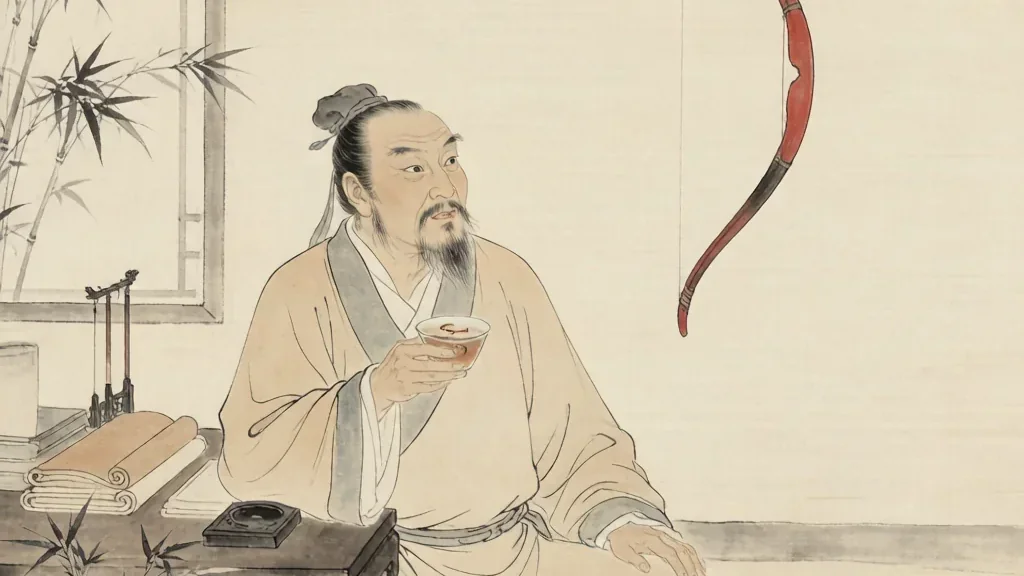
Some fears are born from real danger — a tiger in the grass, a storm on the horizon, an enemy at the gate. But other fears are born from nothing at all, from the tricks our own minds play on us when we are tired, anxious, or simply too ready to believe the worst. The Chinese idiom 杯弓蛇影 (bēi gōng shé yǐng) — "mistaking the reflection of a bow for a snake in one's cup" — belongs to this second category. It is a story about a man who fell gravely ill because of something he never actually saw, and it has been warning people against the dangers of suspicion and unfounded fear for nearly two thousand years.
The tale comes from the "Book of Jin" (晋书), the official history of the Jin Dynasty compiled in the 7th century, though the events it describes took place during the Western Jin period in the 3rd century CE. The story involves two historical figures — Yue Guang, a high-ranking official known for his wisdom and hospitality, and Du Xuan, a younger official who was one of Yue Guang's guests. What happened between them is a small domestic mystery that grew into one of the most enduring psychological parables in Chinese literature.
An Invitation and a Strange Illness
Yue Guang was a man of considerable reputation in the Western Jin court. He was known for his clear thinking, his generosity, and his fondness for gathering friends and colleagues around his table for food and wine. Among the regular guests at these gatherings was a promising young official named Du Xuan, a man of some talent but also of a rather sensitive disposition.
One evening, Yue Guang invited Du Xuan to his home for a private dinner. It was a warm night, the wine was excellent, and the conversation was pleasant. Du Xuan sat facing a wall on which hung a fine red-lacquered bow — one of Yue Guang's prized possessions, a decorative weapon that caught the light of the candles as they flickered. The two men talked and drank, and Du Xuan appeared to enjoy himself, though at one point he paused, stared into his wine cup, and seemed troubled. He said nothing about it, however, and the evening ended on a cordial note.
A few days later, Yue Guang received troubling news. Du Xuan had fallen seriously ill. He was weak, feverish, and had taken to his bed, unable to eat or sleep. The doctors could find no cause for his condition, and no medicine seemed to help. Yue Guang was puzzled and concerned — his friend had been perfectly healthy at the dinner. What could have happened in the intervening days to reduce a vigorous young man to such a state?
The Discovery of the Illusion
Yue Guang decided to visit Du Xuan personally. When he arrived, he found his friend pale and trembling, with a look of deep terror in his eyes. After some gentle questioning, Du Xuan finally confessed what was troubling him. "At your dinner," he whispered, "when I looked into my wine cup, I saw a small snake swimming in the liquid. I did not wish to be rude or make a scene, so I drank it anyway. But ever since that night, I have felt the snake inside me, coiling in my stomach, poisoning my blood. I am certain I am dying."
Yue Guang was startled by this confession. He knew that there could not possibly have been a snake in the wine — his household was meticulously run, and such a thing was unthinkable. But Du Xuan's terror was clearly genuine, and the illness that followed from it was equally real. This was not a case of simple hypochondria. This was a mind that had literally made itself sick from fear.
Determined to solve the mystery, Yue Guang returned home and sat in the exact position Du Xuan had occupied during the dinner. He poured himself a cup of wine and looked into it. There, in the golden liquid, he saw it — a thin, dark, wriggling shape that did indeed look like a small snake. He looked up, and immediately understood. The shape was the reflection of the red bow hanging on the wall behind him, its curved form and the flickering candlelight combining to create a perfect illusion of something alive and moving in the cup.
The Cure and the Revelation
Yue Guang immediately invited Du Xuan back to his home. He placed his friend in the same seat, poured him a cup of wine, and asked him to look into it. "There!" Du Xuan cried out, pointing at the cup. "There is the snake again!" Yue Guang then pointed to the bow on the wall. "Look," he said. "There is your snake. It is nothing but the shadow of this bow, reflected in the wine. There is no snake. There never was a snake. You have been ill from fear of an illusion."
The effect was immediate. Du Xuan stared at the bow, then back at the cup, then back at the bow again. The color returned to his face. The tightness in his chest loosened. He began to laugh — first weakly, then with genuine relief. The moment he understood that his illness had no physical cause, the illness itself began to lift. Within a few days, he had made a full recovery, and he returned to his duties at court with renewed vigor and a much wiser perspective on the workings of his own mind.
The story spread through the court and beyond, and it became a saying: 杯弓蛇影 — "the bow's reflection mistaken for a snake in the cup." It was a cautionary tale about the power of imagination to create suffering where none exists, and about the importance of investigating one's fears rather than simply accepting them as real.
Why the Story Endures
The tale of Yue Guang and Du Xuan is unusual among Chinese idioms in that it is not a parable about morality or ambition or the relationship between rulers and subjects. It is, instead, a parable about psychology — about the way the human mind can generate its own terrors and then fall victim to them. In this sense, it is one of the earliest recorded case studies of what modern psychology would call a psychosomatic illness, and its lesson is as relevant today as it was in the third century.
The idiom speaks to a universal human tendency: the habit of seeing threats where none exist, of interpreting ambiguous signals as evidence of danger, and of allowing suspicion to curdle into conviction without ever checking the facts. Every culture has its version of this warning — the English phrase "making a mountain out of a molehill" captures part of it, and the psychological term "confirmation bias" describes the mechanism. But the Chinese idiom is more vivid and more specific: it reminds us that sometimes the snake in the cup is just a shadow, and the poison we feel is of our own making.
In modern China, 杯弓蛇影 is used in everyday conversation to describe someone who is being unnecessarily suspicious or who is worrying about something that does not exist. A person who reads too much into a friend's casual remark, a manager who sees conspiracy in every minor mistake, a parent who imagines disasters around every corner — all of these are said to be "seeing a snake in their wine cup." The idiom carries a gentle rebuke but also a note of sympathy, because the story acknowledges that the fear, however unfounded, feels real to the person experiencing it.
The story also teaches a more subtle lesson about the role of a good friend or leader. Yue Guang did not dismiss Du Xuan's fear as foolishness. He did not mock him or lecture him. He investigated. He sat in his friend's chair, looked at the world from his friend's perspective, and found the source of the illusion. Then he brought his friend back and showed him the truth, not with arguments but with evidence. This is the model of compassionate problem-solving that the story holds up: not telling someone their fear is irrational, but helping them see for themselves what is really there.
The Medicine of the Mind
Long before modern psychology, the story of bei gong she ying described what we now call a psychosomatic illness, a disorder produced by the mind and felt in the body. Traditional Chinese medicine holds that strong fear can disturb the organs, and Du Xuan's weakness, fever, and loss of appetite fit that old diagnostic picture. What is striking is that the cure was not a medicine but a correction of belief: once Du Xuan saw the bow on the wall, his terror lost its object and his health returned. The tale thus reads like an ancient case study in how conviction alone can sicken or heal a person, a theme Chinese physicians and philosophers would revisit for centuries. Readers still cite it when explaining that a calm mind supports a healthy body as much as any medicine does.
Suspicion in Classical Thought
The idiom belongs to a wider classical interest in how the mind misleads itself. Daoist and Buddhist writers especially warned that appearances deceive and that untrained perception projects threats where none exist. Bei gong she ying captures this in a single domestic scene: a tired guest, a flickering candle, and a curved bow combine to conjure a snake that was never there. Later essayists used the phrase to caution readers against trusting first impressions and against letting anxiety supply facts the senses have not confirmed. In this sense the idiom is less a story about wine than a small treatise on the unreliability of frightened perception. Across the centuries the same insight has appeared in medicine, in fiction, and in everyday advice about not trusting a mind that has already decided to be afraid.
The Idiom in Daily Speech
Today bei gong she ying is a living phrase used to describe a person who is suspicious without cause or who worries about a danger that does not exist. A manager who reads conspiracy into a minor mistake, a parent who imagines disaster in every delay, or a friend who takes a casual remark as an insult may all be told they are seeing a snake in the wine cup. The tone is gently chiding but also sympathetic, because the story admits the fear felt real to the sufferer. Newspapers occasionally use it for public scares, when a reported risk spreads faster than the facts that would calm it, making the idiom a handy word for mass anxiety. It captures, in just four characters, a feeling that English needs a full sentence to express, which is part of its lasting usefulness.
A Tale of Two Friends
Beneath the lesson about illusion lies a quieter model of friendship and leadership. Yue Guang did not mock Du Xuan or dismiss his terror as foolishness. He investigated, sat in his guest's seat, found the source of the illusion, and then showed the truth with evidence rather than argument. That patient, compassionate method is part of why the story endured: it teaches not only that suspicion can deceive us, but that a good friend helps us see what is actually there. The idiom thus offers two lessons at once, one about the danger of an unexamined fear and one about the kindness of a person willing to prove the fear false. That blend of honesty and kindness, rather than mockery, is the quiet heart of the whole idiom and the reason it still teaches today.
❓ Frequently Asked Questions
📝 Chinese Vocabulary
杯 — : "Cup" or "goblet" — the vessel in which the illusion appeared, representing the container of one's perceptions.
弓 — : "Bow" — the decorative weapon whose reflection created the false image of a snake.
蛇 — : "Snake" — the feared creature that was never really there, representing imagined danger.
影 — : "Shadow" or "reflection" — the key to the whole story, reminding us that appearances can deceive.
乐广 — : The wise official who solved the mystery, representing clear thinking and compassionate investigation.
杜宣 — : The young official whose imagined snake in his wine cup made him ill, the patient in Yue Guang's famous cure.
晋书 — : The Book of Jin, the official dynastic history that records the anecdote of the bow's reflection and the snake.
错觉 — : Illusion or misperception, the kind of mistaken sensory reading at the heart of the story.
🎉 Fun Facts
- The story of 杯弓蛇影 is recorded in the "Book of Jin" (晋书·乐广传), making it one of the few Chinese idioms with a verifiable historical setting involving real people, rather than being purely legendary.
- The phenomenon described in the story — becoming physically ill from a purely psychological cause — is now well-documented in medical science as psychosomatic illness, making this one of the earliest literary records of the mind-body connection.
- In traditional Chinese medicine, excessive fear is believed to damage the kidneys, and Du Xuan's symptoms in the story — weakness, fever, and inability to eat — align closely with this diagnostic framework.
- The idiom is often paired with 草木皆兵 (cǎo mù jiē bīng) — "seeing every bush and tree as an enemy soldier" — as the two great Chinese expressions for paranoia and unfounded fear.
- The tale is unusual among Chinese idioms because it names verifiable historical people, Yue Guang and Du Xuan of the Western Jin, rather than purely legendary figures.
- In modern Chinese news and commentary, bei gong she ying is often invoked during health scares and moral panics when people fear a danger that official investigation shows was never really present.