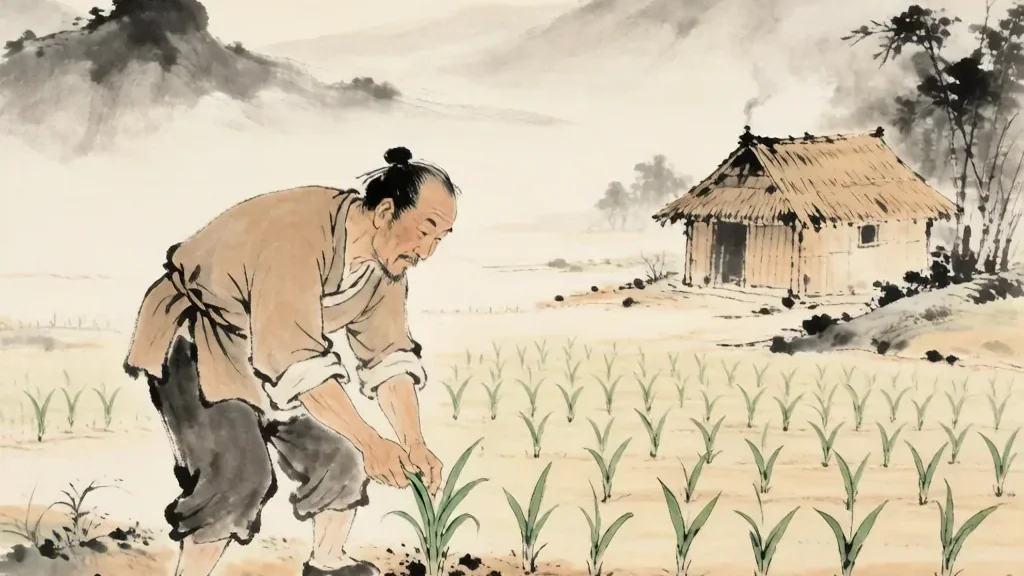
There is a kind of impatience that does not look like impatience. It looks like diligence. It looks like care. It looks like a person working harder than anyone else, more determined than anyone else, more committed to the outcome than anyone else. And yet, beneath the surface, it is impatience — and the damage it does is the damage of impatience, no matter how virtuous it appears. The Chinese idiom 拔苗助长 (bá miáo zhù zhǎng), "pulling up seedlings to help them grow," describes this damage with the precision of a doctor describing a disease, and the story behind it has been warning farmers, parents, teachers, and rulers for over two thousand years.
The tale comes from the "Mencius" (孟子), the foundational Confucian text attributed to Meng Ke, who lived in the fourth century BCE during the Warring States period. Mencius was, after Confucius himself, the most influential thinker in the Confucian tradition, and his work is a long argument that human nature is fundamentally good and that good government consists in nurturing that goodness rather than forcing it. The story of the eager farmer appears as a brief but devastating illustration of what happens when nurture becomes coercion.
The Farmer of Song
In the state of Song (宋国) — a small kingdom already famous in classical Chinese literature as the home of well-meaning fools — there lived a farmer who worked a field of rice. Like all farmers in ancient China, he knew that rice grows slowly. The seedlings must be planted in flooded paddies, tended carefully through the spring, weeded through the early summer, and only harvested in autumn after months of patient labor. There was no way to rush the process. The rice grew at the speed the rice grew, and no amount of wishing could change that.
But this farmer was not a patient man. Every morning, he walked to his field and looked at his seedlings. They were small. They were green. They were growing — but they were growing so slowly that he could not see the growth from one day to the next, and the not-seeing tormented him. He wanted them taller. He wanted them stronger. He wanted, above all, the satisfaction of visible progress, the proof that his work was accomplishing something. The quiet, invisible work of roots taking hold beneath the water was not enough for him. He needed to see results.
Day after day, he stared at his seedlings. Day after day, they looked the same. He began to fret. He began to lose sleep. He began to feel, with growing frustration, that the rice was failing him — that it was not doing its part, that something must be done to help it along. And then, one morning, he had an idea.
The Helper in the Field
The farmer went to his field, knelt down in the mud, and began — very gently, very carefully, with all the love and concern of a parent tucking in a child — to pull each seedling upward. Just a little. Just enough to make it visibly taller. He moved down the rows, one seedling at a time, lifting each one a fraction of an inch out of the mud. It was backbreaking work. By the time the sun set, he had worked his way across the entire paddy, and every seedling in the field was, undeniably, taller than it had been that morning.
The farmer dragged himself home, exhausted but triumphant. He collapsed at his front door, gasping, and called to his family. "I am worn out today," he said. "I have been helping the crops grow." His son, hearing this, was puzzled. Helping the crops grow? What could that mean? The son hurried to the field to see for himself.
What he found was a disaster. The seedlings, pulled upward, had been torn from their delicate root systems. Some had been uprooted entirely. Others, their stems bent and broken, lay dying in the muddy water. By the next morning, the entire field — months of patient planting, the promise of a whole year's harvest — had withered and died. The farmer's "help" had killed the very thing he had been trying to grow.
The Philosophy of Patience
Mencius tells this story as part of a larger argument about moral cultivation. He is arguing that virtue, like rice, grows on its own schedule. It cannot be forced. It cannot be yanked upward by acts of will. The person who tries to force themselves into goodness — through extreme asceticism, through rigid discipline, through constant self-criticism — ends up like the farmer of Song: exhausted, broken, and further from their goal than when they began. True moral growth, Mencius says, comes from steady, patient nourishment. Water the field. Weed the paddy. Trust the seedling. The growth will happen, but it will happen invisibly, in its own time, and trying to speed it up will only destroy it.
This was a radical position in Mencius's time, when rival philosophers were arguing that human nature must be beaten into shape through strict laws and harsh punishments. Mencius disagreed. He believed that the seeds of goodness were already in every human heart, and that the work of moral education was not to force those seeds into sprouts but to create the conditions in which they could sprout on their own. The farmer who pulls his seedlings is not lazy. He is, if anything, too diligent. His mistake is not a lack of effort but a misunderstanding of how growth works.
Why the Idiom Endures
拔苗助长 has lasted because the impulse it describes is universal and eternal. Every parent who has tried to teach a child to read before the child was ready has been the farmer of Song. Every teacher who has pushed a student past the point of comprehension in the name of "rigor" has been pulling seedlings. Every manager who has demanded a project be finished before its foundations were solid has been kneeling in the mud, yanking stems. Every artist who has forced a work into completion before it was ready, every athlete who has trained past the point of injury, every society that has tried to engineer its citizens into virtue through law alone — all of them, in their way, have been standing in the paddy at sunset, tired and proud, while the crop dies behind them.
The idiom's quiet wisdom is that effort and patience are not opposites. They are partners. The good farmer works hard — but he works in cooperation with the rice, not against it. He waters when the rice is thirsty. He weeds when the weeds threaten. He waits when the rice needs to grow. To know which action is required at which moment is the whole art of farming, and the whole art of living. The farmer of Song had all the effort in the world. What he lacked was the wisdom to know when effort becomes harm.
In modern Chinese, the idiom is used most often in education and child-rearing — a culture in which academic pressure can sometimes resemble the farmer's eager hands. It is spoken as a gentle warning to parents whose children are drowning in tutoring, to schools whose curricula have been accelerated past the point of absorption, to anyone who has confused speed with progress. The seedling, the old story reminds us, knows how to grow. Our job is not to lift it. Our job is to give it water, give it sun, give it time — and to trust that the harvest will come when the harvest is ready.
The Botany of a Blunder
The parable is not only a moral tale but sound agronomy. Rice is a lowland crop started in flooded seedbeds, where each seedling grows a fine net of roots that anchor it and pull water and nutrients from the mud. Lifting a plant even a little tears those threads and breaks the stem's transport, so the seedling cannot drink and soon wilts. A field pulled up together is a field condemned, which is exactly what the farmer's son found the next morning. Modern rice farming still depends on patient nursery care and careful transplanting at the right moment, never on hurrying the stalk. The story therefore encodes a real truth about how living things grow: progress is made underground and invisibly, and any attempt to shortcut the root work destroys the very growth one wanted to speed.
Patience in Parenting and Schooling
In modern Chinese the idiom is heard most often in homes and classrooms, where academic pressure can resemble the farmer's eager hands. A child is not a seedling to be tugged taller; readiness for reading, arithmetic, or music arrives on its own schedule, and pushing past the point of absorption produces anxiety and burnout rather than achievement. The old story is invoked as a gentle rebuke to tutoring overload and accelerated curricula, reminding parents that watering, weeding, and waiting are the whole art of raising a person. Educators cite it in debates about early childhood pressure, where it serves as a classical warning against confusing speed with progress. The wisdom is practical: trust the learner's pace, supply the conditions, and let the harvest come when it is ready.
Haste and the Virtue of Timing
At its core the idiom is about timing, the judgment of when effort helps and when it harms. Mencius opposed rival philosophers who believed human nature must be beaten into shape, arguing instead that the seeds of goodness grow when nourished, not yanked. The farmer's flaw was not laziness but a misunderstanding of how growth works, a confusion of motion with advance. The same confusion appears wherever results are forced before foundations are set, in business, art, or self-improvement. The tale thus teaches a quiet discipline: know which action the moment requires, and resist the urge to manufacture visible progress. Effort and patience are partners, and the art of living, like the art of farming, lies in applying the right care at the right time.
Cousins in the Idiom Family
The farmer of Song belongs to a small family of sayings about forced or mistimed effort. The classical phrase yu su bu da, haste makes waste, states the lesson in four characters, while the variant ya miao zhu zhang uses a different word for pull but the same meaning. Together with fables of the same state of Song, such as the man who waited by a stump for a hare, these stories give Chinese a rich vocabulary for the two errors of impatience: doing too much, and doing too little. Knowing the cluster lets a speaker warn against eager overreach and then encourage steady perseverance in the next breath. The farmer's field, in other words, is one plot in a larger garden of cautionary tales about respecting the rhythm of things.
❓ Frequently Asked Questions
📝 Chinese Vocabulary
拔苗助长 — : "To pull up seedlings to help them grow" — to harm something by trying too eagerly to advance it; to spoil through overzealous effort.
孟子 — : The Confucian philosopher Mencius (c. 372–289 BCE), whose work preserves this parable in the chapter "Gongsun Chou."
宋国 — : The State of Song, a small kingdom frequently featured in classical Chinese parables as the home of well-meaning but foolish characters.
揠苗助长 — : An older variant of the idiom, using "ya" (to pull up) instead of "ba" — same meaning, slightly more formal register.
禾苗 — : "Seedlings" — the young rice plants the farmer tried, and failed, to accelerate.
秧 — : A rice seedling or sprout, the young plant the farmer of Song tried to lift.
耐心 — : Patience, the virtue the idiom urges as the partner of effort rather than its opposite.
欲速不达 — : Haste makes waste, a classical saying that expresses the same idea as the farmer's mistake.
🎉 Fun Facts
- The state of Song, this story's setting, was the same small kingdom that produced the famous farmer who waited by a stump for a hare — giving Song a near-monopoly on classical Chinese parables about agricultural mishaps.
- The original text of Mencius describes the farmer returning home and saying "今日病矣,予助苗长矣" — "I am exhausted today, I have helped the seedlings grow" — a line whose deadpan comedy has been appreciated by Chinese readers for over two thousand years.
- The idiom is sometimes rendered as 揠苗助长 in older texts, and both versions are used interchangeably in modern Chinese, though 拔苗助长 is more common in everyday speech.
- Chinese educators frequently cite this idiom in debates about "tiger parenting" and early childhood education, where it serves as a classical rebuke to the impulse to accelerate a child's development past natural readiness.
- The warning yu su bu da, haste makes waste, expresses the same idea in a single classical phrase, often quoted alongside the farmer's tale.
- Agronomy confirms the farmer's error: rice seedlings carry water and nutrients through fine roots that tearing destroys, so pulling them truly kills the plant, which is why the parable is sound botany.