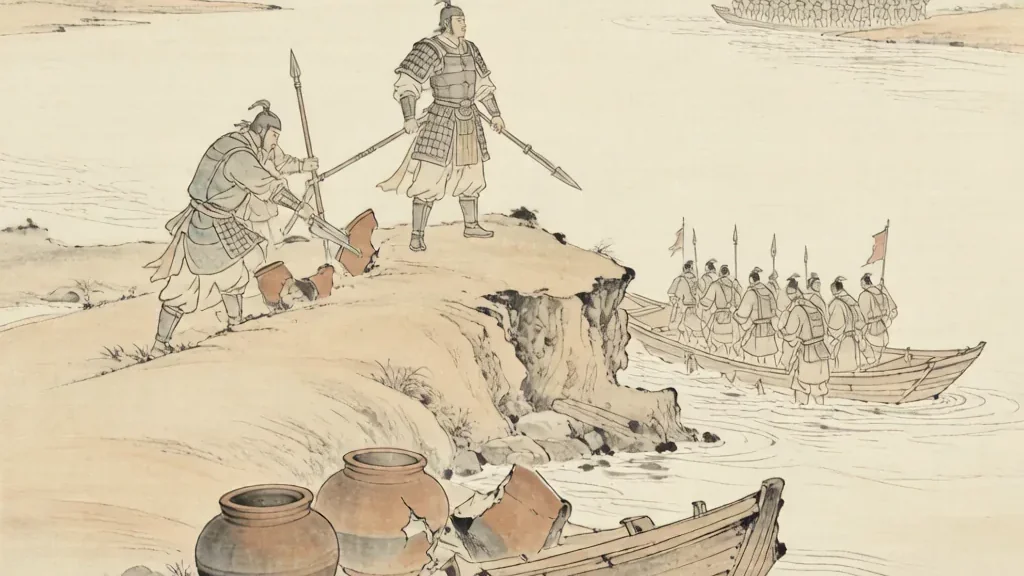
There are moments in history when a leader looks at an impossible situation and, instead of looking for a way out, burns every path of retreat so that there is only one direction left: forward. The Chinese idiom 破釜沉舟 (pò fǔ chén zhōu), "breaking the cauldrons and sinking the boats," describes exactly this kind of moment. It comes from one of the most dramatic episodes in Chinese military history, when a young general named Xiang Yu faced overwhelming odds and responded not with caution but with an act of such breathtaking finality that it has become the definitive Chinese expression for total commitment.
The story is recorded in the "Records of the Grand Historian" (史记), Sima Qian's masterwork of Chinese historiography. It takes place in 207 BCE, during the chaotic final years of the Qin Dynasty, when rebellions had broken out across the empire and the future of China hung in the balance. At the center of this drama stands Xiang Yu, a warrior of legendary strength and ferocity, whose decision at the Zhang River would become one of the most celebrated gambles in military history.
The Rise of Xiang Yu
Xiang Yu was born into an aristocratic family from the former state of Chu, which had been conquered by Qin during the wars of unification. His grandfather, Xiang Yan, had been a famous general who died fighting against the Qin armies, and the young Xiang Yu grew up with a burning hatred for the dynasty that had destroyed his family and his homeland. He was a man of immense physical power — according to Sima Qian, he could lift a bronze tripod cauldron that required several ordinary men to move — and of equally immense ambition.
When rebellions against the Qin Dynasty began to spread in 209 BCE, Xiang Yu and his uncle Xiang Liang raised an army in Chu and quickly became one of the most formidable rebel forces in the empire. After Xiang Liang was killed in battle, Xiang Yu assumed command. He was still in his mid-twenties, but he had already proven himself a commander of exceptional courage and tactical brilliance. The Qin Dynasty, however, was not yet defeated. It still possessed powerful armies, and one of them — commanded by the general Zhang Han — was now threatening to crush the rebellion in the north.
The Crisis at Julu
The city of Julu, in modern-day Hebei province, was under siege by Zhang Han's forces. The rebel army defending it, led by the King of Zhao, was trapped and starving. Other rebel commanders had arrived with relief forces, but none dared to attack. Zhang Han's army was too strong, his position too well fortified, and the other rebel leaders were paralyzed by caution and mutual suspicion. They built fortified camps at a safe distance and watched as the defenders of Julu grew weaker by the day.
Xiang Yu, hearing of the situation, marched his army north with characteristic speed. When he arrived at the Zhang River, south of Julu, he found the other rebel commanders huddled in their camps, arguing about what to do. Xiang Yu had no patience for such hesitation. He understood that every day of delay brought the defenders of Julu closer to collapse and Zhang Han closer to total victory. What was needed was not more discussion but a decision — a decision so final that it would leave no room for doubt or retreat.
The Irreversible Act
Xiang Yu ordered his army to cross the Zhang River. Then, on the far bank, he gave the command that would make him immortal. Every boat that had carried his soldiers across the river was to be sunk. Every cooking cauldron — the great bronze vessels in which the army's food was prepared — was to be smashed to pieces. Every soldier was to carry only three days' worth of dry rations. There would be no way back across the river. There would be no way to cook food once the rations ran out. There would be only one path to survival: victory.
The soldiers understood immediately what their general had done. He had not asked them to be brave. He had made it impossible for them to be anything else. Retreat was no longer an option — the boats were at the bottom of the river. Delay was no longer an option — the food would run out in three days. The only choices left were to defeat Zhang Han's army or to die trying. It was, in its way, a profound act of leadership: not a speech about courage, but the creation of conditions in which courage was the only possible response.
The Battle of Julu
What followed was one of the most astonishing victories in the annals of warfare. Xiang Yu's army, knowing they had no way out, attacked Zhang Han's forces with a ferocity that bordered on madness. They charged the Qin fortifications again and again, fighting with the desperate energy of men who had accepted that they would either win or die. The Qin soldiers, professional and well-trained though they were, had never faced an enemy like this — an enemy that did not seem to care whether it lived or died, an enemy that had been stripped of every option except victory.
Xiang Yu's forces broke through the Qin lines. They routed Zhang Han's army, lifting the siege of Julu and capturing or killing tens of thousands of enemy soldiers. The other rebel commanders, who had been watching from their fortified camps, were so awestruck by what they had witnessed that when they came to Xiang Yu's tent to congratulate him afterward, they knelt and did not dare look him in the face. The battle had transformed Xiang Yu from one rebel leader among many into the undisputed military master of the rebellion.
The Aftermath and the Legend
The Battle of Julu was the turning point of the rebellion against Qin. Zhang Han, his army shattered, eventually surrendered to Xiang Yu, and the Qin Dynasty, already crumbling, collapsed entirely within months. Xiang Yu went on to become the Hegemon-King of Western Chu, the most powerful man in China — though his story would end in tragedy, defeated by his rival Liu Bang at the Battle of Gaixia, surrounded and singing his final song before taking his own life.
But the image that endures from Xiang Yu's story is not his tragic end but his moment of supreme decisiveness at the Zhang River. The act of breaking the cauldrons and sinking the boats was not merely a tactical move. It was a philosophical statement about the nature of commitment. Xiang Yu understood that half-measures produce half-results, that an army with a way out will always be tempted to take it, and that the only way to guarantee maximum effort is to eliminate every alternative. He did not ask his soldiers to be heroes. He made heroism the only path to survival.
Why the Story Endures
In modern Chinese, 破釜沉舟 is used in any situation where someone makes an irreversible commitment to a course of action. A student who quits their job to prepare full-time for a crucial examination, an entrepreneur who invests their entire savings into a new business, a diplomat who issues an ultimatum that cannot be taken back — all of these are said to have "broken their cauldrons and sunk their boats." The idiom captures the psychology of the point of no return, the moment when the bridge behind you is burned and the only direction is forward.
The story is sometimes contrasted with 卧薪尝胆 — "sleeping on brushwood and tasting gall" — the idiom about King Goujian's patient, decades-long preparation for revenge. Goujian's approach was slow and methodical; Xiang Yu's was sudden and absolute. Both are celebrated in Chinese culture, and together they represent the two poles of strategic thinking: the long game and the decisive stroke. Xiang Yu's gamble at Julu was the latter — a bet so audacious that it changed the course of Chinese history.
But the story also carries a warning, visible in the arc of Xiang Yu's life after Julu. The same quality that made him a brilliant battlefield commander — his instinct for the all-or-nothing gamble — also made him a poor statesman. He could win battles but could not build a stable government. He could inspire loyalty but could not manage the complex politics of a new dynasty. The cauldron-breaker, in the end, was broken himself. The idiom celebrates the courage of burning one's bridges, but it also implicitly asks: what happens when you burn all your bridges and still find yourself on the wrong side of the river?
Sima Qian and the Shiji
The story survives because of Sima Qian, whose Shiji, or Records of the Grand Historian, set the model for Chinese historiography around 100 BCE. Sima Qian blended factual chronicle with vivid drama, and the Julu episode shows his gift: he gives us Xiang Yu's thoughts, the soldiers' realization, the kneeling commanders, turning a battle into a character study. The idiom therefore reaches us through a master storyteller as much as through a general. The Shiji's influence was so great that later historians imitated its shape for two thousand years. When we quote 破釜沉舟 today, we are also quoting Sima Qian's conviction that a single decisive act, well told, can define a life and a dynasty.
Commitment and Its Shadow
The idiom's energy comes from a truth about human motivation: an escape route invites escape. By removing it, Xiang Yu converted doubt into action and made courage the only option left. Modern psychology recognizes this as precommitment, a way of binding one's future self to a choice so that willpower need not be relied upon. Yet the story also carries a caution. The same all-or-nothing instinct that won Julu later made Xiang Yu a poor statesman who could not share power or build lasting peace, and he died by his own hand at Gaixia. The broken cauldrons thus teach both sides of total commitment: it can produce a stunning victory, and it can leave no room to recover when the gamble fails.
❓ Frequently Asked Questions
📝 Chinese Vocabulary
破 — : "To break" or "to smash" — the deliberate destruction of the means of retreat and comfort.
釜 — : "Cauldron" — the large bronze cooking vessel, essential for feeding an army, whose destruction symbolized the elimination of any option except victory.
沉 — : "To sink" — the irreversible act of sending the boats to the bottom of the river, cutting off all possibility of retreat.
舟 — : "Boat" — the means of crossing back to safety, deliberately destroyed to force commitment.
项羽 — : The legendary warrior-king whose tactical genius and tragic fate have made him one of the most romantic figures in Chinese history.
巨鹿 — : Julu, the city in present-day Hebei where Xiang Yu's army broke the cauldrons and sank the boats before the decisive battle.
章邯 — : The Qin dynasty general whose besieging army Xiang Yu destroyed after cutting off his own retreat.
西楚霸王 — : Hegemon-King of Western Chu, the title Xiang Yu held after his victory at Julu made him the rebellion's master.
🎉 Fun Facts
- The idiom 破釜沉舟 is sometimes compared to the Western concept of "burning one's boats," which traces back to Hernán Cortés, who allegedly burned his ships upon arriving in Mexico in 1519 — but Xiang Yu's version predates Cortés by over 1,700 years.
- Xiang Yu is said to have been over six feet tall with double pupils in each eye — a physical trait that in Chinese tradition was associated with exceptional destiny and greatness.
- The Battle of Julu is notable not just for the idiom it produced but for the fact that Xiang Yu's army of approximately 50,000-60,000 soldiers defeated a Qin force estimated at 200,000-300,000 — one of the most lopsided victories in Chinese military history.
- Xiang Yu's rivalry with Liu Bang, the founder of the Han Dynasty, is the subject of countless Chinese operas, films, and TV series, and the two men are often presented as opposite archetypes: the noble warrior versus the cunning politician.
- The broken-cauldrons tactic is a recurring motif in military history, but Xiang Yu's version is notable for being recorded in Sima Qian's Shiji as a deliberate psychological move that turned hesitation into ferocity.
- According to the Shiji, the rival commanders who had watched from camp were so awed after the victory that when they came to congratulate Xiang Yu they knelt and dared not look him in the face.