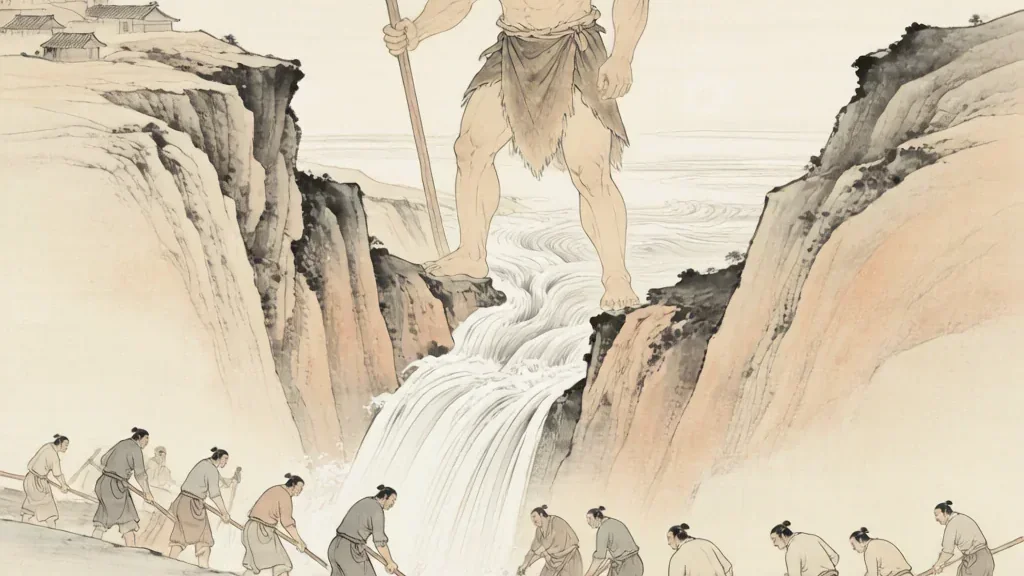
Some heroes are remembered not for conquest but for service, and the Chinese idiom dà yǔ zhì shuǐ honors the greatest servant of all. Written 大禹治水 and pronounced , it means "Yu the Great tames the floods" — the story of a man who spent years redirecting China's rivers and, in doing so, founded a dynasty. English might call it "mastering nature through sacrifice," but Chinese tells it as the founding myth of responsible rule. For readers discovering Chinese culture, the phrase is a doorway into the very origin of kingship, where the right to govern was earned by draining the land. In this article we meet Yu, contrast his method with his father's, and see why "taming the flood" became the measure of a true leader.
The Flood and the Failed Father
The tale is ancient, reaching back to the dawn of Chinese legend. A great flood engulfed the early world, and the ruler Yao charged Gun (鲧), Yu's father, with stopping it. Gun chose to build dikes and dams, blocking the water wherever it rose. The water rose faster, bursting the barriers, and the people suffered for nine years. Gun was eventually executed for his failure, and the task passed to his son Yu.
Yu's inheritance was a drowned land and a father's shame. The contrast between them became the moral heart of the story: brute blocking () against wise channeling (). Gun represented the forceful but foolish answer; Yu would represent the patient, observant one. The flood thus became a test not only of engineering but of character — and the father's failure set the stage for the son's glory.
Yu's Method: Dredge, Don't Dam
Yu approached the water differently. Instead of walling it in, he surveyed the land, dug channels, and guided the floods toward the sea. Where Gun had fought the water head-on, Yu joined its logic, giving it somewhere to go. The work was immense: he is said to have traveled the realm, measuring and cutting channels, and the projects tamed the great rivers that menaced the plains. His method — work with the nature of things rather than against it — became a founding principle of Chinese statecraft.
The lesson rippled far beyond engineering. To govern a people, the story suggests, you must understand their flow and guide it, not merely command and constrain. Yu's success proved that the leader who listens to reality outperforms the one who imposes his will. The idiom thus encodes a whole philosophy of soft, intelligent power — a philosophy China would return to for three thousand years.
The Man Who Passed His Door Three Times
The most beloved detail of the legend is Yu's devotion. Tradition says that during his thirteen years of floodwork, he passed his own home three times and did not enter — once hearing his infant son cry, yet pressing on. The image of the father who would not stop for his family became the supreme symbol of public service. Yu sacrificed the private for the common good, and the culture never forgot it.
This detail is what lifts the story from engineering feat to moral foundation. A ruler might be clever; Yu was also selfless. The "three times past the door" () became its own phrase, invoked whenever someone puts duty above ease. Together with the floodwork, it made Yu the model of the servant-leader — the man whose authority rested on what he gave, not what he took.
From Engineer to Emperor
Yu's success earned him the throne. The ruler Shun, impressed, passed the crown to him, and Yu founded the Xia dynasty (夏), the first in the traditional account of Chinese history. The transfer is crucial: power passed not by blood alone but by proven service. The flood thus became the mythic charter of meritocratic rule — the idea that the right to lead is earned by deeds for the people.
This meritocratic thread runs through Chinese political thought. The sage-kings Yao, Shun, and Yu were admired precisely because they governed for the common good and stepped aside for worthier successors. Yu's story, more than any other, tied ability and self-sacrifice to legitimacy. To say "Yu the Great tames the floods" is therefore to invoke the ideal origin of just government — a king whose first act was to save, not to rule.
How the Idiom Lives Today
Modern Chinese uses to praise patient, systemic problem-solving and selfless public service. An official who tackles a crisis at personal cost may be compared to Yu; a engineer who "channels" rather than "blocks" a problem is said to work in his spirit. The tone is solemn and admiring, touching the deep respect Chinese culture holds for those who serve.
The idiom also teaches method. When people urge "govern the water, don't dam it," they mean address root causes, not symptoms — a lesson echoed in many idioms of this series. Yu's dredging stands as the original "solve it properly" story, the ancestor of every later tale about working with reality instead of against it. His name remains a byword for the long, unglamorous labor of making things right.
A Closing Reflection
There is a quiet grandeur in . It tells us that the greatest kings began as servants, that the hardest work is often the wettest and lowest, and that true authority is earned by what one gives the people. Yu passed his door three times and founded a dynasty by not entering. The idiom asks modern readers a plain question: when the water rises, will we build a wall, or dig a channel? The answer, China has long believed, is the difference between a ruin and a civilization.
The Sage-Kings and the Mandate
Yu's story is the closing chapter of a famous triad of sage-kings, Yao, Shun, and Yu, who represent the ideal origin of Chinese rule. None of them seized power by birth alone; each won it by service and then passed it to a worthier successor. Yao chose Shun, Shun chose Yu, and Yu in turn founded a dynasty only after proving himself through the floods. This chain made a quiet but radical claim: the right to lead rests on deeds for the people, not on blood. The flood is the test that lets Yu join the company of sages, and the idiom carries that founding myth whenever it is spoken, linking everyday problem-solving to the deepest Chinese ideas of legitimate authority.
Channel Not Dam as Statecraft
The contrast between Gun's dams and Yu's channels is more than engineering; it is a theory of government. To dam is to meet a problem with force and prohibition, hoping to wall it in. To dredge is to understand the problem's nature and give it a safe path, guiding reality rather than fighting it. Yu's success taught that the wise ruler listens to the people's flow and channels it, instead of merely commanding and constraining. This soft, intelligent power became a recurring ideal in Chinese statecraft, invoked by later reformers who favored accommodation over coercion. The idiom thus encodes a whole philosophy in two verbs, and its lesson travels from rivers to rebellions to the management of any stubborn human difficulty.
❓ Frequently Asked Questions
📝 Chinese Vocabulary
大禹治水 — : Yu the Great tames the floods; selfless public service.
禹 — : Yu, the flood-taming founder of the Xia dynasty.
治 — : to govern, to control, to tame.
鲧 — : Gun, Yu's father, who failed by damming.
夏 — : the Xia dynasty Yu founded.
尧 — : Yao, the sage-king who first charged Gun to control the flood and who began the line of model rulers.
舜 — : Shun, the sage-king who succeeded Yao and passed the throne to Yu for his floodwork.
疏导 — : To dredge and guide, the method Yu used in place of his father's blocking.
🎉 Fun Facts
- Yu is said to have worked on the floods for thirteen years and passed his home three times without entering.
- His father Gun was executed for failing to stop the flood by building dams.
- Yu founded the Xia dynasty, traditionally China's first, after Shun passed him the throne for his service.
- The "three times past the door" became its own idiom for devotion to duty over family ease.
- Yu's method of digging channels to guide floodwater is still cited by Chinese engineers as an early model of working with, not against, nature.
- The story appears in the classic Book of Documents as well as later histories, giving the flood tale scriptural weight in the Confucian canon.